

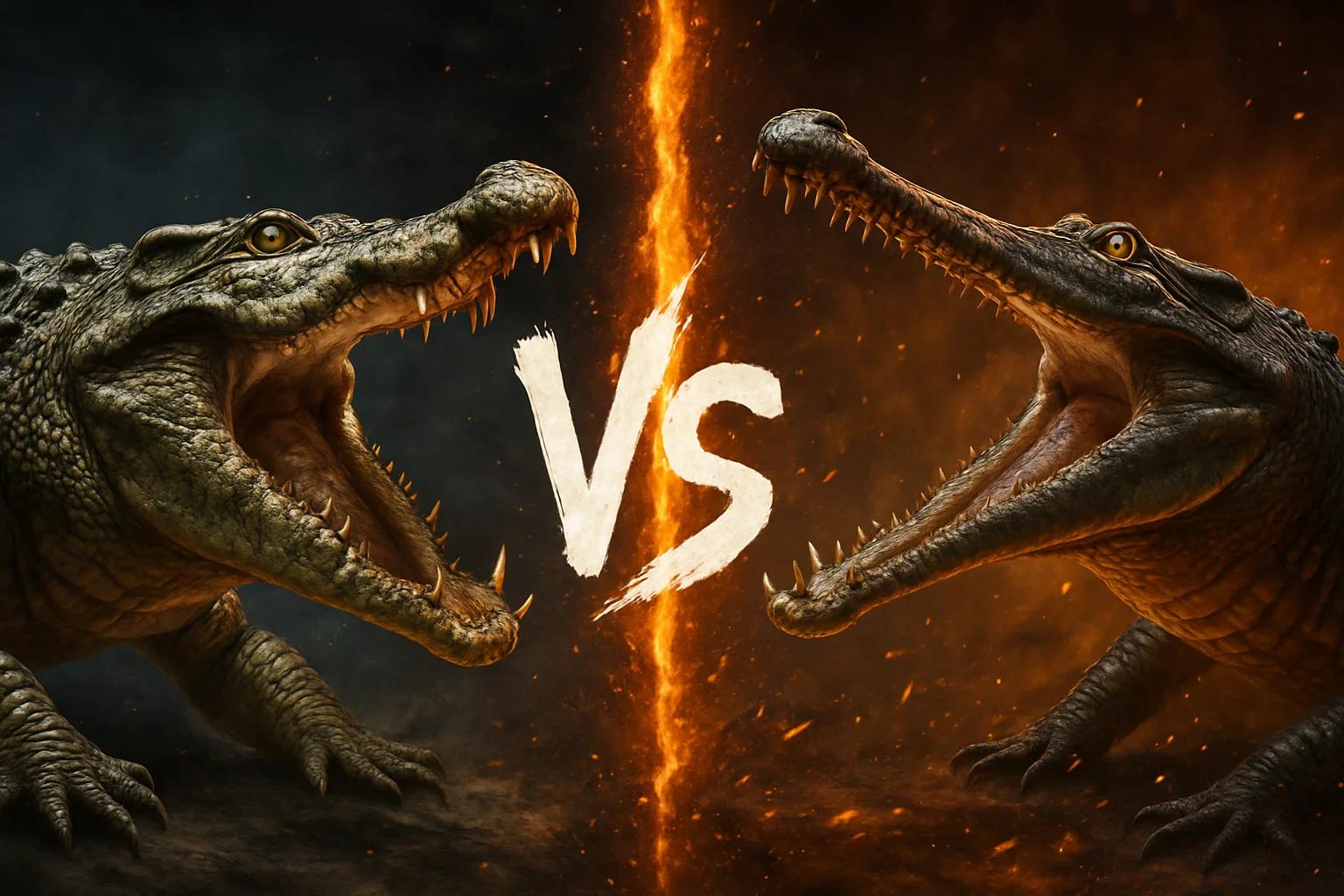
Cuban Crocodile vs False Gharial: Who Actually Wins?
Cuban crocodile vs false gharial: a biology-first breakdown of size, bite design, aggression and habitat to see who would win a crocodilian showdown, and why the loser is still dangerous.
Cuban Crocodile vs False Gharial
Matchup winner
False Gharial
Quick verdict
Start with the direct answer, then use the structured comparison below to see what changes the outcome.
The false gharial wins overall. This is a matchup between a compact, famously aggressive brawler and a much larger, long-bodied water specialist. The Cuban crocodile has the sturdier skull, a broad heavy snout built for crushing, and unusual agility on land, so it would be favored on dry ground. But crocodilian contests are decided mostly by mass, reach and how well each animal handles water. Adult male false gharials commonly reach 4–5 m and can roughly double the weight of a large Cuban crocodile, which typically tops out around 3–3.5 m. In deep, slow water, where both animals naturally fight, that extra length and weight lets the false gharial pin, roll and outlast a smaller opponent. The Cuban crocodile's attitude is real, but it is spending energy against a body that simply has more of everything.
Read the full explanation
Overall winner: False Gharial, mainly through size and mass, often around twice the weight.
The Cuban Crocodile has the stronger snout design and is the better land fighter.
In deep water, the false gharial's length and bulk control grappling and death rolls.
On open ground or dry banks, the Cuban crocodile's agility makes it a real upset threat.
Reader vote
Who do you think wins?
Pick a side — no account needed. Results update live.
No votes yet — be the first to call it.
Editorial note
Why people disagree
The false gharial's slender snout looks fragile, so people assume it would lose any jaw-to-jaw clash, even though its whole body still outweighs the Cuban croc.
Body mass & frame
In crocodilian grappling, mass resists rolling and pinning. The false gharial's bulk is the single biggest factor in this fight.
Bite architecture
The Cuban croc's skull handles twisting and crushing loads better, so its bites do more structural damage per strike.
Aggression & initiative
Initiative lets the Cuban croc land the first committed bite, which matters most in short exchanges.
Read the full explanation +
The Cuban crocodile has a fierce reputation for aggression, including leaping and terrestrial pursuit, which tempts people to favor temperament over mass.
Both species are rare and little studied in the wild, so most claims rely on captive observations and size records rather than documented encounters.
Comparison FAQ
Short, direct answers to the next questions readers usually ask after the headline verdict.
Would a Cuban crocodile beat a false gharial?+
Usually not. The false gharial's large size advantage wins most water-based fights. The Cuban crocodile is favored mainly on land.
Which is stronger, the Cuban crocodile or the false gharial?+
The false gharial has more total strength from its larger body. The Cuban crocodile has a sturdier, more crushing bite structure for its size.
Isn't the false gharial's thin snout a weakness?+
It is less robust than a broad crocodile snout, but the false gharial still takes sizable prey, and its body mass carries the fight.
Why is the Cuban crocodile still dangerous in this matchup?+
It is highly aggressive, quick on land and has a powerful crushing bite. Any fight that starts on firm ground or with a committed first strike can go its way.
Do these species meet in the wild?+
No. The Cuban crocodile lives only in Cuba, while the false gharial lives in Southeast Asian swamps and rivers, so this is a hypothetical comparison.
Head-to-head species stats
These are the same core AnimalDex stat dimensions used on the dedicated animal pages, pulled side by side so the matchup is faster to scan.
Cuban Crocodile
Tier BFalse Gharial
Tier ATrait-by-trait comparison
Only the categories that matter to this matchup are included. The goal is not filler stats, but the real design differences that change the result.
Compact, roughly 2.5–3.5 m
Body mass & frame
False Gharial
Long and heavy, 4–5 m males
Body mass & frame
False Gharial
Broad, robust crushing snout
Bite architecture
Cuban Crocodile
Narrow, elongated snout
Bite architecture
Cuban Crocodile
Notoriously bold and pushy
Aggression & initiative
Cuban Crocodile
Typically more reserved
Aggression & initiative
Cuban Crocodile
Unusually upright, quick on land
Terrestrial agility
Cuban Crocodile
Mostly water-bound
Terrestrial agility
Cuban Crocodile
Capable, but shorter reach
Water control & reach
False Gharial
Long, streamlined swimmer
Water control & reach
False Gharial
Armored but lighter
Close-range durability
False Gharial
Armored with more mass to absorb
Close-range durability
False Gharial
How the verdict forms
Verdict timeline
01 · Body mass & frame
False Gharial
02 · Bite architecture
Cuban Crocodile
03 · Aggression & initiative
Cuban Crocodile
04 · Terrestrial agility
Cuban Crocodile
05 · Water control & reach
False Gharial
06 · Close-range durability
False Gharial
Change the conditions
Scenario breakdown
This is where shallow battle content usually fails. Terrain, spacing, timing, and engagement style can change the answer.
Scenario lean
False Gharial
Verdict confidence
82%
The false gharial dominates.
Deep, slow water is the false gharial's home. Its long body turns reach and weight into leverage, so a death roll from the larger animal is very hard for a lighter opponent to resist. The Cuban crocodile's agility counts for less when nobody has footing.
AnimalDex field profiles
Explore these animals
Cuban Crocodile
Crocodylus rhombifer
freshwater swamp, marsh, and wetland island habitat
False Gharial
Tomistoma schlegelii
swamp forest, peatland river, and flooded lowland wetland
Systems Intelligence & Hidden Purpose
See the animals behind this comparison as engineered biological systems: what each one is built to do, where it gains leverage, and why the matchup changes by scenario.
Specialized Hardware
long-legged athletic build, broad powerful jaws, and restricted island swamp range give the Cuban Crocodile a body plan tuned for its niche.
Systems Script
Cuban Crocodiles operate through freshwater swamp, marsh, and wetland island habitat Their design links movement, shelter, and feeding into one workable survival system.
Strategic Insight
Even excellent systems fail when the room to operate keeps shrinking.
Specialized Hardware
long narrow fish-catching snout, river-specialist crocodilian body, and quiet blackwater ambush give the False Gharial a body plan tuned for its niche.
Systems Script
False Gharials operate through swamp forest, peatland river, and flooded lowland wetland. Their design links movement, feeding, shelter, and timing into one workable survival system.
Strategic Insight
Dense environments reward precision, patience, and the ability to read layered cover.
Final take
The false gharial is the overall winner, but not because the Cuban crocodile is weak. The Cuban croc is one of the most combative crocodilians alive, with a skull built for punishment and land mobility most relatives lack.
Read the full explanation
In the environment where these animals actually live and fight, water decides the outcome. There, the false gharial's extra length and often double the body mass turn grappling into a contest the smaller animal cannot sustain. Give the Cuban croc dry ground and the odds shift sharply, but most real scenarios favor the bigger swimmer.
Collect both animals in AnimalDex
Track the species behind this matchup, compare their real traits, and build the rivalry into your AnimalDex collection.
Discussion
What do you think?
Share your reasoning with other readers. Be civil and stick to the animals.
Sign in to join the discussion.
Sign inNo comments yet. Start the conversation.