

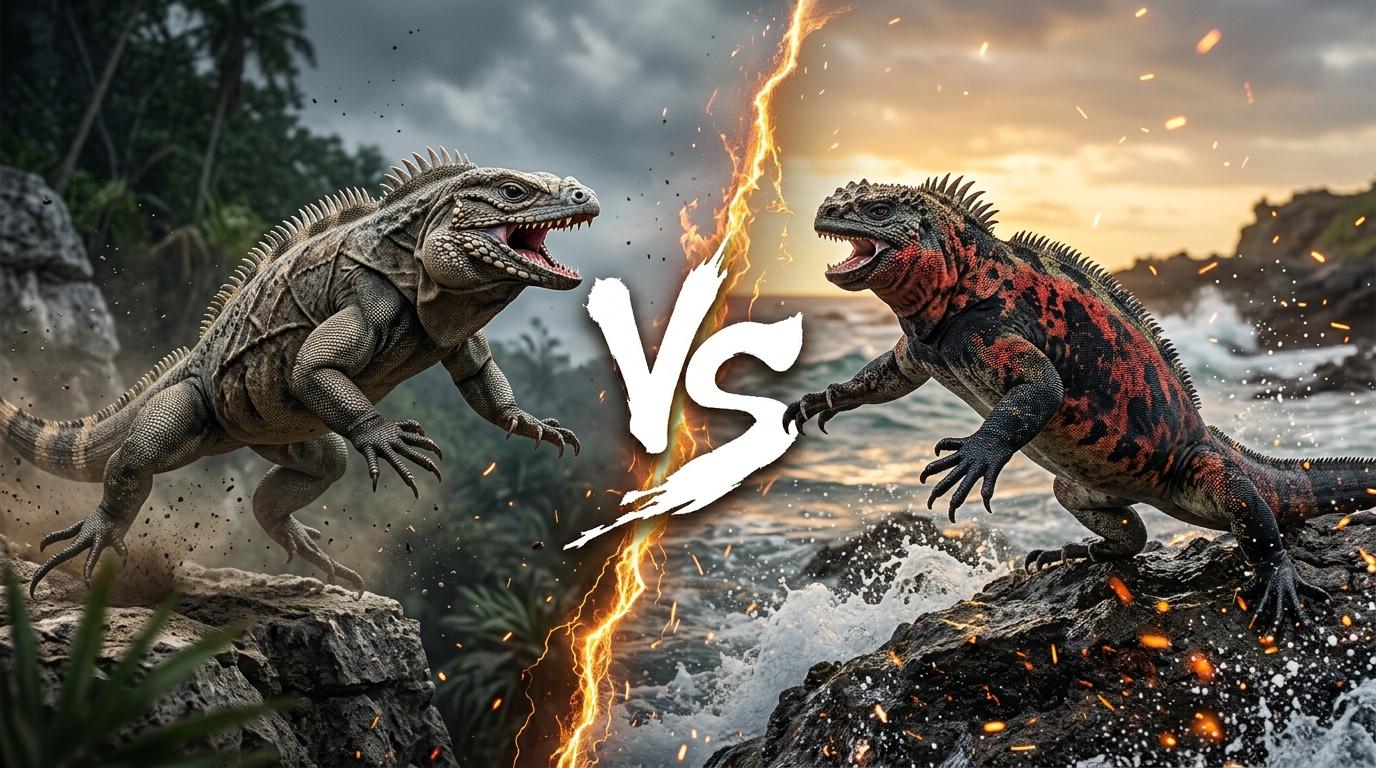
Cuban Rock Iguana vs Marine Iguana: Who Actually Wins?
Cuban rock iguana vs marine iguana: a biology-first breakdown of size, jaws, territorial behavior and terrain to settle who would win.
Cuban Rock Iguana vs Marine Iguana
Matchup winner
Cuban Rock Iguana
Quick verdict
Start with the direct answer, then use the structured comparison below to see what changes the outcome.
The Cuban rock iguana wins this matchup in most realistic frames. It is the bulkier lizard, with large males reaching roughly 1.5 m in total length and several kilograms of mass. It has a heavier head and stronger jaws, and it lives in a territorial land system where males routinely settle disputes with head-bobbing, lateral displays, shoving and biting. The marine iguana is a remarkable specialist. It dives for algae and tolerates cold Pacific water, and it handles salt with nasal glands that sneeze out brine. But its blunt snout and small, tricuspid teeth are built to scrape algae off rock, not to win land grappling contests. Male marine iguanas do head-butt rivals over lekking territories, and they are tough, but their pushing contests are ritualized and lower on damage. Away from the surf, the rock iguana's mass, grip and bite carry the fight.
Read the full explanation
Cuban rock iguana wins overall: bigger, heavier-jawed and built for land territory fights.
Marine iguana dominates in surf and cold water, where the rock iguana can't follow.
Both rely on displays first, so a real clash is usually short and decided by mass.
Confidence is high but not total: terrain can flip the outcome.
Reader vote
Who do you think wins?
Pick a side — no account needed. Results update live.
No votes yet — be the first to call it.
Editorial note
Why people disagree
Marine iguanas look armored and dragon-like, so people overrate their combat hardware. Their spines and crests are mostly display, not weaponry.
Mass and frame
In lizard contests, the heavier animal usually wins the shove, pin and roll.
Jaw hardware
The rock iguana's bite can inflict real wounds, while the marine iguana's mouth is a grazing tool.
Territorial combat habit
Experience with damaging escalation matters when displays fail.
Read the full explanation +
Galápagos footage shows marine iguana males butting heads hard, which reads as aggression. Those contests are ritual pushing matches, not damage-seeking fights.
Size estimates vary wildly. Large Galápagos marine iguanas from Fernandina or Isabela can approach small rock iguanas, so island-to-island variation fuels arguments.
Comparison FAQ
Short, direct answers to the next questions readers usually ask after the headline verdict.
Would a Cuban rock iguana beat a marine iguana in a fight?+
Usually yes on land. It is larger, with a stronger bite and more aggressive territorial behavior.
Which iguana is stronger?+
The Cuban rock iguana. Its heavier body and jaw musculature give it more raw strength than the marine iguana.
Is the marine iguana still dangerous?+
Yes, within limits. Its sharp claws can scratch, and it can butt hard and bite defensively. In water it is untouchable for the rock iguana.
Could these two actually meet in the wild?+
No. Cuban rock iguanas live in Cuba and the Cayman region, while marine iguanas are endemic to the Galápagos. This is a hypothetical matchup.
Are either of these iguanas endangered?+
Both are listed as Vulnerable by the IUCN. Rock iguanas are threatened by habitat loss and introduced predators, and marine iguanas by El Niño events and invasive species.
Head-to-head species stats
These are the same core AnimalDex stat dimensions used on the dedicated animal pages, pulled side by side so the matchup is faster to scan.
Cuban Rock Iguana
Tier CMarine Iguana
Tier CTrait-by-trait comparison
Only the categories that matter to this matchup are included. The goal is not filler stats, but the real design differences that change the result.
Heavy-bodied, large males up to ~1.5 m and several kg
Mass and frame
Cuban Rock Iguana
Variable by island, often lighter and lower-slung
Mass and frame
Cuban Rock Iguana
Broad head, strong bite, serrated teeth
Jaw hardware
Cuban Rock Iguana
Short blunt snout, small algae-scraping teeth
Jaw hardware
Cuban Rock Iguana
Escalates from displays to biting and wrestling
Territorial combat habit
Cuban Rock Iguana
Ritualized head-butting over small lek sites
Territorial combat habit
Cuban Rock Iguana
Can swim but is a land and rock specialist
Aquatic command
Marine Iguana
Dives, grips submerged rock, tolerates cold surf
Aquatic command
Marine Iguana
Strong limbs for digging and climbing rock
Grip and claws
Marine Iguana
Long sharp claws for clinging to wave-washed lava
Grip and claws
Marine Iguana
Thrives in hot, dry scrub
Thermal stamina
Cuban Rock Iguana
Must bask heavily after cold dives
Thermal stamina
Cuban Rock Iguana
How the verdict forms
Verdict timeline
01 · Mass and frame
Cuban Rock Iguana
02 · Jaw hardware
Cuban Rock Iguana
03 · Territorial combat habit
Cuban Rock Iguana
04 · Aquatic command
Marine Iguana
05 · Grip and claws
Marine Iguana
06 · Thermal stamina
Cuban Rock Iguana
Change the conditions
Scenario breakdown
This is where shallow battle content usually fails. Terrain, spacing, timing, and engagement style can change the answer.
Scenario lean
Cuban Rock Iguana
Verdict confidence
82%
Rock iguana's home field.
Among limestone crevices and scrub, the rock iguana uses burrows and ledges it knows. It can launch from close range and bite before the marine iguana commits. Mass and jaw strength decide a short scuffle.
AnimalDex field profiles
Explore these animals
Cuban Rock Iguana
Cyclura nubila
dry forest, rocky shore, and scrub habitat
Marine Iguana
Amblyrhynchus cristatus
Rocky intertidal shore, lava coast, and nearby dry island scrub.
Systems Intelligence & Hidden Purpose
See the animals behind this comparison as engineered biological systems: what each one is built to do, where it gains leverage, and why the matchup changes by scenario.
Specialized Hardware
heavy gray basking body, short horned facial scales, and rocky coastal territorial movement give the Cuban Rock Iguana a body plan tuned for its niche.
Systems Script
Cuban Rock Iguanas operate through dry forest, rocky shore, and scrub habitat. Their design links movement, feeding, shelter, and timing into one workable survival system.
Strategic Insight
Harsh places reward efficiency, timing, and bodies that waste very little.
Specialized Hardware
Salt-expelling nasal glands, laterally compressed tail, and dark heat-absorbing skin make marine iguanas shoreline hardware built for cold surf grazing.
Systems Script
Marine iguanas convert intertidal algae into reptile biomass in a niche most lizards cannot touch. They prove that evolutionary design can turn a rocky hazard zone into a dependable feeding lane.
Strategic Insight
If a resource looks unusable to everyone else, specialized handling can turn it into your home field.
Final take
The Cuban rock iguana is the pick. It brings more mass, a stronger bite and a territorial culture that escalates beyond ritual. Those are the traits that decide land-based lizard contests.
Read the full explanation
The marine iguana loses the fight, but it wins the evolution story. It is the only lizard that forages in the sea. On its own wave-battered shoreline, nothing about the rock iguana's toolkit transfers.
Collect both animals in AnimalDex
Track the species behind this matchup, compare their real traits, and build the rivalry into your AnimalDex collection.
Discussion
What do you think?
Share your reasoning with other readers. Be civil and stick to the animals.
Sign in to join the discussion.
Sign inNo comments yet. Start the conversation.