

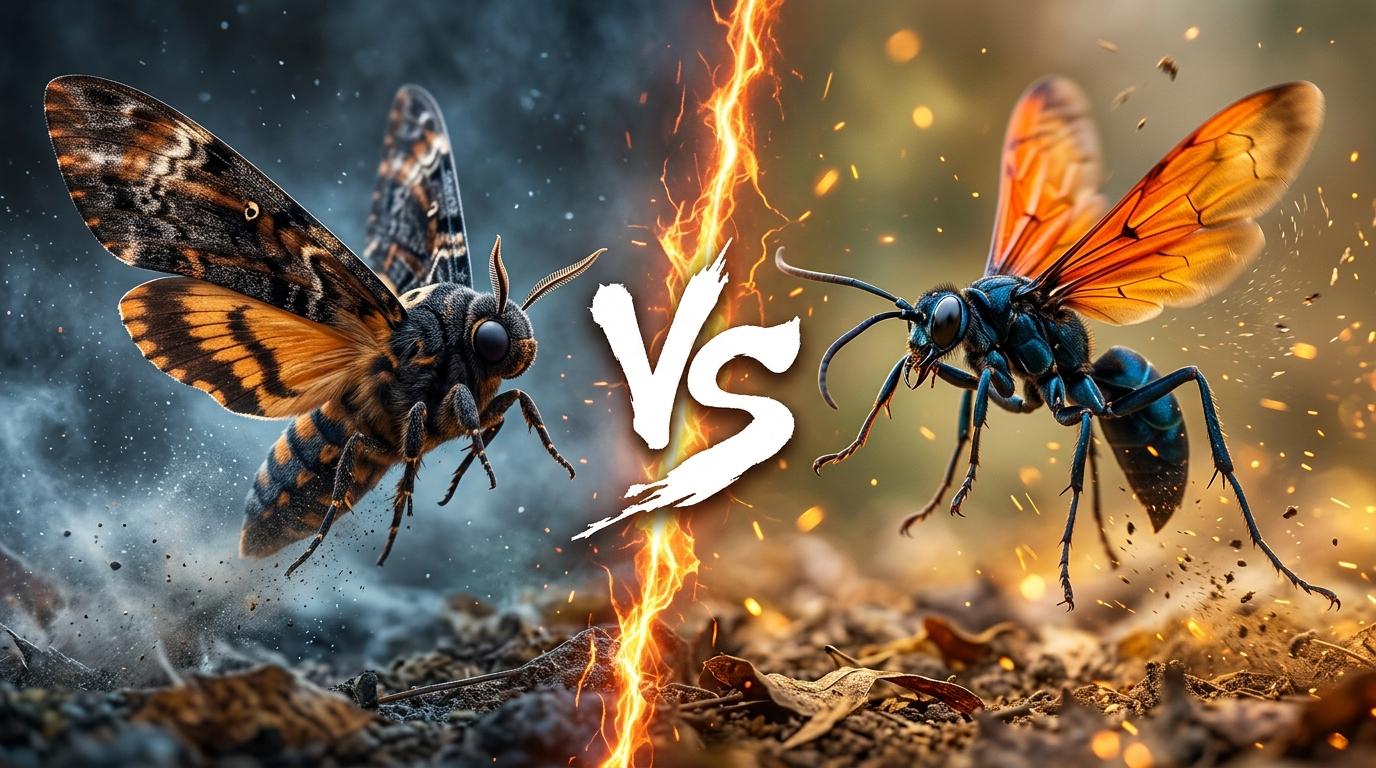
Death's-head Hawkmoth vs Tarantula Hawk Wasp: Who Actually Wins?
Death's-head Hawkmoth vs Tarantula Hawk Wasp: who would win? A biology-first breakdown of speed, armor, venom, and how each insect's real-world toolkit plays out in a fight.
Death's-head Hawkmoth vs Tarantula Hawk Wasp
Matchup winner
Tarantula Hawk Wasp
Quick verdict
Start with the direct answer, then use the structured comparison below to see what changes the outcome.
The Tarantula Hawk Wasp wins, and it isn't especially close in a forced fight. Pepsis grossa is a dedicated predator-grade insect. It carries a long sting, reportedly among the most painful insect stings known, along with strong mandibles, a hard warning-colored exoskeleton, and a hunting routine built around subduing tarantulas that outweigh it many times over. The Death's-head Hawkmoth is a remarkable animal, with a big body, powerful flight, a bee-scent disguise, and a squeak that startles attackers, but its entire kit is built for raiding, deceiving, and escaping rather than fighting. It has no sting and no real biting weapon, and its stout proboscis is a feeding tool. If the two lock up, the wasp's weapons decide it. The moth's best result is never letting the fight start.
Read the full explanation
The Tarantula Hawk Wasp wins a direct fight thanks to its sting, mandibles, and armored predator build.
The Death's-head Hawkmoth is the faster, longer-range flier and can often escape before contact.
The moth's defenses are bluff and disguise: a skull-like thorax pattern, a loud squeak, and bee-mimicking scent. None of these work as weapons.
These two never meet in the wild. The hawkmoth ranges across Africa and Europe, and the wasp lives in the Americas.
Reader vote
Who do you think wins?
Pick a side — no account needed. Results update live.
No votes yet — be the first to call it.
Editorial note
Why people disagree
The hawkmoth is the bigger, more intimidating-looking insect, so size bias makes people overrate it in a fight.
Offensive weaponry
Insect fights are decided by weapons, not bulk. Only one of these animals is armed.
Flight speed and endurance
Speed is the moth's whole survival plan. It controls whether an encounter happens at all.
Body mass
The moth's bulk helps it absorb jostling, but mass without a weapon only delays the outcome.
Read the full explanation +
The hawkmoth survives raids on honeybee hives, which sounds like combat toughness, but it relies on chemical camouflage and a sting-resistant cuticle rather than on attacking anything.
The tarantula hawk does not usually hunt other insects. Some readers argue it would ignore the moth entirely, which is true ecologically but doesn't change who wins once contact is forced.
Comparison FAQ
Short, direct answers to the next questions readers usually ask after the headline verdict.
Would a Death's-head Hawkmoth beat a Tarantula Hawk Wasp?+
No. In a direct fight the Tarantula Hawk Wasp wins because it has a sting and strong mandibles, and the moth has no real weapon.
Which insect is stronger?+
The hawkmoth is heavier and the stronger flier. The tarantula hawk is stronger in combat terms: it can grapple and drag tarantulas many times its own weight.
Can the Death's-head Hawkmoth survive stings?+
It tolerates honeybee stings fairly well thanks to a thick cuticle and bee-mimicking scent. A tarantula hawk's much larger sting is a different threat.
Why is the hawkmoth still dangerous to underestimate?+
Its speed lets it avoid nearly any fight, and its squeak and skull pattern can startle attackers into hesitating. It wins by escape, not by combat.
Do they ever meet in the wild?+
No. Acherontia atropos lives in Africa and Europe, while Pepsis grossa lives in the Americas.
Head-to-head species stats
These are the same core AnimalDex stat dimensions used on the dedicated animal pages, pulled side by side so the matchup is faster to scan.
Death's-head Hawkmoth
Tier DTarantula Hawk Wasp
Tier DTrait-by-trait comparison
Only the categories that matter to this matchup are included. The goal is not filler stats, but the real design differences that change the result.
None meaningful; feeding proboscis only
Offensive weaponry
Tarantula Hawk Wasp
Long sting plus strong mandibles
Offensive weaponry
Tarantula Hawk Wasp
Fast, migratory long-distance flier
Flight speed and endurance
Death's-head Hawkmoth
Agile but slower, low cruising flight
Flight speed and endurance
Death's-head Hawkmoth
Heavy-bodied, very large wingspan
Body mass
Death's-head Hawkmoth
Long, lean, smaller frame
Body mass
Death's-head Hawkmoth
Thick, sting-resistant cuticle
Close-range durability
Tarantula Hawk Wasp
Hard, slick exoskeleton built to survive tarantula fights
Close-range durability
Tarantula Hawk Wasp
Skull pattern, squeak, bee-scent mimicry
Bluff and deception
Death's-head Hawkmoth
Honest warning colors
Bluff and deception
Death's-head Hawkmoth
Avoidance and escape
Ambush control
Tarantula Hawk Wasp
Grapple, pin, and sting
Ambush control
Tarantula Hawk Wasp
How the verdict forms
Verdict timeline
01 · Offensive weaponry
Tarantula Hawk Wasp
02 · Flight speed and endurance
Death's-head Hawkmoth
03 · Body mass
Death's-head Hawkmoth
04 · Close-range durability
Tarantula Hawk Wasp
05 · Bluff and deception
Death's-head Hawkmoth
06 · Ambush control
Tarantula Hawk Wasp
Change the conditions
Scenario breakdown
This is where shallow battle content usually fails. Terrain, spacing, timing, and engagement style can change the answer.
Scenario lean
Tarantula Hawk Wasp
Verdict confidence
82%
Wasp wins decisively.
In tight cover the moth's big wings become a liability and its speed advantage disappears. The tarantula hawk is comfortable working on the ground and among foliage, where it routinely pins large prey. Once its legs and mandibles get a grip, it can drive its sting through softer joints. Nothing in the moth's defenses can stop this.
AnimalDex field profiles
Explore these animals
Death's-head Hawkmoth
Acherontia atropos
woodland edge, scrub, and cultivated landscape
Tarantula Hawk Wasp
Pepsis grossa
Desert scrub, dry woodland, and warm open country.
Systems Intelligence & Hidden Purpose
See the animals behind this comparison as engineered biological systems: what each one is built to do, where it gains leverage, and why the matchup changes by scenario.
Specialized Hardware
skull-like thorax marking, powerful night flight, and deep humming wingbeat give the Death's-head Hawkmoth a body plan tuned for its niche.
Systems Script
Death's-head Hawkmoths operate through woodland edge, scrub, and cultivated landscape. Their design links movement, feeding, shelter, and timing into one workable survival system.
Strategic Insight
Dense environments reward precision, patience, and the ability to read layered cover.
Specialized Hardware
Large dark body with bright wings, long dangling legs in flight, and wasp waist and curved antennae give the Tarantula Hawk Wasp a body plan tuned for its niche.
Systems Script
Tarantula Hawk Wasps operate in desert scrub, dry woodland, and warm open country. Their design helps them match food access, shelter, and timing inside that environment.
Strategic Insight
Extreme specialization can solve a problem that looks too dangerous for a generalist.
Final take
The Tarantula Hawk Wasp is the clear winner. It is an armed specialist whose daily work involves overpowering spiders far larger than itself, and that experience carries straight into any forced insect fight.
Read the full explanation
The Death's-head Hawkmoth isn't a loser in the evolutionary sense. It may be the better survivor, beating predators through speed, chemical disguise, and theatrical bluff. In this matchup, its smartest move is the one it would almost always make: fly away fast.
Collect both animals in AnimalDex
Track the species behind this matchup, compare their real traits, and build the rivalry into your AnimalDex collection.
Related comparisons
Continue with nearby matchups to compare more real-world animal traits without dropping into junky who-wins filler.
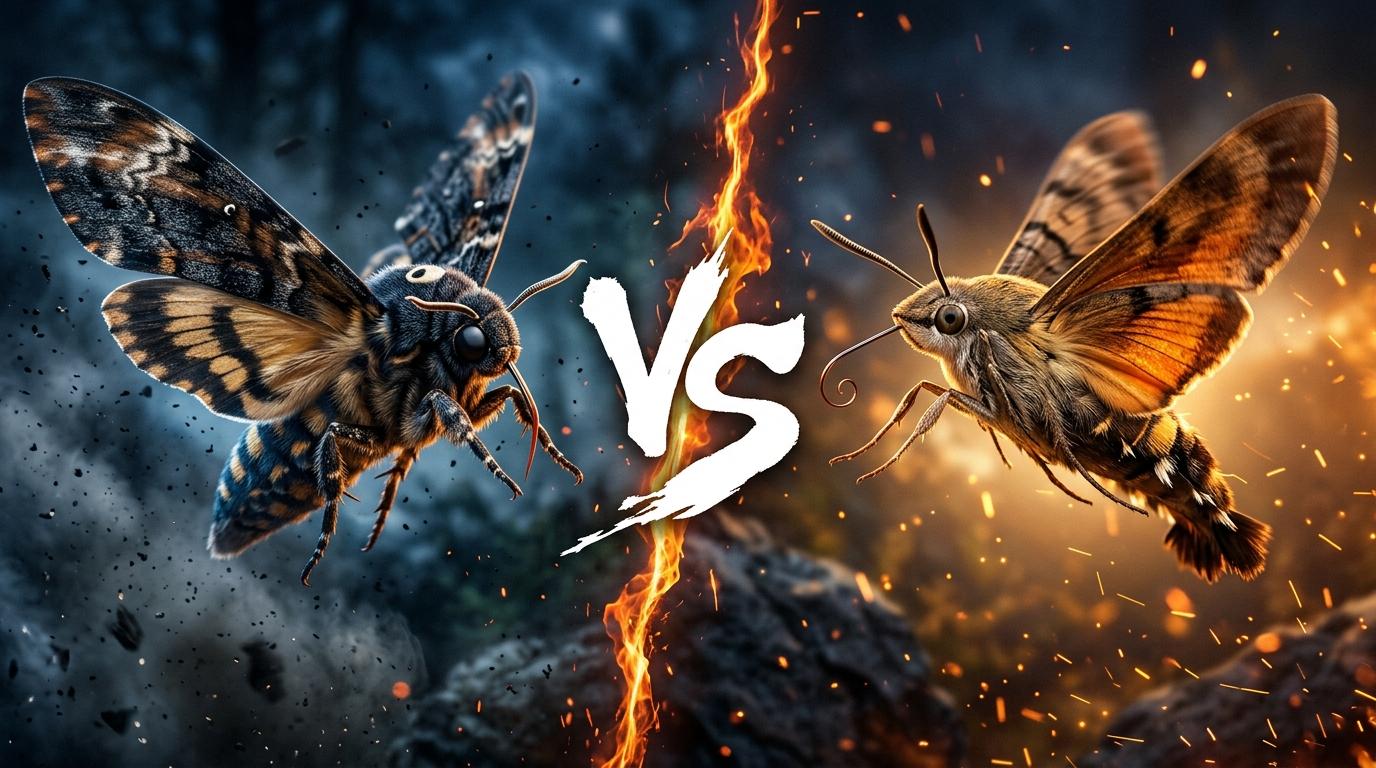
Death's-head Hawkmoth vs Hummingbird Hawk-Moth: Who Actually Wins?
The Death's-head Hawkmoth wins, and it is not especially close in a physical contest. It is Europe's heaviest moth, with a wingspan of roughly 9–13 cm and a thick, armored body. The Hummingbird Hawk-Moth is a 4–4.5 cm daytime hoverer built for precision rather than contact. When two insects of such different mass collide, push, or compete over a food source they can't simply hover away from, weight and toughness settle it. The Death's-head also has an unusual survival kit: a squeak it can produce, a short, stout proboscis able to pierce honeycomb cells, and chemical camouflage that lets it raid beehives. The Hummingbird Hawk-Moth's real edge is hover control and fast, darting flight. That lets it refuse a fight, but it gives it no way to win one.
Read comparison
Discussion
What do you think?
Share your reasoning with other readers. Be civil and stick to the animals.
Sign in to join the discussion.
Sign inNo comments yet. Start the conversation.