

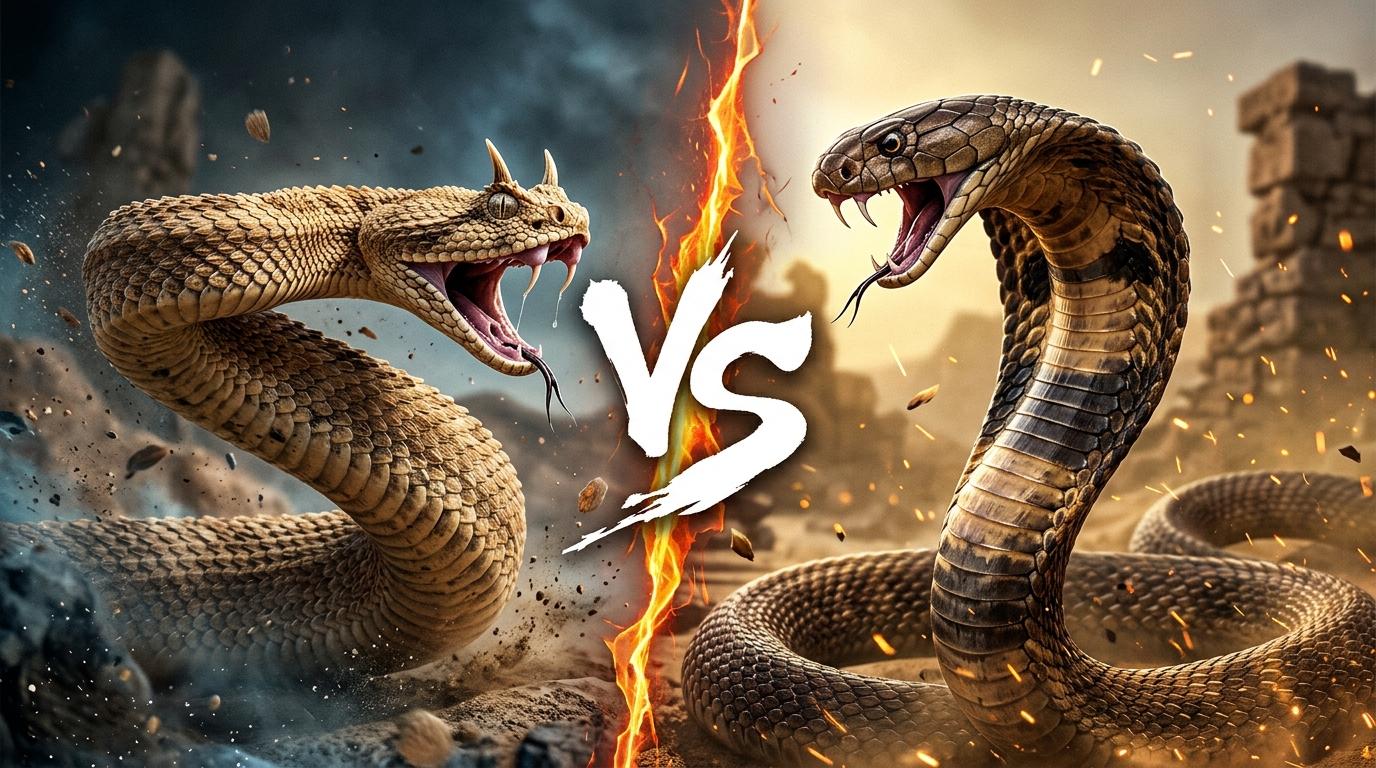
Desert Horned Viper vs Egyptian Cobra: Who Actually Wins?
Desert horned viper vs Egyptian cobra: a biology-first breakdown of size, venom, strike mechanics and behavior to show which North African snake wins and why.
Desert Horned Viper vs Egyptian Cobra
Matchup winner
Egyptian Cobra
Quick verdict
Start with the direct answer, then use the structured comparison below to see what changes the outcome.
The Egyptian Cobra wins this matchup clearly. A typical adult Naja haje is roughly 1.5–2 m long, about three times the length of a desert horned viper (usually 50–70 cm). It is also far heavier and carries a potent neurotoxic venom. Cobras in the genus Naja sometimes eat other snakes, so a small viper sits inside the cobra's prey range. The reverse is not true. The horned viper is a superb sand-burying ambusher with a fast strike and tissue-damaging venom. Its toolkit is built for lizards, rodents and birds, not for subduing a long, muscular elapid that can rear, track and pin. The viper's real chance is a lucky early bite from cover. Even then, its smaller venom dose acts more slowly than the cobra's ability to grab and envenomate.
Read the full explanation
Egyptian Cobra wins: much longer, heavier and stronger, with fast-acting neurotoxic venom.
Cobras sometimes eat other snakes, so the viper falls within a realistic prey size.
The horned viper's best weapon is concealment. A buried, well-timed strike can still land a painful, damaging bite.
Overall edge: cobra in most realistic encounters.
Reader vote
Who do you think wins?
Pick a side — no account needed. Results update live.
No votes yet — be the first to call it.
Editorial note
Why people disagree
Vipers have a reputation for faster strikes and longer fangs, so people assume the viper's first bite decides everything. Size and venom dose matter more in a snake-on-snake fight.
Body mass and reach
Length lets the cobra control distance, wrap and pin. The viper simply cannot overpower it.
Venom speed to effect
Neurotoxins disrupt breathing and movement. Paired with a bigger dose, they shut a small opponent down quickly.
Ambush control
If the encounter starts on the viper's terms, it gets the first strike.
Read the full explanation +
The desert horned viper's sand camouflage is genuinely elite. Supporters picture a perfect ambush rather than an open encounter.
Hemotoxic and cytotoxic venom looks dramatic in photos, which leads some readers to overrate how quickly it would stop a large cobra compared with neurotoxins.
Comparison FAQ
Short, direct answers to the next questions readers usually ask after the headline verdict.
Would a desert horned viper beat an Egyptian cobra?+
Usually not. The Egyptian cobra wins most encounters. The viper's best outcome is a successful ambush bite from sand cover.
Which snake is stronger?+
The Egyptian cobra, by a wide margin. It is far longer and heavier, with the muscle to rear, grip and pin a smaller snake.
Is the cobra's venom stronger than the horned viper's?+
For this fight, yes in practice. The cobra's neurotoxic venom and larger yield act faster on a small snake than the viper's tissue-damaging venom acts on a large one.
Why is the losing viper still dangerous?+
Its camouflage, rapid hinged-fang strike and destructive venom mean a surprise bite can seriously injure even a large cobra, and certainly a human. Always treat it with respect.
Do Egyptian cobras eat other snakes?+
Yes. Their diet centers on rodents, toads and birds, but they will sometimes take other snakes.
Head-to-head species stats
These are the same core AnimalDex stat dimensions used on the dedicated animal pages, pulled side by side so the matchup is faster to scan.
Desert Horned Viper
Tier BEgyptian Cobra
Tier CTrait-by-trait comparison
Only the categories that matter to this matchup are included. The goal is not filler stats, but the real design differences that change the result.
Short, stout, ~50–70 cm
Body mass and reach
Egyptian Cobra
Long, muscular, ~1.5–2 m+
Body mass and reach
Egyptian Cobra
Tissue-damaging hemotoxic mix, smaller dose
Venom speed to effect
Egyptian Cobra
Potent neurotoxin, larger yield
Venom speed to effect
Egyptian Cobra
Buries in sand, only eyes and horns exposed
Ambush control
Desert Horned Viper
Active forager, less concealed
Ambush control
Desert Horned Viper
Fast hinged-fang strike, quick release
Strike mechanics
Desert Horned Viper
Fixed front fangs, rears and grips
Strike mechanics
Desert Horned Viper
Rodents, lizards, birds
Snake-hunting profile
Egyptian Cobra
Broad diet that sometimes includes other snakes
Snake-hunting profile
Egyptian Cobra
Small body, limited reserves
Close-range durability
Egyptian Cobra
Large body absorbs a dose better
Close-range durability
Egyptian Cobra
How the verdict forms
Verdict timeline
01 · Body mass and reach
Egyptian Cobra
02 · Venom speed to effect
Egyptian Cobra
03 · Ambush control
Desert Horned Viper
04 · Strike mechanics
Desert Horned Viper
05 · Snake-hunting profile
Egyptian Cobra
06 · Close-range durability
Egyptian Cobra
Change the conditions
Scenario breakdown
This is where shallow battle content usually fails. Terrain, spacing, timing, and engagement style can change the answer.
Scenario lean
Desert Horned Viper
Verdict confidence
82%
The viper's one real win condition.
Buried in loose sand with only its horned eyes exposed, the viper can strike first as the cobra moves past. A deep bite near the head can inject enough tissue-damaging venom to make the cobra retreat. This is not a guaranteed kill, but it is a clear tactical win for the viper.
AnimalDex field profiles
Explore these animals
Desert Horned Viper
Cerastes cerastes
sand desert, dune slope, and arid plain
Egyptian Cobra
Naja haje
desert fringe, rocky scrub, farmland edge, and river valley
Systems Intelligence & Hidden Purpose
See the animals behind this comparison as engineered biological systems: what each one is built to do, where it gains leverage, and why the matchup changes by scenario.
Specialized Hardware
horns above the eyes, sidewinding sand travel, and buried ambush posture give the Desert Horned Viper a body plan tuned for its niche.
Systems Script
Desert Horned Vipers operate through sand desert, dune slope, and arid plain. Their design links movement, feeding, shelter, and timing into one workable survival system.
Strategic Insight
Harsh places reward efficiency, timing, and bodies that waste very little.
Specialized Hardware
hood-raising display, venomous strike system, and desert-and-river-edge adaptability give the Egyptian Cobra a body plan tuned for its niche.
Systems Script
Egyptian Cobras operate through desert fringe, rocky scrub, farmland edge, and river valley Their design links movement, shelter, and feeding into one workable survival system.
Strategic Insight
A clear warning can shift the fight before contact begins.
Final take
The Egyptian Cobra is the overall winner. It brings roughly three times the length, much greater mass, fast-acting neurotoxic venom, and a diet that sometimes includes other snakes.
Read the full explanation
The desert horned viper is no pushover. Its sand-burial ambush and rapid strike make it one of the desert's most efficient small predators, and in a perfectly timed cover duel it can drive off the cobra. Across realistic encounters, though, size and venom dose win, and the cobra holds both.
Collect both animals in AnimalDex
Track the species behind this matchup, compare their real traits, and build the rivalry into your AnimalDex collection.
Discussion
What do you think?
Share your reasoning with other readers. Be civil and stick to the animals.
Sign in to join the discussion.
Sign inNo comments yet. Start the conversation.