

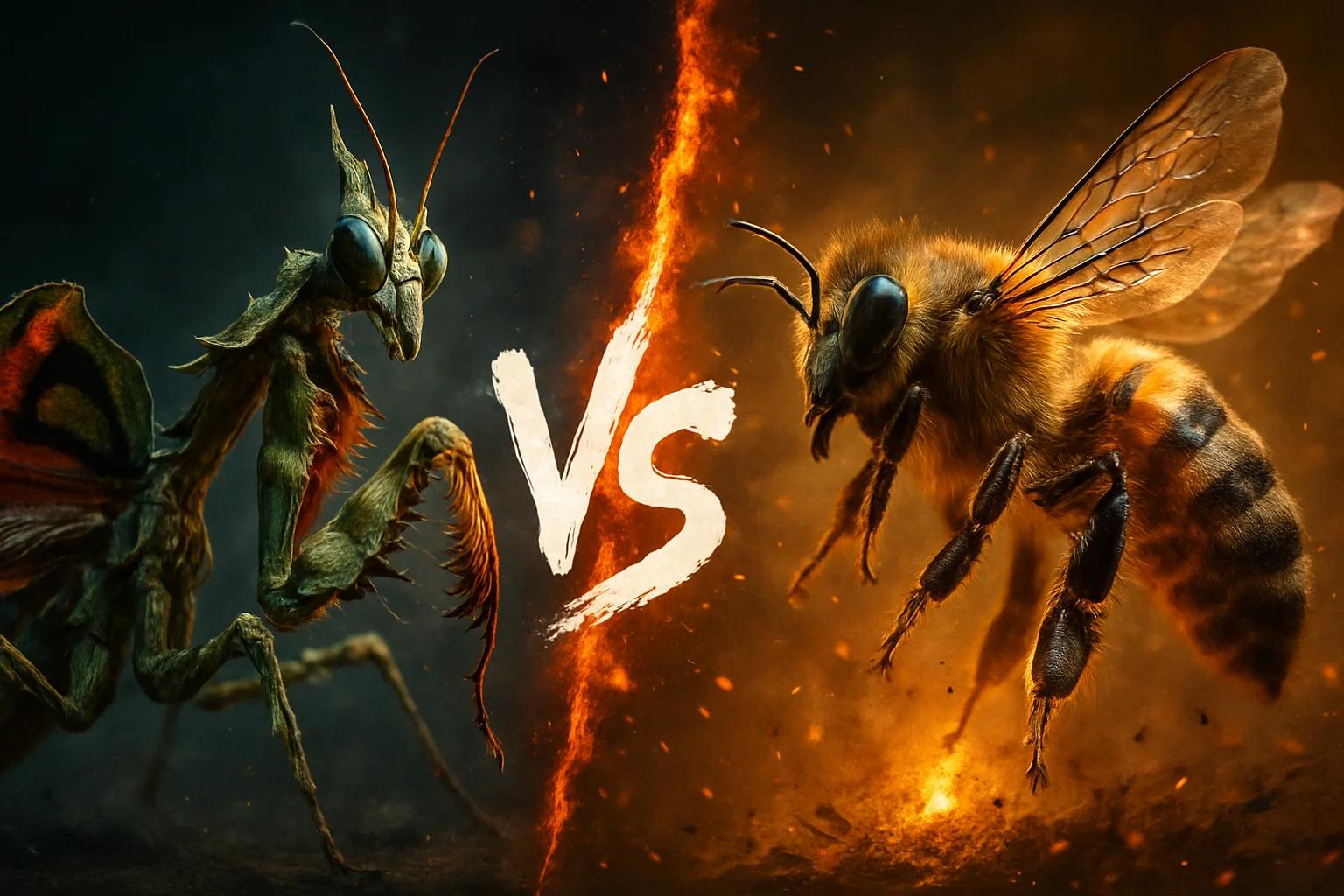
Devil's Flower Mantis vs Western Honey Bee: Who Actually Wins?
Devil's flower mantis vs western honey bee: a biology-first breakdown of size, strike speed, venom, and colony defense to settle who wins one-on-one.
Devil's Flower Mantis vs Western Honey Bee
Matchup winner
Devil's Flower Mantis
Quick verdict
Start with the direct answer, then use the structured comparison below to see what changes the outcome.
The Devil's flower mantis wins a one-on-one encounter. At roughly 10–13 cm, it is many times longer and heavier than a 12–15 mm worker honey bee. Its raptorial forelegs are spiked capture tools built specifically to snatch flying insects, and mantids routinely eat bees at flowers in the wild. The honey bee's sting is barbed and evolved to work against vertebrate skin, not to punch reliably through the joints of a large, armored insect. The bee is faster in the air and can gang up as a colony, but in a single duel the mantis has the reach, grip, and ambush timing to end it in one strike.
Read the full explanation
Overall winner: Devil's flower mantis, by a wide margin in a one-on-one fight.
The mantis is roughly 7–9 times longer than a worker bee and built to catch flying insects.
The bee's best weapon is its colony. Mass defense near the hive can drive off or even kill large insect intruders.
A lone forager caught at a flower is classic mantis prey.
Reader vote
Who do you think wins?
Pick a side — no account needed. Results update live.
No votes yet — be the first to call it.
Editorial note
Why people disagree
Honey bees have a scary reputation because their stings hurt humans badly, but that sting evolved against mammals, not armored insects.
Size and mass advantage
Insect fights are mostly settled by size, and the mantis can pin and hold a bee without real resistance.
Strike precision
A capture organ shaped by evolution for flying prey turns a fight into a feeding event.
Ambush control
The mantis controls where the encounter happens, which is exactly where bees go looking for food.
Read the full explanation +
Some people picture a whole hive rather than a single bee. Colony defense really does change the math.
The Devil's flower mantis looks delicate and ornamental, so people underestimate how lethal its strike is.
Comparison FAQ
Short, direct answers to the next questions readers usually ask after the headline verdict.
Would a Devil's flower mantis beat a honey bee?+
Yes. In a one-on-one fight the mantis wins decisively by seizing the bee with its raptorial forelegs.
Which is stronger, the mantis or the honey bee?+
The mantis by far. It is many times larger and has grasping forelegs that a bee cannot break free from.
Can a honey bee sting kill a mantis?+
Occasionally, if the sting lands in a soft joint, but it rarely gets the chance. The sting is optimized for vertebrate skin rather than insect armor.
Why is the honey bee still dangerous?+
Colony defense. Near the hive, alarm pheromones recruit many stinging defenders who can overwhelm large intruders.
Do mantises really eat bees?+
Yes. Many mantis species hunt at flowers and regularly catch pollinators, including honey bees.
Head-to-head species stats
These are the same core AnimalDex stat dimensions used on the dedicated animal pages, pulled side by side so the matchup is faster to scan.
Devil's Flower Mantis
Tier CWestern Honey Bee
Tier CTrait-by-trait comparison
Only the categories that matter to this matchup are included. The goal is not filler stats, but the real design differences that change the result.
About 10–13 cm, long-bodied
Size and mass advantage
Devil's Flower Mantis
About 12–15 mm worker
Size and mass advantage
Devil's Flower Mantis
Spiked raptorial forelegs, a fast and accurate grab
Strike precision
Devil's Flower Mantis
No grasping weapon; relies on mandibles and sting
Strike precision
Devil's Flower Mantis
Flower-mimic stillness that lures pollinators
Ambush control
Devil's Flower Mantis
Visits flowers as a forager
Ambush control
Devil's Flower Mantis
Weak, clumsy flier
Aerial speed and escape
Western Honey Bee
Agile flier at roughly 25 km/h
Aerial speed and escape
Western Honey Bee
None
Chemical weaponry
Western Honey Bee
Venomous barbed sting plus alarm pheromones
Chemical weaponry
Western Honey Bee
Solitary
Collective defense
Western Honey Bee
Colony that can recruit thousands of defenders
Collective defense
Western Honey Bee
How the verdict forms
Verdict timeline
01 · Size and mass advantage
Devil's Flower Mantis
02 · Strike precision
Devil's Flower Mantis
03 · Ambush control
Devil's Flower Mantis
04 · Aerial speed and escape
Western Honey Bee
05 · Chemical weaponry
Western Honey Bee
06 · Collective defense
Western Honey Bee
Change the conditions
Scenario breakdown
This is where shallow battle content usually fails. Terrain, spacing, timing, and engagement style can change the answer.
Scenario lean
Devil's Flower Mantis
Verdict confidence
82%
Mantis wins quickly.
This is the mantis's home game. It mimics a bloom, holds still, and strikes in a fraction of a second. The forager is seized before it can turn and use its sting, and the mantis's grip keeps the abdomen pinned away from its body.
AnimalDex field profiles
Explore these animals
Devil's Flower Mantis
Idolomantis diabolica
dry scrub, thorn bush, and flowering shrubland
Western Honey Bee
—
Habitat details are not published on a dedicated AnimalDex species page yet.
Species guide coming soon.
Systems Intelligence & Hidden Purpose
See the animals behind this comparison as engineered biological systems: what each one is built to do, where it gains leverage, and why the matchup changes by scenario.
Specialized Hardware
petal-like lobed body, pink-and-white camouflage, and sudden ambush grab give the Devil's Flower Mantis a body plan tuned for its niche.
Systems Script
Devil's Flower Mantiss operate through dry scrub, thorn bush, and flowering shrubland. Their design links movement, feeding, shelter, and timing into one workable survival system.
Strategic Insight
Harsh places reward efficiency, timing, and bodies that waste very little.
Final take
The Devil's flower mantis is the clear overall winner. It is a specialized ambush predator of flying insects, much larger than its opponent, and armed with a capture weapon a honey bee cannot counter in single combat.
Read the full explanation
The honey bee's strength is real but collective. As an individual it is prey; as a colony it is a fortress. Judge the matchup as the duel people usually mean, and the mantis wins.
Collect both animals in AnimalDex
Track the species behind this matchup, compare their real traits, and build the rivalry into your AnimalDex collection.
Discussion
What do you think?
Share your reasoning with other readers. Be civil and stick to the animals.
Sign in to join the discussion.
Sign inNo comments yet. Start the conversation.