

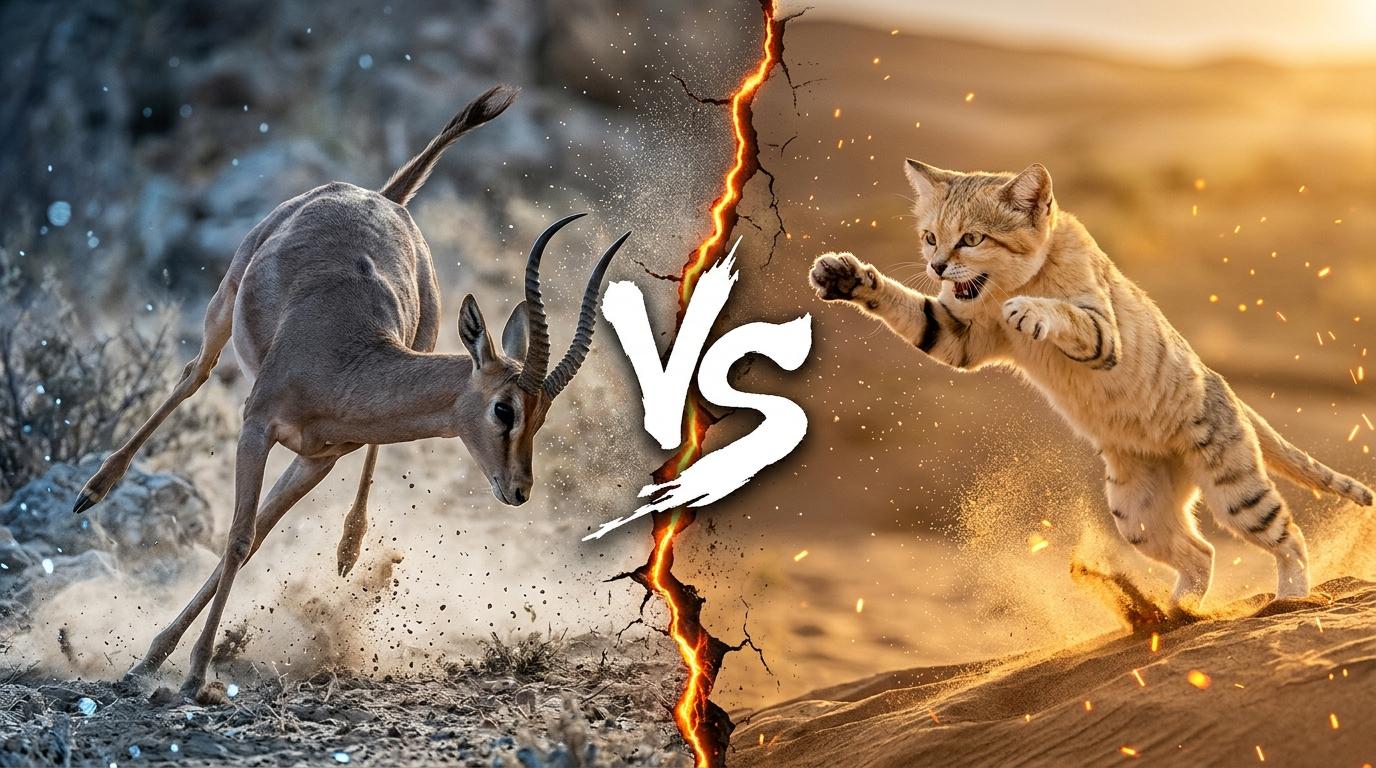
Dibatag vs Sand Cat: Who Actually Wins?
Dibatag vs sand cat: a Somali browsing antelope against the world's toughest tiny desert cat. See who wins on size, weapons, speed, and terrain, and why the cat is still no pushover.
Dibatag vs Sand Cat
Matchup winner
Dibatag
Quick verdict
Start with the direct answer, then use the structured comparison below to see what changes the outcome.
The dibatag wins, and it is not especially close. An adult dibatag (Ammodorcas clarkei) weighs roughly 20–35 kg, about ten times the mass of a sand cat (Felis margarita) at around 1.5–3.4 kg. Males carry short, forward-curving horns, and every dibatag can deliver sharp hoof strikes from long, slender legs. The sand cat is a superb predator of gerbils, jerboas, birds, and venomous snakes, with fast reflexes, real claws, and remarkable desert endurance. But its whole hunting toolkit is scaled for prey that weighs grams, not tens of kilograms. In a forced confrontation, the antelope's mass, reach, and kicking power outclass anything the cat can deliver. The realistic outcome is that the cat disengages and the dibatag walks away. The cat's best result is escape, not victory.
Read the full explanation
Dibatag wins overall thanks to roughly a 10x weight advantage, horns (males), and hard hoof strikes.
The sand cat is a skilled predator of small animals but has no realistic way to bring down a 30 kg antelope.
The sand cat's real edge is evasion: burrows, night activity, and camouflage let it avoid the fight entirely.
Their ranges barely overlap in reality, so this is a hypothetical matchup of body plans.
Reader vote
Who do you think wins?
Pick a side — no account needed. Results update live.
No votes yet — be the first to call it.
Editorial note
Why people disagree
Predator bias: many readers assume any cat beats any herbivore. Sand cats, though, hunt rodents and lizards, not antelope.
Body mass and frame
A tenfold mass gap decides most physical contests between animals before skill comes into play.
Striking weapons
The dibatag's weapons have reach and momentum. The cat's work only up close, where it is most exposed to being trampled.
Ambush control
The cat controls when and whether contact happens, which matters for survival but not for overpowering large prey.
Read the full explanation +
Snake-killing fame: the sand cat's reputation for handling vipers makes it sound tougher than its 2–3 kg frame can support against large prey.
Skittish antelope image: the dibatag is shy and quick to flee, so people underrate how much force a cornered hoofed animal can produce.
Comparison FAQ
Short, direct answers to the next questions readers usually ask after the headline verdict.
Would a dibatag beat a sand cat in a fight?+
Yes. The dibatag's roughly tenfold weight advantage, long kicking legs, and (in males) horns would overwhelm a sand cat in any forced fight. The likely outcome is the cat fleeing.
Which is stronger, the dibatag or the sand cat?+
The dibatag is far stronger in absolute terms because it weighs about 20–35 kg against the sand cat's 1.5–3.4 kg. Pound for pound, the sand cat is a capable predator, but absolute force decides this matchup.
Could a sand cat kill a dibatag?+
Realistically, no. Sand cats hunt gerbils, jerboas, birds, and reptiles. They lack the size and bite power to subdue a large antelope.
Why is the sand cat still dangerous?+
It has sharp claws, fast reflexes, and real fighting instincts. It can deliver painful scratches and bites, and it dodges well enough to avoid being caught by a kick. It is dangerous to anything its own size or smaller, and evasive enough to escape bigger threats.
Do dibatags and sand cats live in the same place?+
Barely, if at all. The dibatag lives in eastern Ethiopia and Somalia, while sand cats live mainly across the Sahara, Arabia, and Central Asia. This comparison is hypothetical.
Which animal is rarer?+
The dibatag is rarer. It is a little-studied, threatened antelope with a very small range, while the sand cat is widespread but elusive and hard to survey.
Head-to-head species stats
These are the same core AnimalDex stat dimensions used on the dedicated animal pages, pulled side by side so the matchup is faster to scan.
Dibatag
Tier BSand Cat
Tier BTrait-by-trait comparison
Only the categories that matter to this matchup are included. The goal is not filler stats, but the real design differences that change the result.
About 20–35 kg, tall, long-necked browser
Body mass and frame
Dibatag
About 1.5–3.4 kg, compact, low-slung cat
Body mass and frame
Dibatag
Forward-curving horns (males), sharp hooves, long legs
Striking weapons
Dibatag
Retractable claws, small but sharp canines
Striking weapons
Dibatag
None; a vigilant prey animal
Ambush control
Sand Cat
Low stalking crouch, sand-colored coat, night hunter
Ambush control
Sand Cat
Fast, upright bounding gait with neck and tail held erect
Open-ground speed
Dibatag
Short sprints of about 30–40 km/h
Open-ground speed
Dibatag
Larger body absorbs scratches and bites
Close-range durability
Dibatag
Small body vulnerable to a single solid kick
Close-range durability
Dibatag
Quick startle, good at spotting threats
Reflexes and agility
Sand Cat
Lightning paw strikes honed on snakes and rodents
Reflexes and agility
Sand Cat
How the verdict forms
Verdict timeline
01 · Body mass and frame
Dibatag
02 · Striking weapons
Dibatag
03 · Ambush control
Sand Cat
04 · Open-ground speed
Dibatag
05 · Close-range durability
Dibatag
06 · Reflexes and agility
Sand Cat
Change the conditions
Scenario breakdown
This is where shallow battle content usually fails. Terrain, spacing, timing, and engagement style can change the answer.
Scenario lean
Dibatag
Verdict confidence
82%
Dibatag dominates with size and reach.
On flat, open terrain the cat has no cover to exploit. The dibatag can see it coming, face it, and strike with hooves or horns from beyond the cat's reach. A 2–3 kg predator gains nothing from closing in on a 30 kg animal that can kick. The sand cat's correct move is to retreat.
AnimalDex field profiles
Explore these animals
Dibatag
Ammodorcas clarkei
arid bushland, open scrub, and sandy plain
Sand Cat
Felis margarita
sand desert, stony plain, and arid scrub
Systems Intelligence & Hidden Purpose
See the animals behind this comparison as engineered biological systems: what each one is built to do, where it gains leverage, and why the matchup changes by scenario.
Specialized Hardware
very long thin neck, slender pointed face, and light desert step running give the Dibatag a body plan tuned for its niche.
Systems Script
Dibatags operate through arid bushland, open scrub, and sandy plain. Their design links movement, feeding, shelter, and timing into one workable survival system.
Strategic Insight
Harsh places reward efficiency, timing, and bodies that waste very little.
Specialized Hardware
furred foot pads, broad low-set ears, and desert-night hunting give the Sand Cat a body plan tuned for its niche.
Systems Script
Sand Cats operate through sand desert, stony plain, and arid scrub. Their design links movement, feeding, shelter, and timing into one workable survival system.
Strategic Insight
Harsh places reward efficiency, timing, and bodies that waste very little.
Final take
The dibatag is the clear winner. This is a matchup between a mid-sized hoofed animal and a predator built for rodents. Body mass, hoof strikes, and the male's horns give the antelope every physical edge that matters in direct contact.
Read the full explanation
The sand cat still deserves respect. It survives in some of the harshest deserts on Earth, kills venomous snakes, and can go long periods without drinking. Its strength is avoidance and precision against small prey, not grappling with animals ten times its size. The smartest sand cat never takes this fight at all.
Collect both animals in AnimalDex
Track the species behind this matchup, compare their real traits, and build the rivalry into your AnimalDex collection.
Related comparisons
Continue with nearby matchups to compare more real-world animal traits without dropping into junky who-wins filler.

Dibatag vs Gemsbok: Who Actually Wins?
The gemsbok wins, and it isn't close in a straight confrontation. An adult gemsbok stands about 1.2 m at the shoulder and weighs roughly 180–240 kg. The dibatag is a slender, gerenuk-like gazelle of about 20–35 kg. Gemsbok of both sexes carry rapier-straight horns up to about 85–120 cm long, and they are famous for using them to hold off big predators. Only male dibatag have horns, and those are short, forward-curving hooks of around 15–25 cm. The dibatag's real strengths are concealment, browsing in dense Ogaden thornbush, and a fast, tail-up escape run. Those skills help it avoid fights, not win them. Once contact happens, mass, reach and a combative temperament decide the outcome, and all three belong to the gemsbok.
Read comparison
Discussion
What do you think?
Share your reasoning with other readers. Be civil and stick to the animals.
Sign in to join the discussion.
Sign inNo comments yet. Start the conversation.