

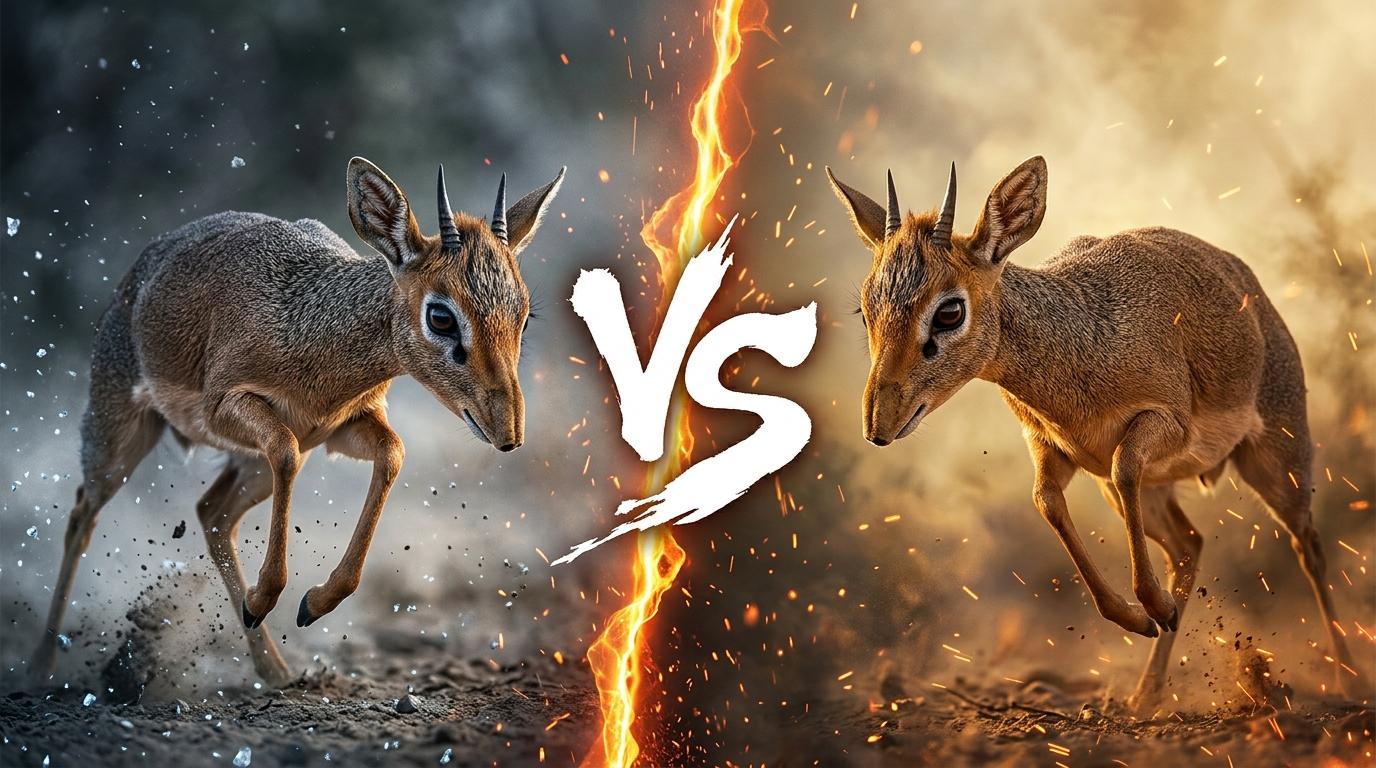
Kirk's Dik-dik vs Kirk's Dik-dik: Who Wins a Same-Species Showdown?
Two Kirk's dik-diks, one species. Here's who wins when a larger, faster territorial dik-dik meets a smaller, sharper rival, and why size and speed decide the contest.
Kirk's Dik-dik vs Kirk's Dik-dik
Matchup winner
Kirk's Dik-dik
Quick verdict
Start with the direct answer, then use the structured comparison below to see what changes the outcome.
This is a mirror match: both entries are Kirk's dik-dik (Madoqua kirkii), so it plays out the way these tiny antelopes actually settle disputes, as a contest between two individuals. The edge goes to Animal A, the bigger, faster, more dominant dik-dik (dominance 47 vs 34, speed 59 vs 52, size 28 vs 24). Dik-dik fights are mostly ritual. Rivals raise their crests, dash at each other, posture and sometimes jab with short horns. In that kind of contest, a few extra percent of body mass and acceleration usually decide who holds ground and who retreats. Animal B is slightly more perceptive and a little rarer in the data, which helps it read situations and slip away. But it lacks the physical surplus to evict a confident territory holder. Expect Animal A to win most encounters by pushing its rival back, not by injuring it.
Read the full explanation
Animal A wins: it is larger, faster and higher in dominance.
Both are the same species, so this is a rival-vs-rival territorial contest, not predator vs prey.
Animal B's slight intelligence edge helps it avoid losing badly, but not to win.
Real dik-dik disputes end in retreat far more often than in injury.
Reader vote
Who do you think wins?
Pick a side — no account needed. Results update live.
No votes yet — be the first to call it.
Editorial note
Why people disagree
Because both are the same species, some readers think the matchup should be a coin flip. Small stat gaps still matter in ritualized contests.
Explosive power
Dik-dik clashes open with short charges, and the quicker launch claims space first.
Body mass leverage
In head-to-head pushing, even a small mass advantage shifts the rival backward.
Territorial presence
Dominance predicts who holds ground during crest-raising and display before contact.
Read the full explanation +
Animal B scores higher on intelligence, and people overrate how much awareness helps in a shoving-and-posturing duel.
Dik-dik 'fights' look like bluffing, so people argue whether a winner exists at all. In practice, the one who keeps the territory wins.
Comparison FAQ
Short, direct answers to the next questions readers usually ask after the headline verdict.
Would Kirk's dik-dik A beat Kirk's dik-dik B?+
Yes, most of the time. Animal A is larger, faster and more dominant, which decides ritualized dik-dik contests.
Which dik-dik is stronger?+
Animal A. It has a higher size score and a higher dominance score, giving it more leverage in head-to-head pushing.
Do dik-diks actually fight each other?+
Yes, but mostly ritually. Males raise their crests, charge and sometimes clash horns, and the contest usually ends when one retreats.
Why does the losing dik-dik stay dangerous?+
Animal B is more aware and agile in cover. It can avoid being cornered, return to contest boundaries, and use short, sharp horns if pressed.
Is this a fair comparison if both are the same species?+
It works as a rival-vs-rival matchup. Small differences between individuals are exactly what settle real territorial disputes.
Head-to-head species stats
These are the same core AnimalDex stat dimensions used on the dedicated animal pages, pulled side by side so the matchup is faster to scan.
Kirk's Dik-dik
Tier CKirk's Dik-dik
Tier CTrait-by-trait comparison
Only the categories that matter to this matchup are included. The goal is not filler stats, but the real design differences that change the result.
Sharper burst, speed 59
Explosive power
Kirk's Dik-dik
Solid burst, speed 52
Explosive power
Kirk's Dik-dik
Slightly heavier frame, size 28
Body mass leverage
Kirk's Dik-dik
Lighter build, size 24
Body mass leverage
Kirk's Dik-dik
Assertive, dominance 47
Territorial presence
Kirk's Dik-dik
More yielding, dominance 34
Territorial presence
Kirk's Dik-dik
Adequate, intelligence 37
Situational awareness
Kirk's Dik-dik
Keener, intelligence 42
Situational awareness
Kirk's Dik-dik
Fast but more committed
Thicket navigation
Kirk's Dik-dik
Nimble, reads escape routes
Thicket navigation
Kirk's Dik-dik
How the verdict forms
Verdict timeline
01 · Explosive power
Kirk's Dik-dik
02 · Body mass leverage
Kirk's Dik-dik
03 · Territorial presence
Kirk's Dik-dik
04 · Situational awareness
Kirk's Dik-dik
05 · Thicket navigation
Kirk's Dik-dik
Change the conditions
Scenario breakdown
This is where shallow battle content usually fails. Terrain, spacing, timing, and engagement style can change the answer.
Scenario lean
Kirk's Dik-dik
Verdict confidence
82%
The smaller dik-dik uses the bush to avoid a decisive clash.
Dense scrub limits charging runs and rewards spatial reading. Animal B's sharper awareness lets it slip through gaps and deny Animal A a clean push. It doesn't defeat Animal A here, but it avoids being displaced, which counts as a draw-leaning win in cover.
AnimalDex field profiles
Explore these animals
Kirk's Dik-dik
—
Habitat details are not published on a dedicated AnimalDex species page yet.
Species guide coming soon.
Kirk's Dik-dik
—
Habitat details are not published on a dedicated AnimalDex species page yet.
Species guide coming soon.
Systems Intelligence & Hidden Purpose
See the animals behind this comparison as engineered biological systems: what each one is built to do, where it gains leverage, and why the matchup changes by scenario.
Specialized Hardware
Compact, springy legs for explosive bursts, short ridged horns (males), and gland-marked scent signaling near the eyes. Its crest raises during displays.
Systems Script
Holds a small, fixed territory with a mate. It marks borders with scent and dung middens, browses selectively on leaves and shoots, and sounds alarms that alert other species nearby.
Strategic Insight
A small edge, applied consistently at clear boundaries, beats bigger ambitions spread thin.
Specialized Hardware
An elongated, mobile snout that helps with heat regulation, large eyes for spotting threats, and a light frame built for darting through dense scrub.
Systems Script
Thrives in thornbush by reading cover and exits. It gets most of its water from browse, and its whistled alarm calls act as an early-warning system for the community.
Strategic Insight
When you can't overpower a rival, master the terrain. Knowing where to slip away keeps you in the game.
Final take
Animal A takes this same-species matchup. Dik-dik contests are decided by display, charge and push, and Animal A wins all three on speed, size and dominance.
Read the full explanation
Animal B is not a pushover. Its sharper awareness makes it hard to corner in thick bush, and it will rarely be hurt. Still, holding territory is what counts in dik-dik life, and the stronger individual usually keeps it.
Collect both animals in AnimalDex
Track the species behind this matchup, compare their real traits, and build the rivalry into your AnimalDex collection.
Discussion
What do you think?
Share your reasoning with other readers. Be civil and stick to the animals.
Sign in to join the discussion.
Sign inNo comments yet. Start the conversation.