

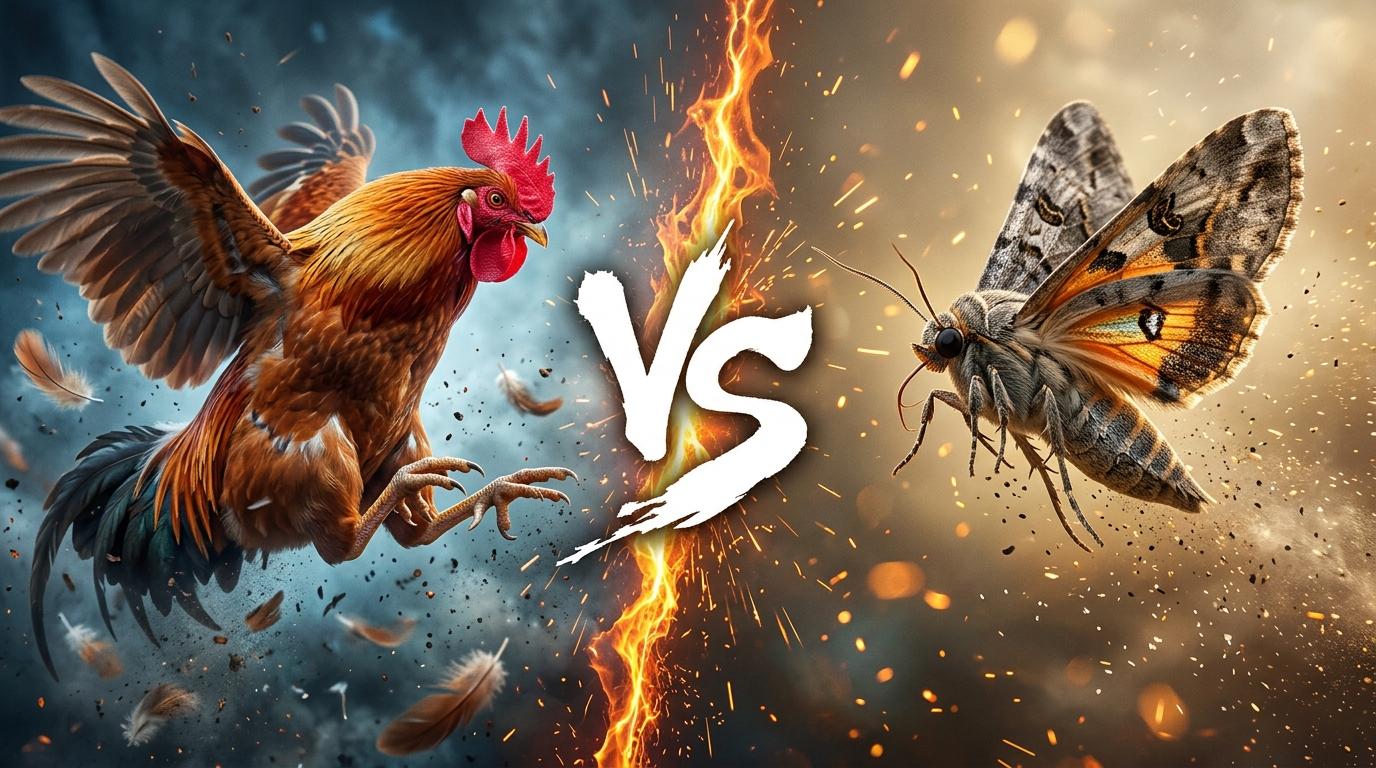
Domestic Chicken vs Pea Moth: Who Actually Wins?
Domestic chicken vs pea moth: a biology-first breakdown of size, speed, senses and survival tactics, and why the chicken wins almost every encounter.
Chicken vs Pea Moth
Matchup winner
Chicken
Quick verdict
Start with the direct answer, then use the structured comparison below to see what changes the outcome.
The domestic chicken wins, and it isn't close. A chicken weighs roughly 1.5 to 3 kg. A pea moth weighs a few milligrams and has a wingspan of about 12 to 16 mm. Chickens are descended from red junglefowl and are built to hunt insects. They have sharp color vision tuned to small moving targets and a fast, precise pecking strike, and they forage by scratching at the ground. To a chicken, an adult pea moth is a snack. The moth has no sting, no bite and no chemical defense to stop that. Its real strengths are elsewhere: it is small, active mostly at dusk, flies erratically, and its larvae hide inside pea pods. Those traits keep the species alive at the population level, but they don't win a direct confrontation.
Read the full explanation
The chicken wins decisively. The moth is prey-sized, and chickens are active insect hunters.
The chicken outclasses the moth in size, strike speed, vision and sheer control of the encounter.
The pea moth's only real edge is avoidance: dusk flight, tiny size and larvae hidden inside pods.
The moth can 'win' only by never meeting the chicken, not by fighting it.
Reader vote
Who do you think wins?
Pick a side — no account needed. Results update live.
No votes yet — be the first to call it.
Editorial note
Why people disagree
Some readers count a moth flying away as a win. In a battle frame, escaping isn't beating your opponent.
Body mass advantage
The size gap is over a million to one. Nothing the moth's body can do threatens the chicken.
Strike precision
Encounters between a predator and a small target are settled by how accurately the predator can hit. The chicken is built for exactly that.
Visual targeting
In daylight the chicken spots, tracks and hits small moving insects very reliably.
Read the full explanation +
Pea moths are serious crop pests, so people mix up economic damage with fighting ability.
Chickens look clumsy, but their pecking strike is fast and accurate. That precision is what decides small-prey encounters.
Comparison FAQ
Short, direct answers to the next questions readers usually ask after the headline verdict.
Would a chicken beat a pea moth in a fight?+
Yes. A chicken would simply peck and eat the moth. The moth has no way to fight back.
Which is stronger, a chicken or a pea moth?+
The chicken, by a huge margin. It is roughly a million times heavier and has muscular legs, a strong beak and a sturdy skeleton.
Do chickens eat moths?+
Yes. Chickens are omnivores that eagerly eat moths, caterpillars and many other insects.
Why is the pea moth still dangerous if it loses?+
Not to the chicken. It matters to crops. Its larvae bore into pea pods and damage the seeds, which can cause significant losses in pea harvests.
Can a pea moth escape a chicken?+
Sometimes. Dusk activity, small size and erratic flight help it avoid being found. But once a chicken targets it in daylight, escape is unlikely.
Head-to-head species stats
These are the same core AnimalDex stat dimensions used on the dedicated animal pages, pulled side by side so the matchup is faster to scan.
Chicken
Tier DPea Moth
Tier CTrait-by-trait comparison
Only the categories that matter to this matchup are included. The goal is not filler stats, but the real design differences that change the result.
About 1.5–3 kg of muscle and bone
Body mass advantage
Chicken
A few milligrams
Body mass advantage
Chicken
Fast, accurate pecks aimed by vision
Strike precision
Chicken
No offensive weapon
Strike precision
Chicken
Color vision tuned to detect motion
Visual targeting
Chicken
Compound eyes adapted to low light
Visual targeting
Chicken
Conspicuous; active by day
Evasion and concealment
Pea Moth
Tiny, drab, flies at dusk with an erratic path
Evasion and concealment
Pea Moth
Feathers, skeleton and real body mass
Close-range durability
Chicken
Fragile wings and a soft body
Close-range durability
Chicken
Survives largely because humans keep and protect it
Population resilience
Pea Moth
Many eggs laid; larvae protected inside pods
Population resilience
Pea Moth
How the verdict forms
Verdict timeline
01 · Body mass advantage
Chicken
02 · Strike precision
Chicken
03 · Visual targeting
Chicken
04 · Evasion and concealment
Pea Moth
05 · Close-range durability
Chicken
06 · Population resilience
Pea Moth
Change the conditions
Scenario breakdown
This is where shallow battle content usually fails. Terrain, spacing, timing, and engagement style can change the answer.
Scenario lean
Chicken
Verdict confidence
82%
The chicken eats the moth.
In daylight with no cover, the chicken's vision and pecking strike decide everything. The moth's erratic flight buys it a second at most, and chickens readily snap insects out of the air or off the ground.
AnimalDex field profiles
Explore these animals
Chicken
Gallus gallus domesticus
farmyard, village edge, garden, and managed grass run
Pea Moth
—
Habitat details are not published on a dedicated AnimalDex species page yet.
Species guide coming soon.
Systems Intelligence & Hidden Purpose
See the animals behind this comparison as engineered biological systems: what each one is built to do, where it gains leverage, and why the matchup changes by scenario.
Specialized Hardware
Color vision tuned to motion, a fast pecking beak, scratching feet and a crop that stores food for later digestion.
Systems Script
Searches the ground layer for insects, seeds and larvae, turning soil and cutting back invertebrate numbers wherever it forages.
Strategic Insight
Steady, precise attention to small details adds up to control over the whole area.
Specialized Hardware
Small drab body, dusk-active flight and larvae that tunnel into pea pods for protection.
Systems Script
Lays eggs on pea crops, where the larvae feed inside the pods. It acts as both a food source for predators and a pressure on legume crops.
Strategic Insight
When you can't win head-on, good timing and concealment can keep you in the game.
Final take
The domestic chicken is the clear winner. It is a small-prey hunter with overwhelming size, a precise strike and sharp daylight vision, while the pea moth has no weapon and no defense once it's caught.
Read the full explanation
The pea moth's success is real, but it comes from a different strategy: being small, flying at dusk, and hiding its larvae inside pods. It thrives by avoiding fights like this one. In a direct battle, the chicken wins almost every time.
Collect both animals in AnimalDex
Track the species behind this matchup, compare their real traits, and build the rivalry into your AnimalDex collection.
Related comparisons
Continue with nearby matchups to compare more real-world animal traits without dropping into junky who-wins filler.
Siberian Husky vs Domestic Chicken: Who Comes Out on Top?
In a head-to-head comparison, the Siberian Husky clearly takes the win over the Domestic Chicken due to its superior physical attributes, agility, and predatory instincts. While the chicken is a remarkable creature with its own unique defenses, it simply lacks the strength and speed to compete with the Husky's capabilities.
Read comparison
Discussion
What do you think?
Share your reasoning with other readers. Be civil and stick to the animals.
Sign in to join the discussion.
Sign inNo comments yet. Start the conversation.