

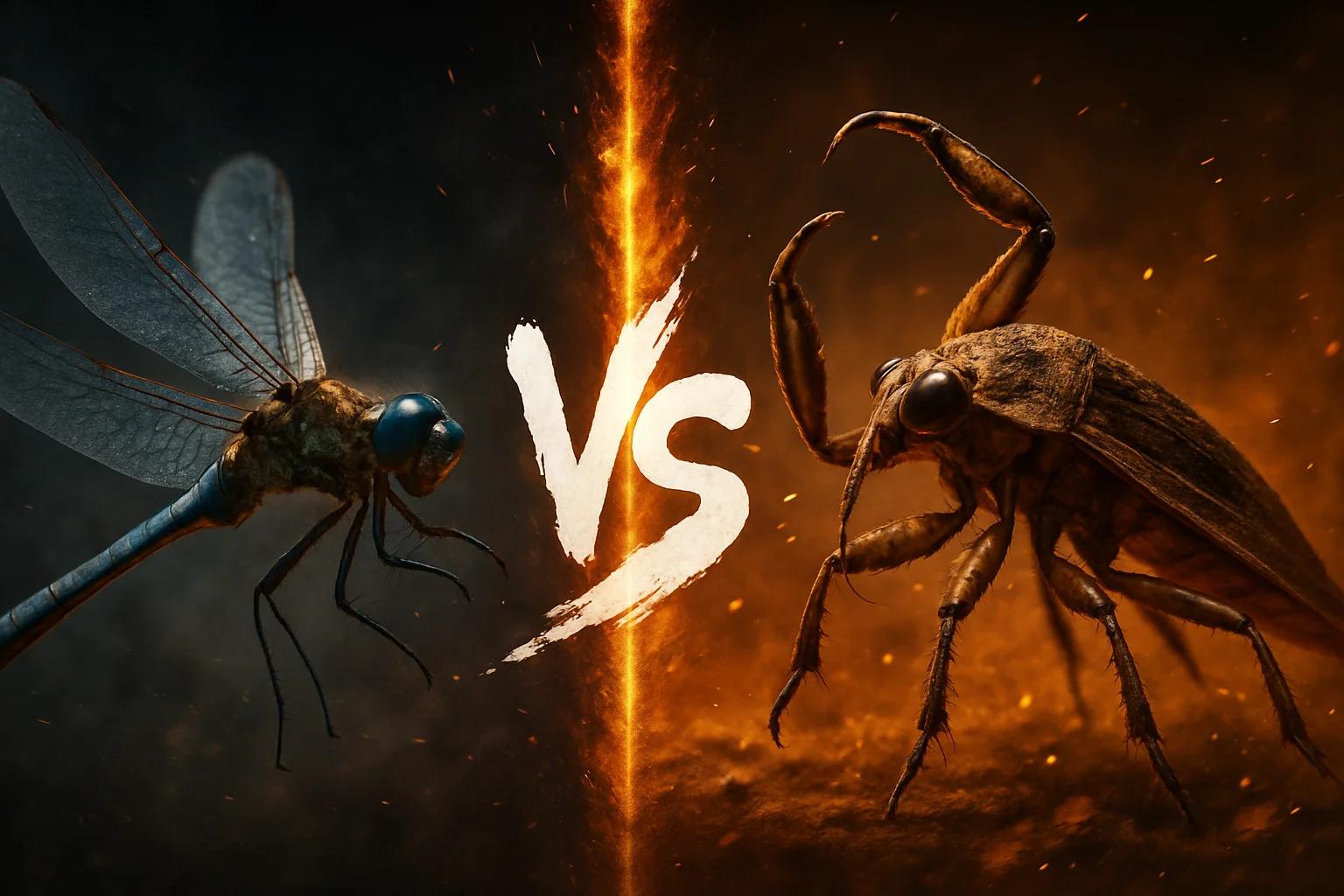
Dragonfly vs Giant Water Bug: Who Actually Wins?
Dragonfly vs giant water bug: who would win? A biology-first breakdown of aerial precision against an aquatic grappler with digestive saliva, covering who wins, when, and why.
Dragonfly vs Giant Water Bug
Matchup winner
Giant Water Bug
Quick verdict
Start with the direct answer, then use the structured comparison below to see what changes the outcome.
The giant water bug wins a real fight. Lethocerus americanus is a heavier-bodied ambush predator built for one job: grab with thick raptorial forelegs, pierce with a beak-like rostrum, and inject saliva that paralyzes and liquefies prey from the inside. It routinely subdues fish, frogs, and tadpoles larger than a dragonfly. The dragonfly is one of the most precise aerial hunters on Earth, but its weapons (spiny legs and chewing jaws) are tuned for midair captures of gnats and flies, not for wrestling an armored, venom-assisted grappler. The dragonfly's real advantage is that it never has to accept the fight. Once contact happens near water, the bug's grip-and-inject system ends the matchup fast.
Read the full explanation
Giant water bug wins any fight that involves contact, especially at the waterline.
Its raptorial forelegs and paralyzing, tissue-dissolving saliva outclass the dragonfly's jaws.
The dragonfly wins only by not fighting: in open air, it is faster and far more agile.
Underwater, giant water bugs also prey on dragonfly nymphs, but large nymphs can return the favor on small bugs.
Reader vote
Who do you think wins?
Pick a side — no account needed. Results update live.
No votes yet — be the first to call it.
Editorial note
Why people disagree
Dragonflies have a famous capture success rate, so people assume elite hunting means elite fighting. Catching gnats is not the same as overpowering a grappler.
Close-range lethality
Fights between insects end at contact. The bug's injection system disables prey that are bigger than a dragonfly.
Aerial command
In the air, the dragonfly chooses whether any engagement happens at all.
Ambush control
A dragonfly dipping to the water surface to drink, lay eggs, or snatch prey enters the bug's strike zone.
Read the full explanation +
Both insects fly, so some readers imagine an air battle. The giant water bug is a clumsy flier and a deadly ambusher, and it fights where it is strong.
Nymph vs nymph is a genuine two-way street in ponds, which muddies the adult-vs-adult answer.
Comparison FAQ
Short, direct answers to the next questions readers usually ask after the headline verdict.
Would a dragonfly beat a giant water bug?+
Not in a fight. The giant water bug wins almost any contact encounter. The dragonfly survives by staying airborne and out of reach.
Which is stronger, a dragonfly or a giant water bug?+
The giant water bug. It grips and subdues fish and frogs, while the dragonfly is built for light, fast aerial captures.
Do giant water bugs eat dragonflies?+
Yes. They readily eat dragonfly nymphs and can snatch adults that touch the water surface.
Why is the dragonfly still dangerous?+
It is an elite interceptor with outstanding vision, and its nymphs are fierce underwater predators that can kill small water bug juveniles. Speed and awareness make it very hard to catch.
Can a giant water bug hurt humans?+
Its bite is very painful but not considered medically dangerous, which is why it is nicknamed the 'toe-biter.'
Head-to-head species stats
These are the same core AnimalDex stat dimensions used on the dedicated animal pages, pulled side by side so the matchup is faster to scan.
Dragonfly
Tier DGiant Water Bug
Tier BTrait-by-trait comparison
Only the categories that matter to this matchup are included. The goal is not filler stats, but the real design differences that change the result.
Spiny leg basket, strong chewing mandibles
Close-range lethality
Giant Water Bug
Raptorial forelegs plus a piercing rostrum with digestive saliva
Close-range lethality
Giant Water Bug
Four independently driven wings, hovering, backward flight
Aerial command
Dragonfly
Capable but heavy, mostly dispersal flights
Aerial command
Dragonfly
Interception hunter that predicts flight paths
Ambush control
Giant Water Bug
Motionless sit-and-wait grabber in vegetation
Ambush control
Giant Water Bug
Light, flight-optimized frame with fragile wings
Grip and durability
Giant Water Bug
Flattened, tough body with a locking foreleg clasp
Grip and durability
Giant Water Bug
Near-360° compound vision with tens of thousands of facets
Sensory targeting
Dragonfly
Vibration and motion detection at close range
Sensory targeting
Dragonfly
Top aerial insect hunter
Raw dominance
Giant Water Bug
Takes vertebrate prey, nicknamed the 'toe-biter'
Raw dominance
Giant Water Bug
How the verdict forms
Verdict timeline
01 · Close-range lethality
Giant Water Bug
02 · Aerial command
Dragonfly
03 · Ambush control
Giant Water Bug
04 · Grip and durability
Giant Water Bug
05 · Sensory targeting
Dragonfly
06 · Raw dominance
Giant Water Bug
Change the conditions
Scenario breakdown
This is where shallow battle content usually fails. Terrain, spacing, timing, and engagement style can change the answer.
Scenario lean
Giant Water Bug
Verdict confidence
82%
The bug's home turf, and a decisive win.
Dragonflies touch the water to drink, lay eggs, and pick off prey. A giant water bug lurking in emergent plants strikes in a fraction of a second, clamps on with its forelegs, and injects saliva. Paralysis follows quickly, and the dragonfly's wings become a liability while it is pinned at the surface.
AnimalDex field profiles
Explore these animals
Dragonfly
Anisoptera
Ponds, lakes, marshes, slow rivers, and wet meadows where aquatic larvae can develop.
Giant Water Bug
Lethocerus americanus
Ponds, marshes, slow streams, and still freshwater habitat.
Systems Intelligence & Hidden Purpose
See the animals behind this comparison as engineered biological systems: what each one is built to do, where it gains leverage, and why the matchup changes by scenario.
Specialized Hardware
Independent wing control, near-360-degree vision, and predictive flight tracking make dragonflies elite hardware for midair capture.
Systems Script
Dragonflies suppress mosquitoes and other insects across wetland systems while bridging aquatic juvenile stages and aerial adulthood. Few designs switch domains this cleanly and stay lethal in both.
Strategic Insight
Precision compounds when sensing and maneuverability improve together instead of separately.
Specialized Hardware
Flattened brown aquatic body, powerful grasping front legs, and strong rear legs for swimming give the Giant Water Bug a body plan tuned for its niche.
Systems Script
Giant Water Bugs operate in ponds, marshes, slow streams, and still freshwater habitat. Their design helps them match food access, shelter, and timing inside that environment.
Strategic Insight
Control of the first contact can decide the whole contest.
Final take
The giant water bug is the better fighter, and it is not especially close. Its whole body is a capture-and-dissolve system: forelegs that lock, a rostrum that pierces, and saliva that does the killing.
Read the full explanation
The dragonfly is the better escape artist and arguably the more elegant hunter. Its survival principle is control of the encounter. When it loses that control at the water's edge, it loses the fight.
Collect both animals in AnimalDex
Track the species behind this matchup, compare their real traits, and build the rivalry into your AnimalDex collection.
Related comparisons
Continue with nearby matchups to compare more real-world animal traits without dropping into junky who-wins filler.
Great Egret vs Dragonfly: Who Actually Wins?
In a contest between the Great Egret and the Dragonfly, the Great Egret emerges as the clear winner due to its superior size, dominance, and hunting prowess. With a powerful strike and strategic ambush capabilities, the Great Egret can effectively capture and consume the Dragonfly, despite its quick agility and aerial skills.
Read comparison
Discussion
What do you think?
Share your reasoning with other readers. Be civil and stick to the animals.
Sign in to join the discussion.
Sign inNo comments yet. Start the conversation.