

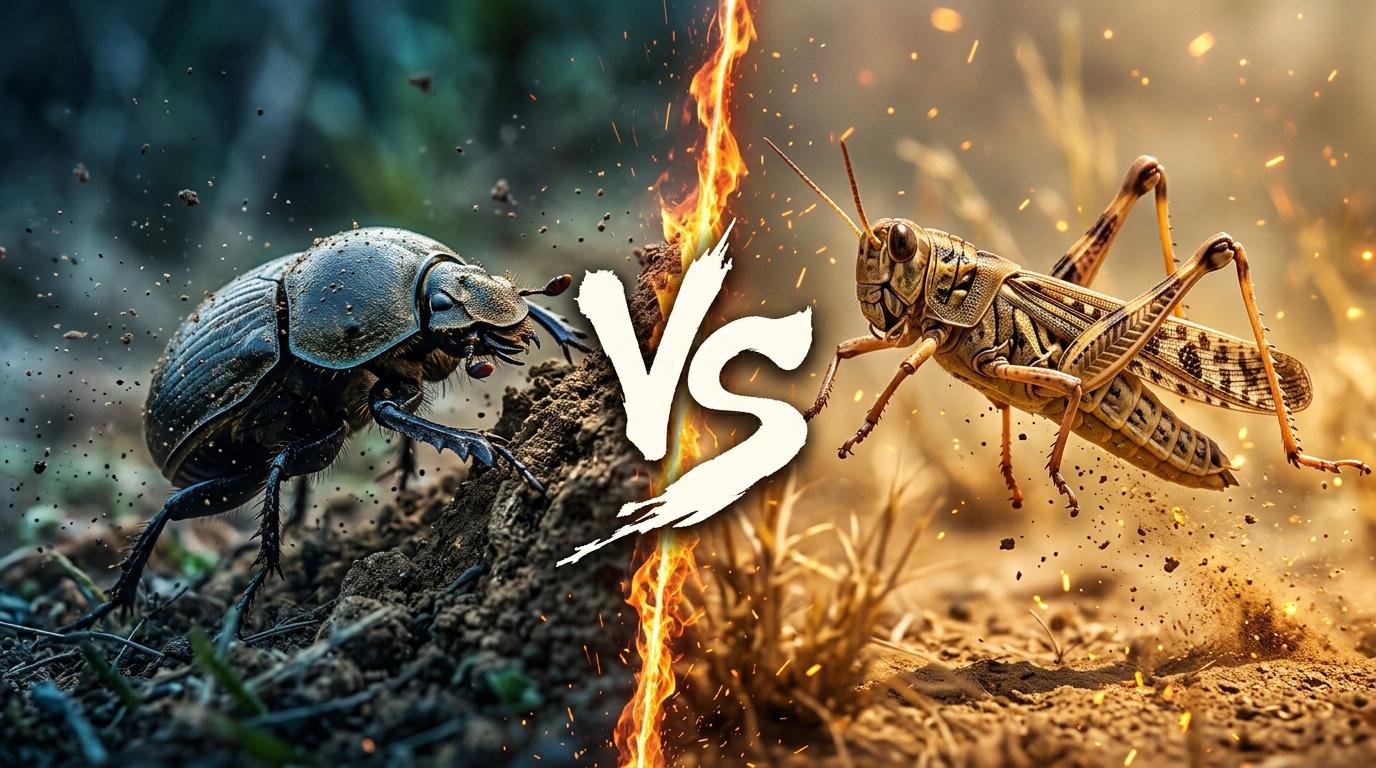
Dung Beetle vs Grasshopper & Locust: Who Actually Wins?
Dung beetle vs grasshopper or locust, who would win? A biology-first breakdown of armor, strength, jumping power and survival strategy, with a clear verdict.
Dung Beetle vs Grasshopper & Locust
Matchup winner
Dung Beetle
Quick verdict
Start with the direct answer, then use the structured comparison below to see what changes the outcome.
The dung beetle wins a direct confrontation. It is a compact, heavily armored scarab with spade-like forelegs and leverage-heavy legs built to shove, dig and wrestle rivals. Some species, such as Onthophagus taurus, can pull loads around a thousand times their own body mass. The grasshopper or locust is longer and faster to launch, but its body is built for leaping, flight and grinding plants rather than grappling. Its thinner cuticle, long breakable hind legs and lack of close-range weapons leave it with little to do once a beetle gets a grip. The grasshopper's real win condition is escape, not victory. If it jumps away, the contest never resolves. If it is pinned, the scarab's armor and pushing strength decide it.
Read the full explanation
Dung beetle wins a forced close-range contest thanks to armor and extreme pushing strength.
Grasshoppers and locusts out-jump and out-fly the beetle and win any contest decided by escape.
Neither species is a predator of the other, so a real clash would be an accidental shove-off, not a hunt.
The locust's danger is collective. A swarm reshapes landscapes, while a single individual is fragile.
Reader vote
Who do you think wins?
Pick a side — no account needed. Results update live.
No votes yet — be the first to call it.
Editorial note
Why people disagree
Size fools people. Many grasshoppers and locusts are longer than common dung beetles, but length is mostly legs and wings, not combat mass.
Close-range durability
In a pinch-and-push contest, whoever cannot be dented or snapped keeps working longer.
Shoving and grappling power
Dung beetles evolved by wrestling rivals off dung balls and out of tunnels, which is exactly the skill a duel tests.
Explosive launch
Explosive power gives the grasshopper the ability to end the fight on its own terms by leaving.
Read the full explanation +
The relative-strength record goes to dung beetles, while the jumping record goes to grasshoppers. Fans of each trait crown a different champion.
Locust swarms feel unstoppable, so people imagine one locust as formidable. Swarm power does not transfer to a one-on-one duel.
Comparison FAQ
Short, direct answers to the next questions readers usually ask after the headline verdict.
Would a dung beetle beat a grasshopper in a fight?+
Yes. In a forced close-range fight, the dung beetle wins thanks to its heavy armor, strong digging legs and extreme pushing strength.
Which is stronger, a dung beetle or a locust?+
The dung beetle, by far, in pulling and pushing strength. Some species can move loads around a thousand times their body mass. Locusts concentrate their power in jumping.
Is a grasshopper faster than a dung beetle?+
Yes. Grasshoppers and locusts jump explosively and fly well, while dung beetles mostly walk or fly clumsily.
Why is the grasshopper still dangerous if it loses?+
It rarely has to lose, because its jump can end any encounter instantly. As locusts, swarms can devastate crops across huge regions, which makes them far more dangerous to humans than any beetle.
Do dung beetles and grasshoppers fight in the wild?+
Not really. One eats dung and the other eats plants, so they rarely compete. Any clash would be an incidental shove, not predation.
Head-to-head species stats
These are the same core AnimalDex stat dimensions used on the dedicated animal pages, pulled side by side so the matchup is faster to scan.
Dung Beetle
Tier CGrasshopper & Locust
Tier CTrait-by-trait comparison
Only the categories that matter to this matchup are included. The goal is not filler stats, but the real design differences that change the result.
Thick domed elytra and a hardened pronotum
Close-range durability
Dung Beetle
Lighter cuticle and exposed long legs
Close-range durability
Dung Beetle
Among the strongest animals for its size; built to pull and push
Shoving and grappling power
Dung Beetle
Power concentrated in the jumping hind legs
Shoving and grappling power
Dung Beetle
Slow walker, capable but clumsy flier
Explosive launch
Grasshopper & Locust
Catapult hind legs that jump many body lengths
Explosive launch
Grasshopper & Locust
Steady ball-roller that navigates using the sun, moonlight and even the Milky Way
Open-ground mobility
Grasshopper & Locust
Fast jumper and strong flier; locusts migrate vast distances
Open-ground mobility
Grasshopper & Locust
Toothed digging forelegs, horns in some species, leverage
Contact weapons
Dung Beetle
Plant-chewing mandibles, kicking hind spines, defensive regurgitation
Contact weapons
Dung Beetle
Persistent, goal-directed guarding of resources
Tactical control
Dung Beetle
Reactive startle-and-escape behavior
Tactical control
Dung Beetle
How the verdict forms
Verdict timeline
01 · Close-range durability
Dung Beetle
02 · Shoving and grappling power
Dung Beetle
03 · Explosive launch
Grasshopper & Locust
04 · Open-ground mobility
Grasshopper & Locust
05 · Contact weapons
Dung Beetle
06 · Tactical control
Dung Beetle
Change the conditions
Scenario breakdown
This is where shallow battle content usually fails. Terrain, spacing, timing, and engagement style can change the answer.
Scenario lean
Dung Beetle
Verdict confidence
82%
Dung beetle, by grip and armor.
Clutter cancels the grasshopper's jump. Its long hind legs snag, and it cannot get a clean takeoff. The beetle thrives in confined, low-slung space like dung piles and tunnels, where it pushes, pins and levers. With no escape lane, the lighter-bodied insect is outmuscled.
AnimalDex field profiles
Explore these animals
Dung Beetle
Scarabaeinae
Grassland, savannah, woodland, pasture, and forest with mammal activity and workable soil.
Grasshopper & Locust
—
Habitat details are not published on a dedicated AnimalDex species page yet.
Species guide coming soon.
Systems Intelligence & Hidden Purpose
See the animals behind this comparison as engineered biological systems: what each one is built to do, where it gains leverage, and why the matchup changes by scenario.
Specialized Hardware
Compact pushing strength, scent tracking, and ball-rolling behavior make dung beetles nutrient-transfer hardware for grasslands and forests.
Systems Script
Dung beetles bury waste, suppress parasites, and move fertility back into the soil. They perform janitorial work that every productive ecosystem quietly depends on.
Strategic Insight
Systems improve when someone handles the unglamorous throughput everyone else would rather ignore.
Final take
The dung beetle is the overall winner. Whenever the contest is forced into contact, its tank-like body and record-setting pushing strength decide it. Grasshoppers and locusts were never built to wrestle.
Read the full explanation
That does not make the grasshopper a pushover. Its whole design is a counter to fighting: launch, fly and move on. Give it open space, and it never loses because it never stays. Give it numbers, and locusts become one of the most consequential insects on Earth.
Collect both animals in AnimalDex
Track the species behind this matchup, compare their real traits, and build the rivalry into your AnimalDex collection.
Related comparisons
Continue with nearby matchups to compare more real-world animal traits without dropping into junky who-wins filler.

Dung Beetle vs Firefly: Who Actually Wins?
The dung beetle wins, and it is not especially close. Both insects are beetles (order Coleoptera), but they are built for opposite jobs. Dung beetles are compact, heavily armored excavators. Many species have digging forelegs, a shovel-like head, and in some species horns that males use in shoving contests inside tunnels. The horned dung beetle Onthophagus taurus has been measured pulling roughly 1,141 times its own body weight, one of the strongest ratios recorded in any animal. Fireflies belong to a soft-bodied lineage. Their wing covers are leathery rather than hard, their bodies are lightly built, and most adults barely feed at all. Their real defense is chemical: bitter, toxic steroids called lucibufagins and reflex bleeding of distasteful blood. Those defenses deter birds and spiders far better than they stop another armored beetle with no interest in eating them. In a shoving, grappling, pinning contest, the dung beetle's armor, leverage, and raw pulling power decide it. The firefly's best outcome is a stalemate it escapes by flying away.
Read comparison
Domestic Dog vs Grasshopper & Locust: Who Actually Wins?
In a confrontation between a Domestic Dog and a Grasshopper or Locust, the Domestic Dog emerges as the clear winner. With superior strength, size, and intelligence, dogs are equipped to dominate in both physical prowess and strategic thinking, making it nearly impossible for the smaller, less capable Grasshopper or Locust to secure a victory.
Read comparison
Black Spiny-tailed Iguana vs Grasshopper & Locust: Who Actually Wins?
In a head-to-head matchup, the Black Spiny-tailed Iguana emerges as the clear winner due to its superior size, dominance, and defensive capabilities compared to the Grasshopper & Locust. While the latter may be agile and numerous, they lack the physicality to overpower the iguana.
Read comparison
Spiny Lizard vs Grasshopper & Locust: Who Actually Wins?
In a battle scenario, the Spiny Lizard emerges as the winner due to its superior dominance and defensive capabilities, despite the Grasshopper & Locust's speed advantage. The lizard's ability to utilize its spines for protection and its opportunistic hunting strategy gives it the edge in survival.
Read comparison
Discussion
What do you think?
Share your reasoning with other readers. Be civil and stick to the animals.
Sign in to join the discussion.
Sign inNo comments yet. Start the conversation.