


Dusky Gopher Frog vs Olm: Who Actually Wins?
Dusky gopher frog vs olm: a biology-first breakdown of a critically endangered Mississippi burrow frog and Europe's blind cave salamander. See who wins and why.
Dusky Gopher Frog vs Olm
Matchup winner
Dusky Gopher Frog
Quick verdict
Start with the direct answer, then use the structured comparison below to see what changes the outcome.
The dusky gopher frog wins this matchup. The olm is roughly two to three times longer, but most of that length is a slender, weakly muscled body built to conserve energy in cold, food-poor cave water, not to grapple. The gopher frog is the opposite: a compact, stocky sit-and-wait predator with a wide gape and powerful hind limbs. It is willing to swallow anything that fits, including other frogs, and its warty skin releases bitter, sticky secretions that make it unpleasant to bite. The olm keeps a real edge in total darkness and cold water, where its electroreception and chemical senses let it track the frog without sight. In most frames, though, the frog's muscle density, ambush strike, and chemical defense decide the encounter before the olm's patience matters.
Read the full explanation
Winner: Dusky Gopher Frog, on body density, strike speed, and skin chemistry.
The olm is longer but slender and low-powered, an energy miser rather than a fighter.
In pitch-black cave water, the olm's non-visual senses swing things its way.
Neither animal is likely to kill the other. 'Winning' here means displacing the rival or driving it off.
Reader vote
Who do you think wins?
Pick a side — no account needed. Results update live.
No votes yet — be the first to call it.
Editorial note
Why people disagree
Length vs mass: the olm looks bigger in photos, but the frog packs more muscle per centimeter.
Explosive power
In small-animal contests, the first fast, committed move usually decides position.
Ambush control
The frog's mouth is built to engulf sizable prey. The olm's is sized for tiny invertebrates.
Sensory reach in darkness
Take away the light and the olm becomes the only one who knows where the other is.
Read the full explanation +
Habitat bias: drop the fight into a flooded cave and many readers flip their pick to the olm.
Endurance vs output: the olm can go years without eating, which looks like toughness but does not translate into fighting power.
Comparison FAQ
Short, direct answers to the next questions readers usually ask after the headline verdict.
Would a dusky gopher frog beat an olm?+
Yes, in most scenarios. Its stocky build, fast strike, and toxic-tasting skin outclass the olm's slender, low-power body. The exception is dark cave water, where the olm has the edge.
Which is stronger, the dusky gopher frog or the olm?+
The dusky gopher frog. The olm is longer, but it has far less muscle mass relative to its size, because its body is optimized for energy conservation rather than force.
Why is the olm still dangerous despite losing?+
In darkness it can detect the frog with electroreception and chemical senses while the frog is effectively blind. It can also outlast almost any animal through starvation-level endurance.
Is the dusky gopher frog poisonous?+
It secretes bitter, sticky, milky skin compounds that deter predators. They are a genuine defense, not a lethal venom.
Could these animals ever actually meet?+
No. The dusky gopher frog lives in Mississippi, while the olm lives in the caves of the Balkans. This matchup is a hypothetical biology comparison.
Head-to-head species stats
These are the same core AnimalDex stat dimensions used on the dedicated animal pages, pulled side by side so the matchup is faster to scan.
Dusky Gopher Frog
Tier DOlm
Tier CTrait-by-trait comparison
Only the categories that matter to this matchup are included. The goal is not filler stats, but the real design differences that change the result.
Strong hind-leg launch, sudden lunge
Explosive power
Dusky Gopher Frog
Slow eel-like undulation
Explosive power
Dusky Gopher Frog
Wide-gape sit-and-wait strike
Ambush control
Dusky Gopher Frog
Snaps at small crustaceans
Ambush control
Dusky Gopher Frog
Visual hunter, weak in the dark
Sensory reach in darkness
Olm
Electroreception plus acute chemical and vibration senses
Sensory reach in darkness
Olm
Stocky, warty, toxic-tasting skin
Close-range durability
Dusky Gopher Frog
Soft skin, exposed external gills
Close-range durability
Dusky Gopher Frog
Typical amphibian fasting tolerance
Metabolic endurance
Olm
Can survive years without food
Metabolic endurance
Olm
About 7–10 cm, compact and heavy-set
Frame and reach
Dusky Gopher Frog
About 20–30 cm, thin and elongated
Frame and reach
Dusky Gopher Frog
How the verdict forms
Verdict timeline
01 · Explosive power
Dusky Gopher Frog
02 · Ambush control
Dusky Gopher Frog
03 · Sensory reach in darkness
Olm
04 · Close-range durability
Dusky Gopher Frog
05 · Metabolic endurance
Olm
06 · Frame and reach
Dusky Gopher Frog
Change the conditions
Scenario breakdown
This is where shallow battle content usually fails. Terrain, spacing, timing, and engagement style can change the answer.
Scenario lean
Dusky Gopher Frog
Verdict confidence
82%
The frog owns tight, cluttered spaces.
Dusky gopher frogs shelter in gopher tortoise burrows and stump holes, and they brace there with a hunched, eye-covering defensive posture. In a confined hideout, the olm's long, weak body has no leverage. The frog's grip, bulk, and bitter secretions make it impossible to dislodge.
AnimalDex field profiles
Explore these animals
Dusky Gopher Frog
Lithobates sevosus
longleaf pine flatwood, ephemeral pond, and sandy upland
Olm
Proteus anguinus
limestone cave water and underground karst river systems
Systems Intelligence & Hidden Purpose
See the animals behind this comparison as engineered biological systems: what each one is built to do, where it gains leverage, and why the matchup changes by scenario.
Specialized Hardware
squat dark-spotted body, deep burrow sheltering, and explosive rain breeding give the Dusky Gopher Frog a body plan tuned for its niche.
Systems Script
Dusky Gopher Frogs operate through longleaf pine flatwood, ephemeral pond, and sandy upland. Their design links movement, feeding, shelter, and timing into one workable survival system.
Strategic Insight
Good design turns a difficult habitat into usable ground.
Specialized Hardware
blind cave-dwelling body, external gills, and extreme low-energy underground life give the Olm a body plan tuned for its niche.
Systems Script
Olms operate through limestone cave water and underground karst river systems Their design links movement, shelter, and feeding into one workable survival system.
Strategic Insight
When resources are scarce and conditions are stable, slowing the whole system down can be a winning strategy.
Final take
The dusky gopher frog is our pick. It is a dense, ambush-ready predator wrapped in chemically defended skin, while the olm is a marvel of low-energy cave survival that was never built for confrontation.
Read the full explanation
The olm's victory condition is narrow but real. Put the contest in cold, lightless water and its senses and patience take over. Everywhere else, the frog's compact power wins.
In reality the two will never meet. One lives in Mississippi's longleaf pine ponds and the other in the Dinaric karst caves of southeastern Europe, and both are conservation-priority species whose real battle is against habitat loss.
Collect both animals in AnimalDex
Track the species behind this matchup, compare their real traits, and build the rivalry into your AnimalDex collection.
Related comparisons
Continue with nearby matchups to compare more real-world animal traits without dropping into junky who-wins filler.
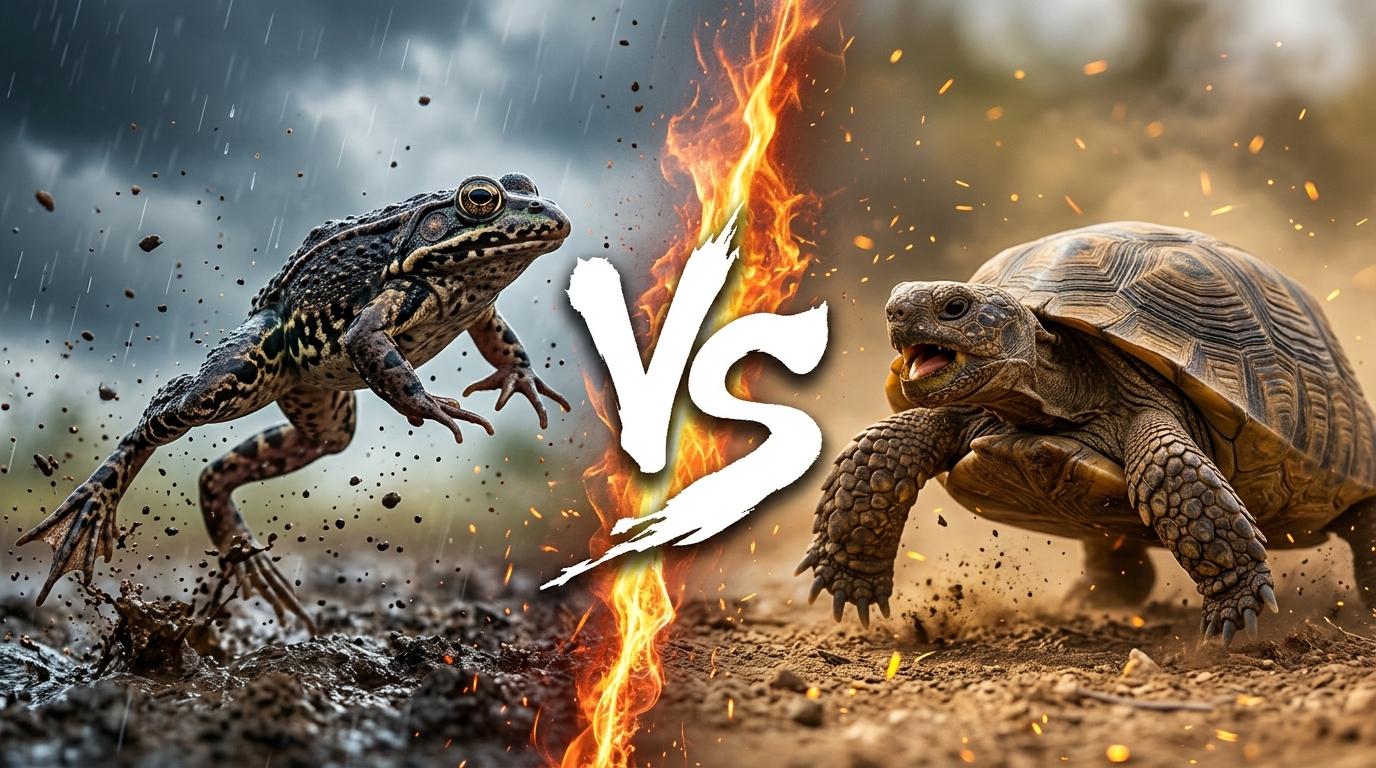
Dusky Gopher Frog vs Gopher Tortoise: Who Actually Wins?
The gopher tortoise wins clearly. An adult weighs roughly 4 to 9 kg and carries a domed bony shell, while an adult dusky gopher frog weighs well under 100 grams. The frog has no claws, no real bite, and its best defenses are bitter, irritating skin secretions and covering its eyes with its forelimbs, which deter predators but do nothing against a tortoise that simply isn't trying to eat it. The tortoise wins any direct contest through sheer mass, armor, and shovel-like forelimbs, and it has outlasted almost everything in the longleaf pine ecosystem. The twist is that these two are not enemies at all. The frog often depends on gopher tortoise burrows for shelter, so the 'fight' is really a tenant meeting its landlord.
Read comparison
Discussion
What do you think?
Share your reasoning with other readers. Be civil and stick to the animals.
Sign in to join the discussion.
Sign inNo comments yet. Start the conversation.