

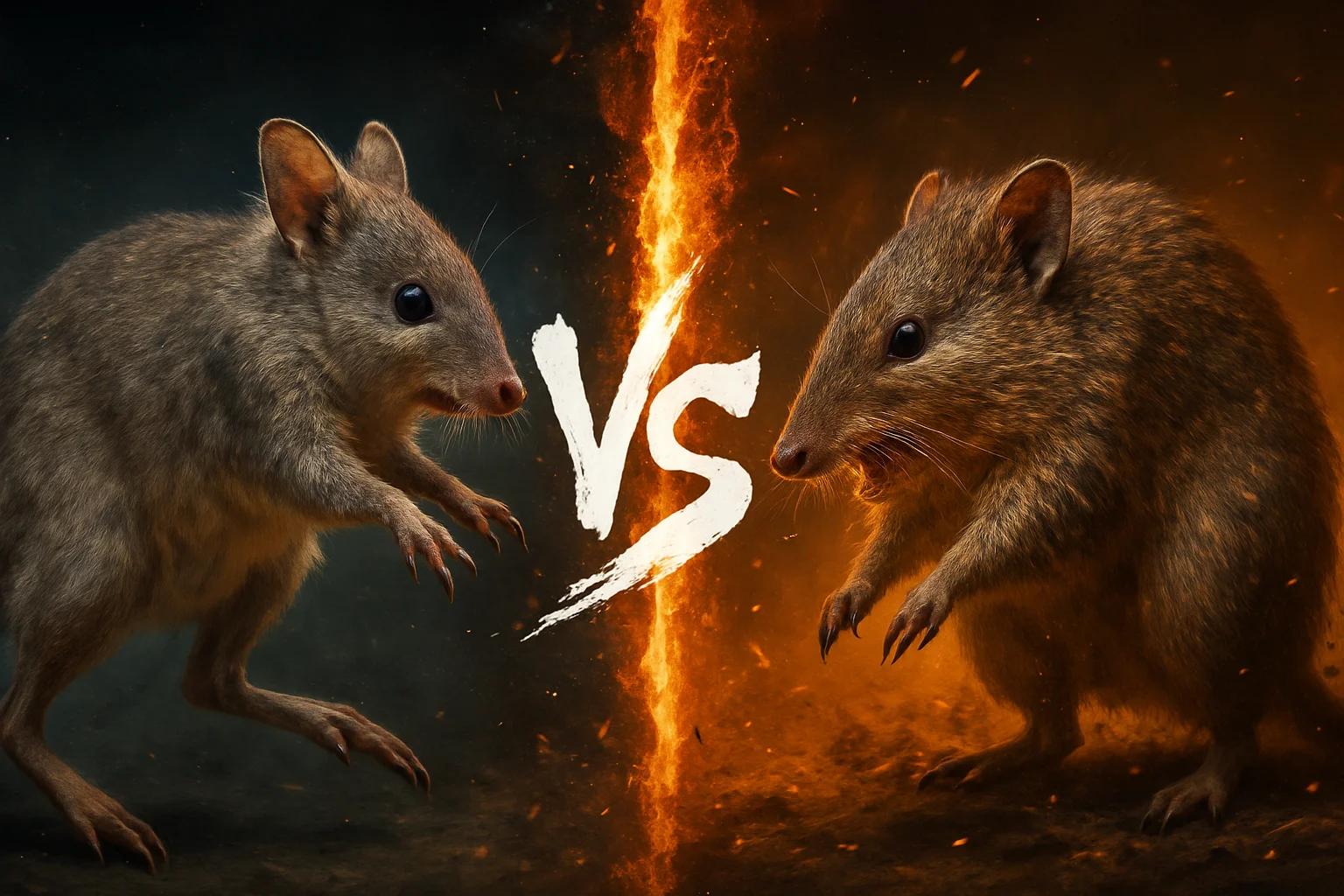
Eastern Bettong vs Quenda: Who Actually Wins?
Eastern Bettong vs Quenda: a biology-first look at which small Australian marsupial wins a standoff. We compare size, hind-leg power, claws, temperament and terrain.
Eastern Bettong vs Quenda
Matchup winner
Eastern Bettong
Quick verdict
Start with the direct answer, then use the structured comparison below to see what changes the outcome.
The Eastern Bettong wins a narrow decision. This Tasmanian rat-kangaroo usually weighs about 1.2–2.25 kg. Most Quenda sit around 0.5–1.5 kg, and only big males approach 2 kg. That weight edge sits on spring-loaded kangaroo-style hind legs, which give the bettong explosive bounding speed, kicking thrust and the ability to break contact at will. The Quenda is no pushover. It is a stocky, short-tempered bandicoot with strong digging claws, a quick snapping bite, and males that fight readily over space. In a tight scrap it can land the sharper hits. But real encounters between small marsupials are shoving, kicking and chasing contests, not fights to the death. Mass, leg drive and control over distance decide who holds the ground, and those factors favor the bettong more often than not.
Read the full explanation
Overall winner: Eastern Bettong, by a modest margin (about 58% confidence).
The bettong's edges are typical body mass, powerful hind-leg kicks and superior bounding escape speed.
The Quenda's edges are an aggressive temperament, digging claws and a fast bite in close quarters.
Most real clashes end with one animal displaced, not injured. The bettong usually does the displacing.
Reader vote
Who do you think wins?
Pick a side — no account needed. Results update live.
No votes yet — be the first to call it.
Editorial note
Why people disagree
Temperament vs mass: bandicoots are famously scrappy, and some readers rate attitude above the bettong's extra few hundred grams.
Body mass & frame
In small-animal shoving contests, a few hundred grams of extra mass often decides who gets pushed off.
Explosive power
Hind-leg thrust lets the bettong strike, rebound and reposition faster than its rival can close.
Close-range weaponry
If the encounter collapses into a tangle, the Quenda's front-end tools are more effective.
Read the full explanation +
Weapon type: claws and teeth look more dangerous than kicks, but a hopping marsupial's hind legs carry most of its muscle.
Range dependence: up close and tangled, the Quenda's front-end weapons matter. Given any space, the bettong dictates distance.
Comparison FAQ
Short, direct answers to the next questions readers usually ask after the headline verdict.
Would an Eastern Bettong beat a Quenda?+
Usually, yes. The bettong's typically heavier body and powerful hind legs let it win most shoving-and-kicking contests and control distance. The result is narrow, though.
Which is stronger, an Eastern Bettong or a Quenda?+
The Eastern Bettong is generally stronger in total output thanks to its greater mass and kangaroo-style leg muscles. The Quenda has proportionally strong forelimbs for digging.
Do bettongs and quendas actually fight in the wild?+
No. They live in different regions: the Eastern Bettong in Tasmania and the Quenda in southwestern Australia. This is a hypothetical comparison based on their biology.
Why is the Quenda still dangerous to a bettong?+
Quendas are aggressive, carry sharp digging claws and bite quickly. In tight cover where the bettong cannot bound away, a Quenda can drive it off.
Which animal is rarer?+
The Eastern Bettong. It has disappeared from mainland Australia and survives in the wild mainly in Tasmania, with reintroductions underway. The Quenda remains relatively widespread in southwest Western Australia, including some suburbs.
Head-to-head species stats
These are the same core AnimalDex stat dimensions used on the dedicated animal pages, pulled side by side so the matchup is faster to scan.
Eastern Bettong
Tier CQuenda
Tier CTrait-by-trait comparison
Only the categories that matter to this matchup are included. The goal is not filler stats, but the real design differences that change the result.
About 1.2–2.25 kg, compact rat-kangaroo build
Body mass & frame
Eastern Bettong
About 0.5–2 kg, most well under 1.5 kg
Body mass & frame
Eastern Bettong
Spring-loaded hind legs built for bounding and kicking
Explosive power
Eastern Bettong
Quick bursts on all fours, built more for digging than leaping
Explosive power
Eastern Bettong
Claws and incisors, used mostly for defense
Close-range weaponry
Quenda
Strong digging claws and a sharp, snappy bite
Close-range weaponry
Quenda
Generally avoids conflict and flees early
Aggression drive
Quenda
Pugnacious, especially territorial males
Aggression drive
Quenda
Elite bounding escape; chooses engagement range
Distance control
Eastern Bettong
Fast scurry, but less evasive in the open
Distance control
Eastern Bettong
Memory-driven truffle hunter; carries nesting grass with its prehensile tail
Foraging smarts
Eastern Bettong
Opportunistic omnivore digging for invertebrates, fungi and bulbs
Foraging smarts
Eastern Bettong
How the verdict forms
Verdict timeline
01 · Body mass & frame
Eastern Bettong
02 · Explosive power
Eastern Bettong
03 · Close-range weaponry
Quenda
04 · Aggression drive
Quenda
05 · Distance control
Eastern Bettong
06 · Foraging smarts
Eastern Bettong
Change the conditions
Scenario breakdown
This is where shallow battle content usually fails. Terrain, spacing, timing, and engagement style can change the answer.
Scenario lean
Quenda
Verdict confidence
82%
Quenda edges it in tight scrub.
Dense vegetation erases the bettong's bounding advantage and forces short-range contact. Here the Quenda's low profile, digging claws and readiness to snap and lunge give it the initiative. The bettong is more likely to retreat than to press through tangled cover.
AnimalDex field profiles
Explore these animals
Eastern Bettong
—
Habitat details are not published on a dedicated AnimalDex species page yet.
Species guide coming soon.
Quenda
Isoodon fusciventer
coastal scrub, woodland, and wet shrubland
Systems Intelligence & Hidden Purpose
See the animals behind this comparison as engineered biological systems: what each one is built to do, where it gains leverage, and why the matchup changes by scenario.
Specialized Hardware
short rounded ears, powerful digging foreclaws, and leaf-litter rooting behavior give the Quenda a body plan tuned for its niche.
Systems Script
Quendas operate through coastal scrub, woodland, and wet shrubland. Their design links movement, feeding, shelter, and timing into one workable survival system.
Strategic Insight
Dense environments reward precision, patience, and the ability to read layered cover.
Final take
The Eastern Bettong is the better bet. It does not out-aggress the Quenda; it outweighs it, out-thrusts it and controls range better. Those are the factors that settle real small-marsupial disputes.
Read the full explanation
The Quenda keeps this close because it fights above its weight. In cramped cover, or when a male is defending his patch, its claws and bite make it a legitimate threat, and it will win some exchanges.
Across open ground, contested food and surprise meetings, the advantage goes to the bettong's spring-loaded build.
Collect both animals in AnimalDex
Track the species behind this matchup, compare their real traits, and build the rivalry into your AnimalDex collection.
Discussion
What do you think?
Share your reasoning with other readers. Be civil and stick to the animals.
Sign in to join the discussion.
Sign inNo comments yet. Start the conversation.