


Electric Catfish vs Goliath Tigerfish: Who Actually Wins?
Electric Catfish vs Goliath Tigerfish: a 350-volt living stun gun faces Africa's most feared toothed river predator. Here is who wins, where, and why.
Electric Catfish vs Goliath Tigerfish
Matchup winner
Goliath Tigerfish
Quick verdict
Start with the direct answer, then use the structured comparison below to see what changes the outcome.
The Goliath Tigerfish wins this matchup, though the margin is narrow. It is longer, heavier at the top end (record fish exceed 1.5 m and 50 kg, while large electric catfish rarely pass about 1 m), much faster, and armed with 32 interlocking dagger teeth built for slash-and-release strikes in powerful current. The Electric Catfish carries one of the most dramatic defenses in freshwater, an electric organ that can deliver discharges of roughly 300–450 volts that stun nearby fish. That weapon works best at contact range, while the tigerfish's whole hunting style is built on fast entry, a deep cut, and immediate disengagement. If the tigerfish controls distance and timing, it controls the fight. If it lets the catfish dictate a slow, close tangle in cover, the result can flip.
Read the full explanation
Overall winner: Goliath Tigerfish, at about 62% confidence.
The tigerfish wins on speed, size ceiling, initiative, and its slash-and-retreat bite.
The Electric Catfish's shock can stun or repel an attacker that stays in contact.
Inside dark, tight cover, the catfish becomes the favorite.
Reader vote
Who do you think wins?
Pick a side — no account needed. Results update live.
No votes yet — be the first to call it.
Editorial note
Why people disagree
Shock versus teeth: some readers assume electricity beats everything. Others point out that a weapon which needs contact loses value against a predator that hits and leaves.
Explosive power
The fish that starts the exchange picks where and when contact happens.
Signature weapon
The shock is a rarer and stranger weapon, and it can shut down an attacker without any biting at all.
Reach and tempo control
A weapon that only fires at contact rewards an opponent who keeps that contact brief.
Read the full explanation +
Size confusion: average fish of both species are far smaller than record fish, so the size gap depends heavily on which specimens you imagine.
Habitat mismatch: the two species mostly live in different parts of Africa and different microhabitats, so every matchup is partly hypothetical, and the chosen arena decides a lot.
Comparison FAQ
Short, direct answers to the next questions readers usually ask after the headline verdict.
Would an Electric Catfish beat a Goliath Tigerfish?+
Usually not. The Goliath Tigerfish wins most scenarios. The Electric Catfish's best chance comes in tight cover, where the tigerfish is forced into sustained contact.
Which is stronger, the Electric Catfish or the Goliath Tigerfish?+
The Goliath Tigerfish is physically stronger and can grow much larger. The Electric Catfish's power is electrical rather than muscular.
Can an Electric Catfish's shock stun a tigerfish?+
Yes. A discharge of several hundred volts can stun fish nearby, and a tigerfish that stays latched on is especially exposed.
Why is the Electric Catfish still dangerous even when it loses?+
Its shock punishes any prolonged contact. Even a winning tigerfish risks being stunned, and a stunned fish in a river is vulnerable to current, injury, and other predators.
Do Electric Catfish and Goliath Tigerfish meet in the wild?+
Rarely, if ever. The Goliath Tigerfish is a Congo Basin species, while Malapterurus electricus is found mainly in the Nile and West African waters, so this is largely a hypothetical matchup.
Head-to-head species stats
These are the same core AnimalDex stat dimensions used on the dedicated animal pages, pulled side by side so the matchup is faster to scan.
Electric Catfish
Tier BGoliath Tigerfish
Tier CTrait-by-trait comparison
Only the categories that matter to this matchup are included. The goal is not filler stats, but the real design differences that change the result.
Short lunge, slow burst
Explosive power
Goliath Tigerfish
Torpedo strike built for strong current
Explosive power
Goliath Tigerfish
Electric organ, roughly 300–450 V stunning discharge
Signature weapon
Electric Catfish
32 exposed dagger teeth for slashing bites
Signature weapon
Electric Catfish
Contact-range only
Reach and tempo control
Goliath Tigerfish
Hit-and-disengage at will
Reach and tempo control
Goliath Tigerfish
Thick, slimy, scaleless body that can absorb some damage
Close-range durability
Electric Catfish
Muscular but streamlined build
Close-range durability
Electric Catfish
About 1 m, rarely larger
Size ceiling
Goliath Tigerfish
1.5 m and 50+ kg records
Size ceiling
Goliath Tigerfish
Nocturnal sit-and-wait in burrows and debris
Ambush control
Electric Catfish
Active pursuit predator in rapids
Ambush control
Electric Catfish
How the verdict forms
Verdict timeline
01 · Explosive power
Goliath Tigerfish
02 · Signature weapon
Electric Catfish
03 · Reach and tempo control
Goliath Tigerfish
04 · Close-range durability
Electric Catfish
05 · Size ceiling
Goliath Tigerfish
06 · Ambush control
Electric Catfish
Change the conditions
Scenario breakdown
This is where shallow battle content usually fails. Terrain, spacing, timing, and engagement style can change the answer.
Scenario lean
Electric Catfish
Verdict confidence
82%
The Electric Catfish's home ground.
In tight, dark cover the tigerfish loses its speed advantage and has to commit to close, slow contact. That is exactly when the catfish's discharge does the most work. A tigerfish that bites and gets tangled in debris risks being stunned repeatedly.
AnimalDex field profiles
Explore these animals
Electric Catfish
Malapterurus electricus
river, floodplain, and murky freshwater channel
Goliath Tigerfish
Hydrocynus goliath
large river channel, rocky rapid, and deep freshwater pool
Systems Intelligence & Hidden Purpose
See the animals behind this comparison as engineered biological systems: what each one is built to do, where it gains leverage, and why the matchup changes by scenario.
Specialized Hardware
electric discharge organs, smooth scaleless body, and night river ambush give the Electric Catfish a body plan tuned for its niche.
Systems Script
Electric Catfishs operate through river, floodplain, and murky freshwater channel. Their design links movement, feeding, shelter, and timing into one workable survival system.
Strategic Insight
Where water controls movement, position and timing often matter more than speed.
Specialized Hardware
oversized dagger teeth, muscular river body, and violent current-water strikes give the Goliath Tigerfish a body plan tuned for its niche.
Systems Script
Goliath Tigerfishs operate through large river channel, rocky rapid, and deep freshwater pool. Their design links movement, feeding, shelter, and timing into one workable survival system.
Strategic Insight
Where water controls movement, position and timing often matter more than speed.
Final take
The Goliath Tigerfish takes the overall win because it controls the one thing the Electric Catfish needs most: how long contact lasts. Speed, a larger size ceiling, and a bite designed for brief, devastating contact let it fight on its own terms.
Read the full explanation
The catfish is not an easy target. In murky cover at night, it is the fish you least want to grab, and a careless tigerfish could end up stunned and vulnerable. Context matters, but across the realistic range of arenas, the tigerfish is ahead.
Collect both animals in AnimalDex
Track the species behind this matchup, compare their real traits, and build the rivalry into your AnimalDex collection.
Related comparisons
Continue with nearby matchups to compare more real-world animal traits without dropping into junky who-wins filler.
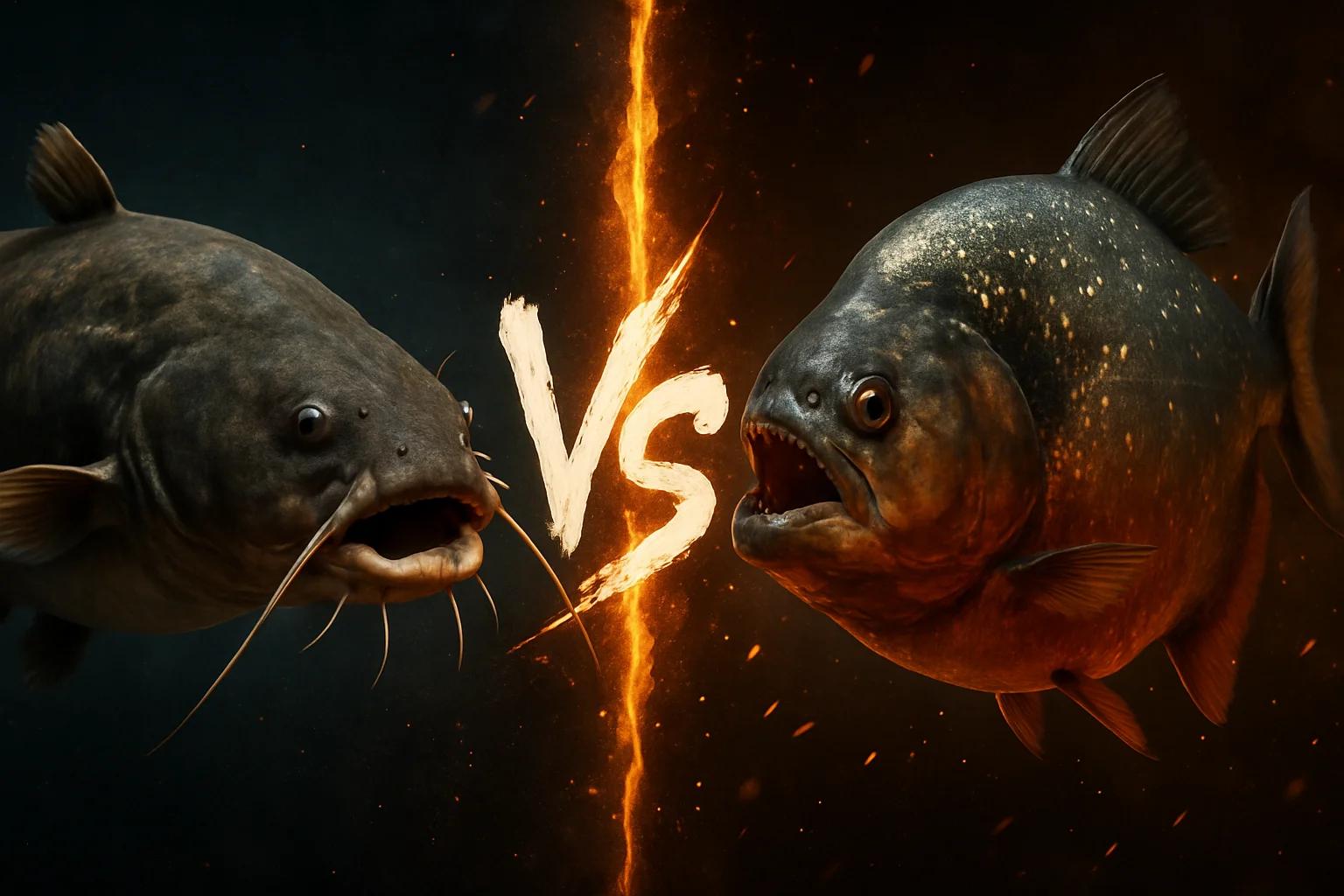
Electric Catfish vs Red-bellied Piranha: Who Actually Wins?
The Electric Catfish wins one-on-one, and it isn't especially close. Malapterurus electricus is a heavy, slime-coated, nocturnal ambusher that can grow to around 1 m and roughly 20 kg. Specialized electric organs wrapped around its body discharge pulses of about 300–450 volts. A red-bellied piranha weighs well under a kilogram and typically measures 25–33 cm. To bite, it has to close to contact range, and contact range is exactly where a full-strength discharge stuns small fish. The piranha's interlocking, triangular teeth are excellent at shearing flesh, but they work best on targets that are already weakened, distracted or outnumbered. The catfish's defense switches on the moment it is touched. Add a size gap of roughly 20 to 1 and thick, scaleless skin under a mucus layer, and the solo matchup goes to the catfish. The piranha's best realistic outcome is a nip and a retreat.
Read comparison
Discussion
What do you think?
Share your reasoning with other readers. Be civil and stick to the animals.
Sign in to join the discussion.
Sign inNo comments yet. Start the conversation.