

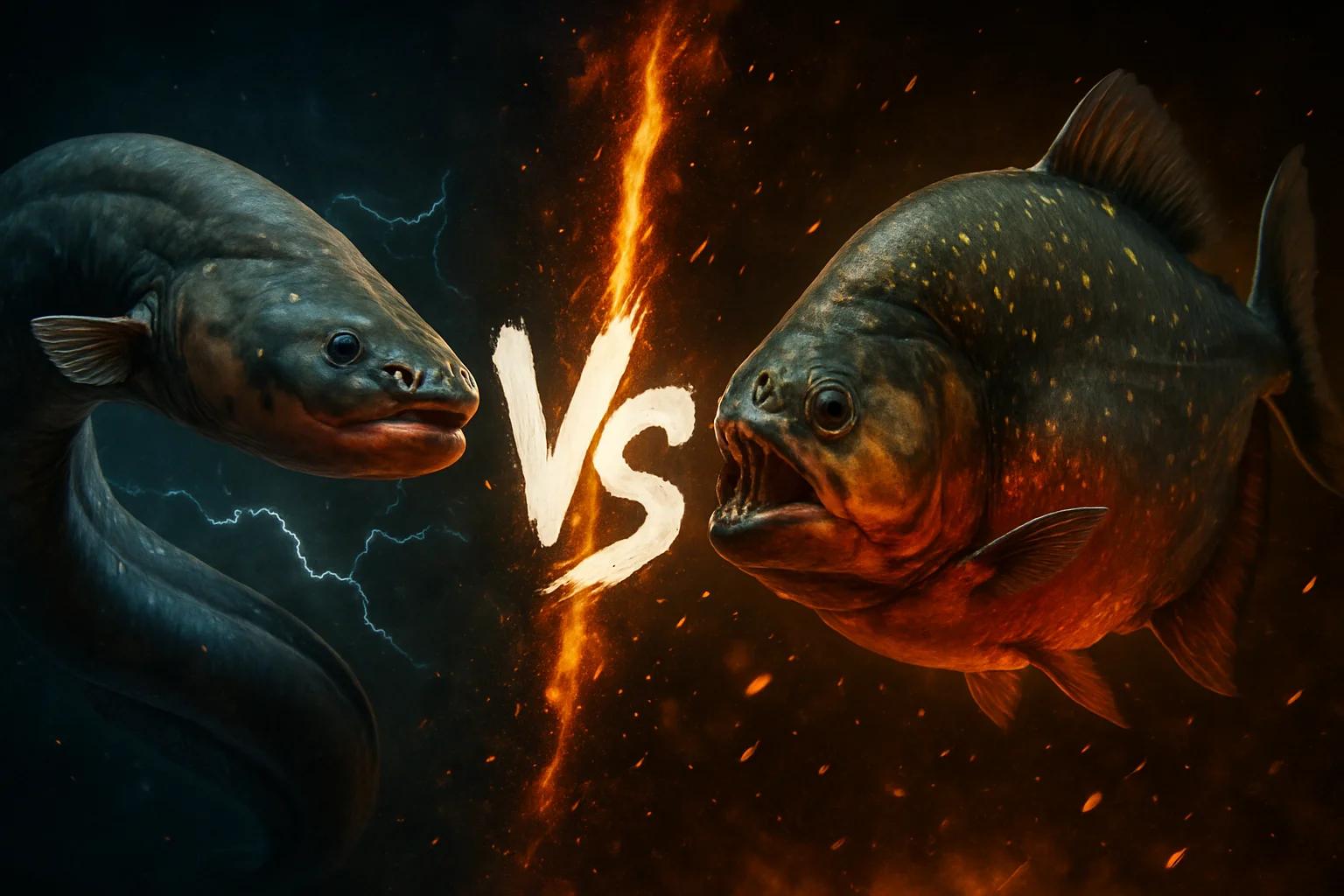
Electric Eel vs Red-bellied Piranha: Who Actually Wins?
Electric eel vs red-bellied piranha: who would win? A biology-first breakdown of voltage, bite force, size, schooling and Amazon river tactics.
Electric Eel vs Red-bellied Piranha
Matchup winner
Electric Eel
Quick verdict
Start with the direct answer, then use the structured comparison below to see what changes the outcome.
The electric eel wins, and it is not especially close in a one-on-one. Adult Electrophorus electricus commonly reach 1.5–2 m and can discharge bursts of up to roughly 600–860 volts depending on species and size. A single red-bellied piranha is about 25–33 cm long. It carries a famously powerful bite for its size, but it has to make physical contact to use it. The eel never needs to touch anything. Its high-voltage pulses travel through the water and can cause involuntary muscle spasms and temporary paralysis in nearby fish, and the eel uses low-voltage electrolocation to track prey in murky water. A piranha that closes in gets shocked before it can bite. The piranha's real threat is its numbers. A large shoal raises the risk to a weakened or exposed eel, and some of the oldest, most dramatic accounts of piranhas swarming bigger animals involve exactly that scenario. Even so, the eel's discharges hit everything within range, which blunts a group attack too.
Read the full explanation
Electric eel wins one-on-one: it can stun a piranha before the piranha reaches biting range.
Size gap is huge: about 2 m of eel against about 30 cm of piranha.
Piranhas are dangerous mainly in groups, and mostly to animals that are already injured or trapped.
Shoals rarely attack healthy large animals, and a shocking eel is a terrible target.
Reader vote
Who do you think wins?
Pick a side — no account needed. Results update live.
No votes yet — be the first to call it.
Editorial note
Why people disagree
Piranha mythology inflates their danger. Real red-bellied piranhas are often skittish and school mostly for protection, not for hunting.
Explosive power
The shock works without contact, while the bite requires the piranha to get close.
Size and mass
The eel is many times larger, so each bite does far less proportional damage to it.
Ambush control in murky water
In silty Amazon water the eel detects threats first.
Read the full explanation +
People imagine 'the swarm' rather than a single piranha, and a swarm does change the math.
Eel voltage is finite per burst series. Some argue a sustained group assault could outlast the eel's discharges, though there is little field evidence for this.
Comparison FAQ
Short, direct answers to the next questions readers usually ask after the headline verdict.
Would an electric eel beat a piranha?+
Yes. In a one-on-one fight, the eel's high-voltage shock incapacitates a piranha almost immediately.
Which is stronger, an electric eel or a piranha?+
The electric eel. It is far larger and can deliver discharges of hundreds of volts. The piranha's bite is strong for its body size but limited in reach.
Can a school of piranhas kill an electric eel?+
It is possible against a weakened or trapped eel, especially in a crowded dry-season pool. A healthy eel usually repels them.
Why is the piranha still dangerous if it loses?+
It has razor-sharp interlocking teeth and lives in schools that can feed rapidly on injured animals. That makes it a real hazard to vulnerable prey.
Do electric eels eat piranhas?+
Electric eels eat fish, so small piranhas could be taken, but there is little documentation of piranhas being a regular part of their diet.
Head-to-head species stats
These are the same core AnimalDex stat dimensions used on the dedicated animal pages, pulled side by side so the matchup is faster to scan.
Electric Eel
Tier CRed-bellied Piranha
Tier CTrait-by-trait comparison
Only the categories that matter to this matchup are included. The goal is not filler stats, but the real design differences that change the result.
Up to ~600–860 V discharge bursts
Explosive power
Electric Eel
Sharp, high-force bite for its size
Explosive power
Electric Eel
1.5–2+ m, up to ~20 kg
Size and mass
Electric Eel
~25–33 cm, under 4 kg
Size and mass
Electric Eel
Electrolocation senses prey in darkness
Ambush control in murky water
Electric Eel
Sight, smell and lateral line
Ambush control in murky water
Electric Eel
Slow, deliberate swimmer
Burst speed and maneuverability
Red-bellied Piranha
Quick, agile darts
Burst speed and maneuverability
Red-bellied Piranha
Mostly solitary; occasional group hunting reported in one species
Group leverage
Red-bellied Piranha
Schools of 20 to over 100
Group leverage
Red-bellied Piranha
Thick body, but relies on air-breathing surfacing
Close-range durability
Electric Eel
Small body, easily stunned
Close-range durability
Electric Eel
How the verdict forms
Verdict timeline
01 · Explosive power
Electric Eel
02 · Size and mass
Electric Eel
03 · Ambush control in murky water
Electric Eel
04 · Burst speed and maneuverability
Red-bellied Piranha
05 · Group leverage
Red-bellied Piranha
06 · Close-range durability
Electric Eel
Change the conditions
Scenario breakdown
This is where shallow battle content usually fails. Terrain, spacing, timing, and engagement style can change the answer.
Scenario lean
Electric Eel
Verdict confidence
82%
Eel detects first and stuns.
In tangled, low-visibility shallows, electrolocation gives the eel early warning. The eel then needs only one discharge to stop the piranha cold.
AnimalDex field profiles
Explore these animals
Electric Eel
Electrophorus electricus
slow river, floodplain, and muddy tropical freshwater
Red-bellied Piranha
Pygocentrus nattereri
river channel, floodplain lagoon, and backwater
Systems Intelligence & Hidden Purpose
See the animals behind this comparison as engineered biological systems: what each one is built to do, where it gains leverage, and why the matchup changes by scenario.
Specialized Hardware
electrical discharge system, air-breathing freshwater life, and murky-water hunting give the Electric Eel a body plan tuned for its niche.
Systems Script
Electric Eels operate through slow river, floodplain, and muddy tropical freshwater Their design links movement, shelter, and feeding into one workable survival system.
Strategic Insight
The best tool sometimes solves detection and action at once.
Specialized Hardware
silver body with red belly, triangular serrated teeth, and shoaling river feeding give the Red-bellied Piranha a body plan tuned for its niche.
Systems Script
Red-bellied Piranhas operate through river channel, floodplain lagoon, and backwater. Their design links movement, feeding, shelter, and timing into one workable survival system.
Strategic Insight
Where water controls movement, position and timing often matter more than speed.
Final take
The electric eel is the clear winner. It turns its whole body into a weapon that works at a distance, and the piranha's best tool only works at contact range.
Read the full explanation
The piranha stays relevant because of ecology, not individual strength. Shoals, hunger and extreme conditions like shrinking dry-season pools are its only real path to beating an eel.
Overall pick: Electric Eel, with high confidence.
Collect both animals in AnimalDex
Track the species behind this matchup, compare their real traits, and build the rivalry into your AnimalDex collection.
Discussion
What do you think?
Share your reasoning with other readers. Be civil and stick to the animals.
Sign in to join the discussion.
Sign inNo comments yet. Start the conversation.