


Elephant Beetle vs Green Orchid Bee: Who Actually Wins?
Elephant beetle vs green orchid bee: a biology-first breakdown of armor, horns, flight, and stingers. See who wins and why the bee still matters.
Elephant Beetle vs Orchid Bee
Matchup winner
Elephant Beetle
Quick verdict
Start with the direct answer, then use the structured comparison below to see what changes the outcome.
The elephant beetle wins clearly. Megasoma elephas is a heavily armored rhinoceros beetle that can grow past 10 cm and weigh many times more than Euglossa dilemma, a metallic green orchid bee about 1.3 cm long. The beetle's thick chitin exoskeleton and grasping legs make it close to immune to anything the bee can do. The bee's sting is short and built for defense, and its venom is mild. The bee's real edge is speed: it is a fast, agile flier that can disengage whenever it wants. That means the bee can avoid a loss, but it has no way to win. In any frame where the two actually make contact, the beetle's mass and armor decide it.
Read the full explanation
Elephant beetle wins: it is vastly heavier, fully armored, and the bee's sting barely threatens it.
The orchid bee is faster and more agile in the air, so it can escape but can't force a win.
Size difference is extreme. The beetle can be roughly 8x longer and far heavier.
The real 'contest' is the bee choosing not to fight.
Reader vote
Who do you think wins?
Pick a side — no account needed. Results update live.
No votes yet — be the first to call it.
Editorial note
Why people disagree
Stingers sound scary, but a small bee sting rarely gets through thick beetle armor.
Raw mass and size
At insect scale, mass difference this large makes the result nearly one-sided.
Close-range durability
The bee needs a soft joint to sting. The beetle offers almost none.
Offensive hardware
The beetle's horns are built for shoving rivals. The bee's sting is built to deter mammals, not to pierce armor.
Read the full explanation +
People treat flight speed as power. Escaping a fight is not the same as winning it.
Beetles look slow and clumsy, yet their armor and leverage are a complete defensive system.
Comparison FAQ
Short, direct answers to the next questions readers usually ask after the headline verdict.
Would an elephant beetle beat a green orchid bee?+
Yes. In any physical contest the elephant beetle's size, armor, and grip overwhelm the much smaller bee.
Which is stronger?+
The elephant beetle by far. Rhinoceros beetles are among the strongest insects for their size, and this one is also vastly larger.
Can the orchid bee's sting hurt the beetle?+
Rarely. The sting is short and the beetle's armor is thick, so the bee would need to hit an exposed joint.
Why is the orchid bee still dangerous?+
Its speed, vision, and sting make it hard to catch and painful for soft-bodied attackers. It also matters ecologically as a key orchid pollinator.
Do they meet in the wild?+
Their ranges in the American tropics overlap in places, but they rarely interact. Beetles feed on sap and fruit, while bees visit flowers.
Head-to-head species stats
These are the same core AnimalDex stat dimensions used on the dedicated animal pages, pulled side by side so the matchup is faster to scan.
Elephant Beetle
Tier BOrchid Bee
Tier DTrait-by-trait comparison
Only the categories that matter to this matchup are included. The goal is not filler stats, but the real design differences that change the result.
Up to ~12 cm, heavy-bodied giant
Raw mass and size
Elephant Beetle
~1.3 cm, lightweight
Raw mass and size
Elephant Beetle
Thick chitin plating and hardened elytra
Close-range durability
Elephant Beetle
Thin exoskeleton, exposed wing joints
Close-range durability
Elephant Beetle
Horns and spiny legs for prying and pinning
Offensive hardware
Elephant Beetle
Short sting with mild venom
Offensive hardware
Elephant Beetle
Clumsy, heavy flier
Aerial agility
Orchid Bee
Rapid, precise hovering flight
Aerial agility
Orchid Bee
Basic chemical and tactile cues
Sensory navigation
Orchid Bee
Excellent vision and scent mapping
Sensory navigation
Orchid Bee
Powerful tarsal claws and lifting horns
Grip and leverage
Elephant Beetle
Light grip for flowers
Grip and leverage
Elephant Beetle
How the verdict forms
Verdict timeline
01 · Raw mass and size
Elephant Beetle
02 · Close-range durability
Elephant Beetle
03 · Offensive hardware
Elephant Beetle
04 · Aerial agility
Orchid Bee
05 · Sensory navigation
Orchid Bee
06 · Grip and leverage
Elephant Beetle
Change the conditions
Scenario breakdown
This is where shallow battle content usually fails. Terrain, spacing, timing, and engagement style can change the answer.
Scenario lean
Elephant Beetle
Verdict confidence
82%
Beetle dominates in close quarters.
In tight cover the bee loses its flight advantage. The beetle can pin it with its claws or crush it with its horns, and the bee's sting skids off plated armor.
AnimalDex field profiles
Explore these animals
Elephant Beetle
Megasoma elephas
rainforest, cloud forest, and tropical woodland
Orchid Bee
Euglossa dilemma
tropical forest, garden edge, and flowering woodland
Systems Intelligence & Hidden Purpose
See the animals behind this comparison as engineered biological systems: what each one is built to do, where it gains leverage, and why the matchup changes by scenario.
Specialized Hardware
velvety giant horned body, powerful lifting strength, and rainforest night activity give the Elephant Beetle a body plan tuned for its niche.
Systems Script
Elephant Beetles operate through rainforest, cloud forest, and tropical woodland. Their design links movement, feeding, shelter, and timing into one workable survival system.
Strategic Insight
Dense environments reward precision, patience, and the ability to read layered cover.
Specialized Hardware
metallic jewel-green body, long nectar tongue, and fragrance-collecting male behavior give the Orchid Bee a body plan tuned for its niche.
Systems Script
Orchid Bees operate through tropical forest, garden edge, and flowering woodland. Their design links movement, feeding, shelter, and timing into one workable survival system.
Strategic Insight
Dense environments reward precision, patience, and the ability to read layered cover.
Final take
The elephant beetle is the overall winner. Its strategy is built around armor and pushing power, which makes it nearly untouchable at insect scale. The orchid bee's sting and agility are excellent tools against predators that can be deterred, but they can't overcome a target this big and this well plated.
Read the full explanation
The bee's real talent is avoiding the fight altogether. Its speed means the 'win' column only ever fills on one side. The beetle wins any fight that actually happens, and the bee's victory is simply not being there.
Collect both animals in AnimalDex
Track the species behind this matchup, compare their real traits, and build the rivalry into your AnimalDex collection.
Related comparisons
Continue with nearby matchups to compare more real-world animal traits without dropping into junky who-wins filler.
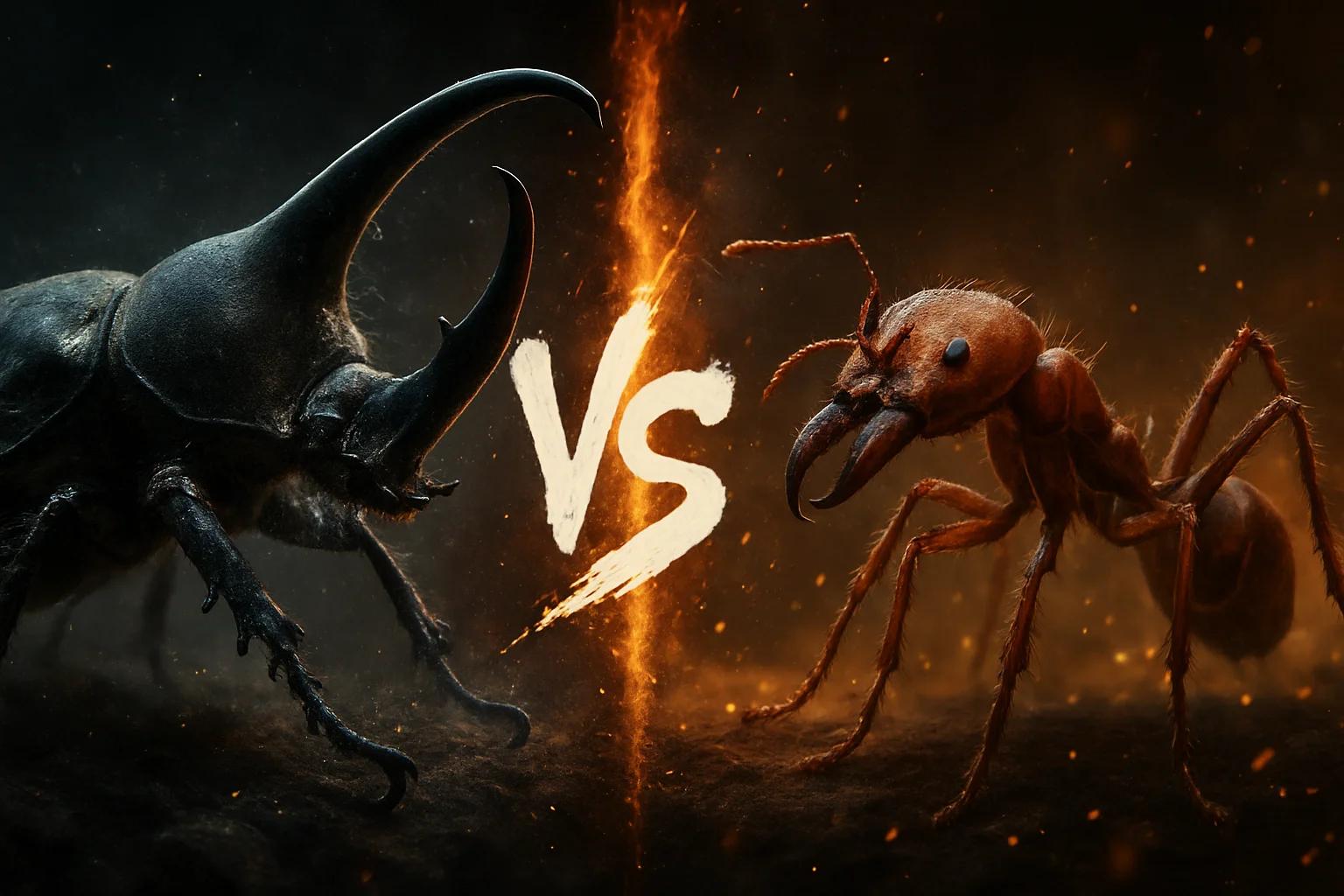
Elephant Beetle vs Leafcutter Ant: Who Actually Wins?
In a one-on-one fight, the Elephant Beetle (Megasoma elephas) wins clearly. A large male can reach roughly 7–12 cm and carries a hardened exoskeleton and forked horns. Even a big leafcutter soldier at around 1.5–2 cm cannot bite through that armor in any meaningful way. Leafcutter mandibles are built to slice soft leaves and deter vertebrate intruders, not to breach thick, domed elytra. The beetle can shove, pin, or ignore a single ant almost at will. The real argument starts when people swap 'an ant' for 'the colony.' Atta cephalotes nests can hold millions of workers, and mass swarming is the ant's genuine superpower. Even then, an adult beetle is slow, armored, and has little the colony needs to defend against or harvest. So the most likely outcome is that the beetle walks away. The ants are only dangerous to a beetle that is pinned, injured, or soft-bodied. Overall winner: Elephant Beetle.
Read comparison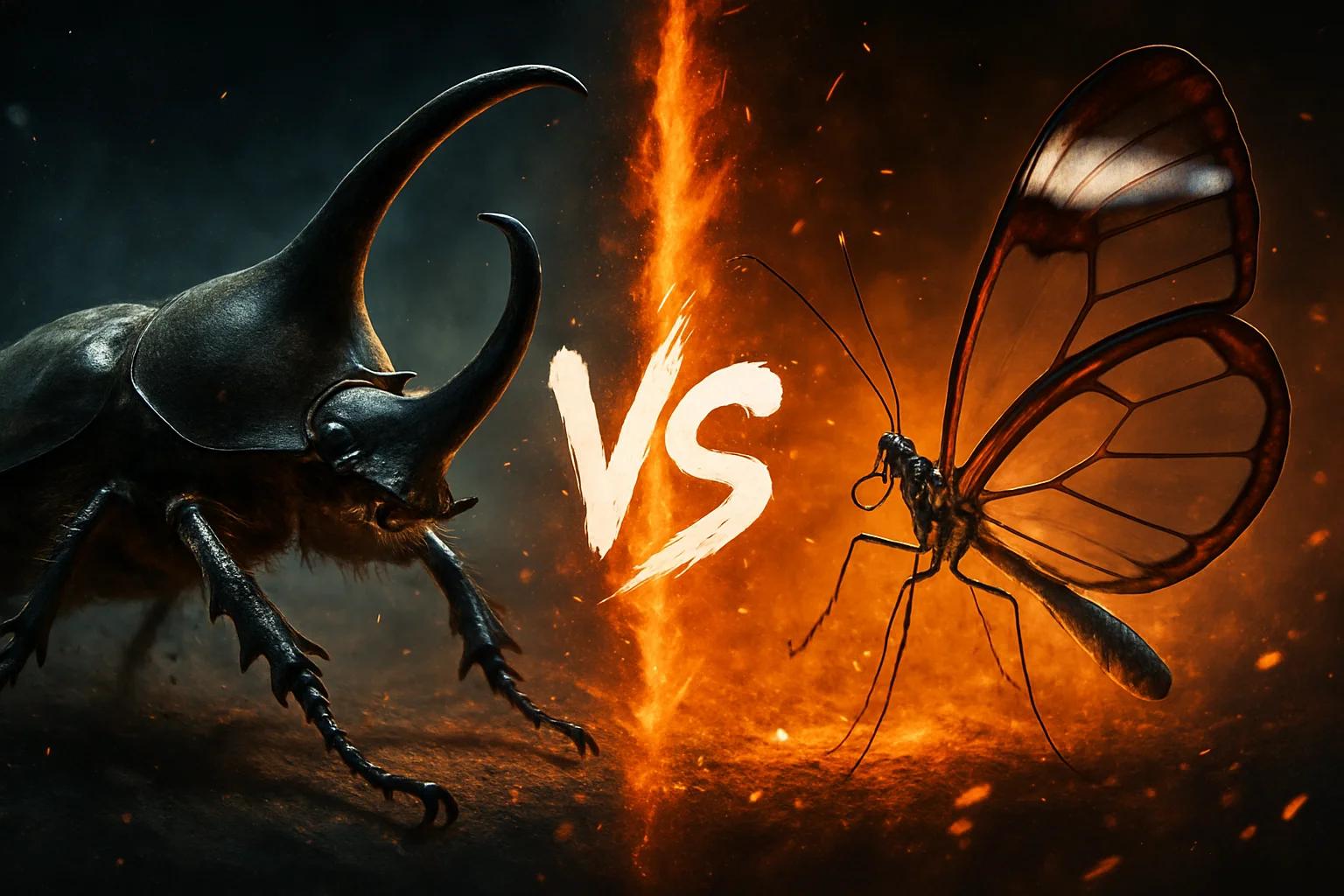
Elephant Beetle vs Glasswing Butterfly: Who Actually Wins?
The elephant beetle wins clearly. Megasoma elephas is one of the heaviest beetles in the Americas. It can reach about 12 cm and is built like a tank: a thick chitin exoskeleton, a long cephalic horn, and legs with hooked tarsi made for prying and gripping. The glasswing butterfly (Greta oto) has a wingspan of about 5–6 cm and weighs a fraction of a gram. Its whole design is about not being found and not being worth eating. It has no weapons, no armor, and no way to push back. In any forced physical contest, the beetle's mass, grip, and horn decide it almost instantly. Neither animal is a predator of the other, so 'winning' here means controlling contact and space. The butterfly's real victory condition is to never make contact at all.
Read comparison
Elephant Beetle vs Hercules Beetle: Who Actually Wins?
The Hercules beetle wins most matchups. Both are giant dynastine scarabs built for the same job, which is prying rivals off branches with their horns. The Hercules beetle's major males can pass 17 cm thanks to their huge thoracic and head horns. Those horns close like a pincer, so the beetle can clamp, lift, and throw an opponent rather than just shove it. The elephant beetle is bulkier and heavily armored, with a thick, fuzzy-coated body and a stout forward horn. That makes it hard to dislodge and dangerous at close quarters, but its weapon is built for levering more than gripping. When the contest is about getting the other beetle airborne and off the perch, the Hercules beetle's reach and pincer control usually decide it.
Read comparison
Discussion
What do you think?
Share your reasoning with other readers. Be civil and stick to the animals.
Sign in to join the discussion.
Sign inNo comments yet. Start the conversation.