

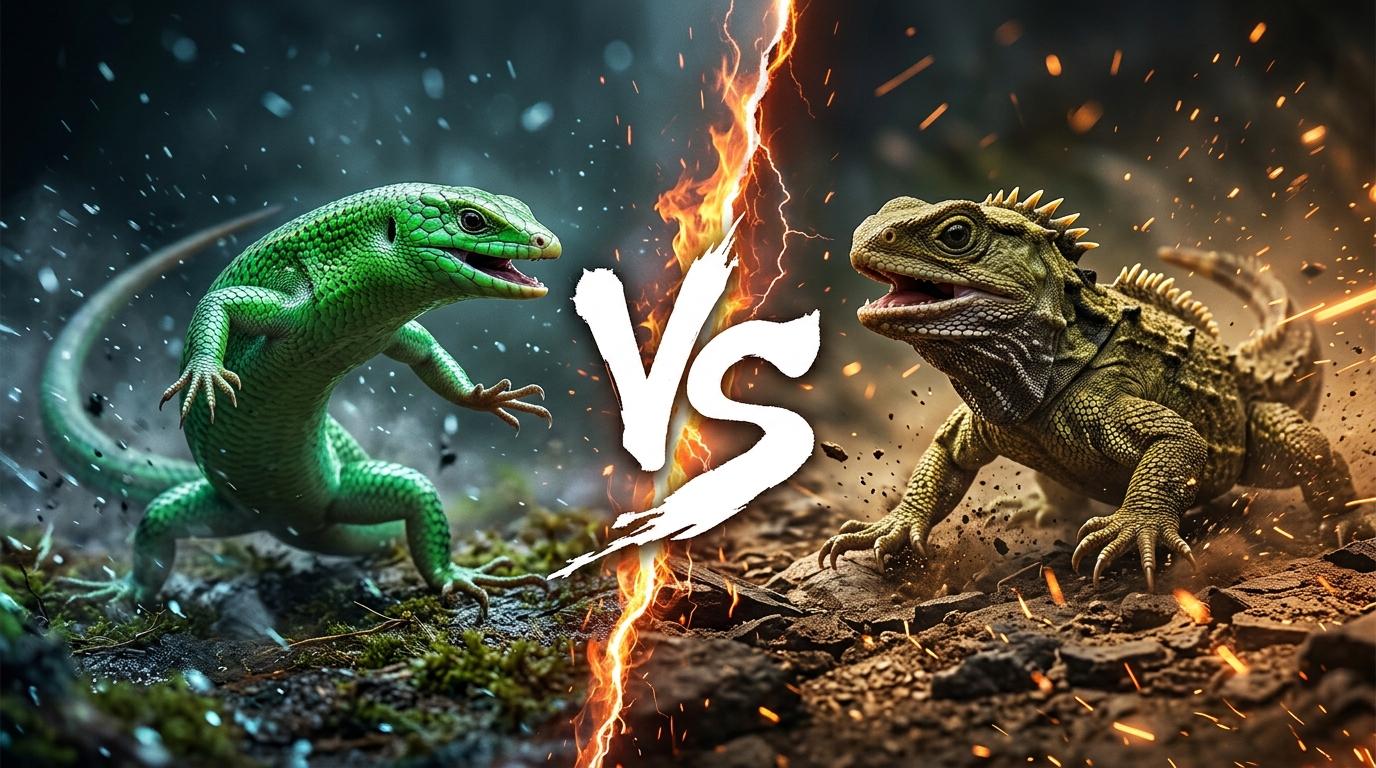
Emerald Tree Skink vs Tuatara: Who Actually Wins?
Emerald tree skink vs tuatara: who would win? A biology-first breakdown of size, bite, speed, and habitat shows why the tuatara wins a real confrontation, and why the skink is so hard to catch.
Emerald Tree Skink vs Tuatara
Matchup winner
Tuatara
Quick verdict
Start with the direct answer, then use the structured comparison below to see what changes the outcome.
The tuatara wins clearly. New Zealand's living relic is roughly two to three times longer than the emerald tree skink and many times heavier. Adults reach about 50–80 cm and up to around 1 kg, against a slender skink of roughly 20–25 cm. The tuatara also has a shearing bite built on fused, wedge-like teeth, and it already eats small lizards, seabird chicks, and large invertebrates. A bright green skink sits comfortably inside its prey range. The emerald tree skink's real edge is evasion. It is quicker, highly arboreal, and alert by day, so if it sees the tuatara coming and has a branch to climb, it simply leaves. Once the two are in contact on the ground, though, size, jaw power, and the tuatara's patient sit-and-wait strike decide it fast.
Read the full explanation
Tuatara wins: much bigger, heavier, and armed with a shearing bite that already handles small lizards.
The emerald tree skink is faster and climbs far better, so escape is its best outcome, not victory.
On the ground or near a burrow, the tuatara's ambush-and-clamp style is decisive.
The two never meet in the wild. Tuatara live in New Zealand, and the skink lives in Southeast Asia and the western Pacific.
Reader vote
Who do you think wins?
Pick a side — no account needed. Results update live.
No votes yet — be the first to call it.
Editorial note
Why people disagree
Both are 'lizard-shaped', so people assume a near-even match. The tuatara is not even a lizard. It is the last of an ancient reptile order with a far heavier build.
Body mass & frame
In reptile confrontations, mass largely sets who can restrain whom. The tuatara can pin and swallow prey the skink's size.
Bite & jaw hardware
The tuatara's jaw saws as well as grips. It is built for crunching beetles, chicks, and small reptiles.
Burst speed & reflexes
The skink's speed is its whole survival plan. It decides whether contact ever happens.
Read the full explanation +
The skink's speed looks like a fighting advantage, but in small reptiles speed mostly buys escape rather than wins.
The tuatara's slow, cold-adapted metabolism makes it seem sluggish, yet its strikes from stillness are quick and its bite is serious.
Comparison FAQ
Short, direct answers to the next questions readers usually ask after the headline verdict.
Would an emerald tree skink beat a tuatara?+
No. In a direct confrontation the tuatara wins. It is far bigger and has a shearing bite capable of killing and eating small lizards.
Which is stronger, the tuatara or the emerald tree skink?+
The tuatara, by a wide margin. It can weigh many times more than the skink, and it has a robust skull and powerful jaws.
Why is the emerald tree skink still dangerous to catch?+
It is quick, alert in daylight, and an excellent climber, and it can drop its tail to escape a grip. A predator has to surprise it on the ground to succeed.
Is a tuatara a lizard?+
No. The tuatara is the only living member of Rhynchocephalia, a reptile order that split from lizards and snakes over 200 million years ago.
Do these two animals ever meet in the wild?+
No. Tuatara live only in New Zealand. Emerald tree skinks live in Southeast Asia and the western Pacific islands.
Head-to-head species stats
These are the same core AnimalDex stat dimensions used on the dedicated animal pages, pulled side by side so the matchup is faster to scan.
Emerald Tree Skink
Tier CTuatara
Tier BTrait-by-trait comparison
Only the categories that matter to this matchup are included. The goal is not filler stats, but the real design differences that change the result.
Slender, ~20–25 cm, tens of grams
Body mass & frame
Tuatara
Stocky, up to ~80 cm, up to ~1 kg
Body mass & frame
Tuatara
Small insect-grade jaws
Bite & jaw hardware
Tuatara
Fused acrodont teeth with a forward-back shearing slice
Bite & jaw hardware
Tuatara
Quick, warm-bodied daytime sprinter
Burst speed & reflexes
Emerald Tree Skink
Slow mover, fast strike from rest
Burst speed & reflexes
Emerald Tree Skink
Expert tree-trunk and canopy climber
Vertical escape
Emerald Tree Skink
Ground and burrow dweller
Vertical escape
Emerald Tree Skink
Active forager, rarely ambushes
Ambush control
Tuatara
Patient sit-and-wait burrow-mouth hunter
Ambush control
Tuatara
Light frame, can drop its tail
Close-range durability
Tuatara
Thick skin, spiny crest, robust skull
Close-range durability
Tuatara
How the verdict forms
Verdict timeline
01 · Body mass & frame
Tuatara
02 · Bite & jaw hardware
Tuatara
03 · Burst speed & reflexes
Emerald Tree Skink
04 · Vertical escape
Emerald Tree Skink
05 · Ambush control
Tuatara
06 · Close-range durability
Tuatara
Change the conditions
Scenario breakdown
This is where shallow battle content usually fails. Terrain, spacing, timing, and engagement style can change the answer.
Scenario lean
Tuatara
Verdict confidence
82%
Tuatara, once contact is made.
With no trees nearby, the skink must outrun a predator that does not need to chase far. Tuatara rely on a short strike from stillness. If the skink comes within lunging range, the size gap and shearing bite end it quickly. The skink's only out is to spot the threat first and leave.
AnimalDex field profiles
Explore these animals
Emerald Tree Skink
Lamprolepis smaragdina
coastal forest, coconut grove, and island woodland
Tuatara
Sphenodon punctatus
Coastal forest, shrubland, and predator-free island sanctuary habitat.
Systems Intelligence & Hidden Purpose
See the animals behind this comparison as engineered biological systems: what each one is built to do, where it gains leverage, and why the matchup changes by scenario.
Specialized Hardware
glossy green scales, communal branch basking, and smooth arboreal sprint give the Emerald Tree Skink a body plan tuned for its niche.
Systems Script
Emerald Tree Skinks operate through coastal forest, coconut grove, and island woodland. Their design links movement, feeding, shelter, and timing into one workable survival system.
Strategic Insight
Dense environments reward precision, patience, and the ability to read layered cover.
Specialized Hardware
Spiny crest along the back, stout lizard-like body, and slow growth and long lifespan give the Tuatara a body plan tuned for its niche.
Systems Script
Tuataras operate in coastal forest, shrubland, and predator-free island sanctuary habitat. Their design helps them match food access, shelter, and timing inside that environment.
Strategic Insight
Some of the rarest systems matter because they preserve an old design almost nowhere else remains.
Final take
The tuatara wins this matchup with high confidence. It is larger, heavier, and fitted with one of the most distinctive bites in the reptile world, and its diet already includes animals the skink's size.
Read the full explanation
The emerald tree skink is not a pushover, though. Its speed, vigilance, and climbing skill make it hard to catch. In most realistic encounters near trees, it never gets caught at all. It wins by not being there, which is a real strategy, but not a fight win.
Collect both animals in AnimalDex
Track the species behind this matchup, compare their real traits, and build the rivalry into your AnimalDex collection.
Related comparisons
Continue with nearby matchups to compare more real-world animal traits without dropping into junky who-wins filler.
Chinese Water Dragon vs Emerald Tree Skink: Who Actually Wins?
The Chinese water dragon wins, and it isn't close in a straight confrontation. A big male dragon can reach about 90 cm long and outweighs an emerald tree skink many times over. The skink is a slim canopy lizard of roughly 20–25 cm. The dragon has a broad head, strong jaws, sturdy limbs, and a crested, muscular frame built for riverbank scrambles, swimming, and seizing live prey, including small vertebrates. The skink is a sleek, smooth-scaled insect hunter whose real strengths are agility, grip on bark, and getting away fast. Wherever the two meet on the ground, on the riverbank, or over a shared basking spot, the dragon's size and bite decide it. The skink's one dependable result is not losing: in a tangle of thin branches it can climb, dodge, and drop its tail to escape.
Read comparison
Discussion
What do you think?
Share your reasoning with other readers. Be civil and stick to the animals.
Sign in to join the discussion.
Sign inNo comments yet. Start the conversation.