

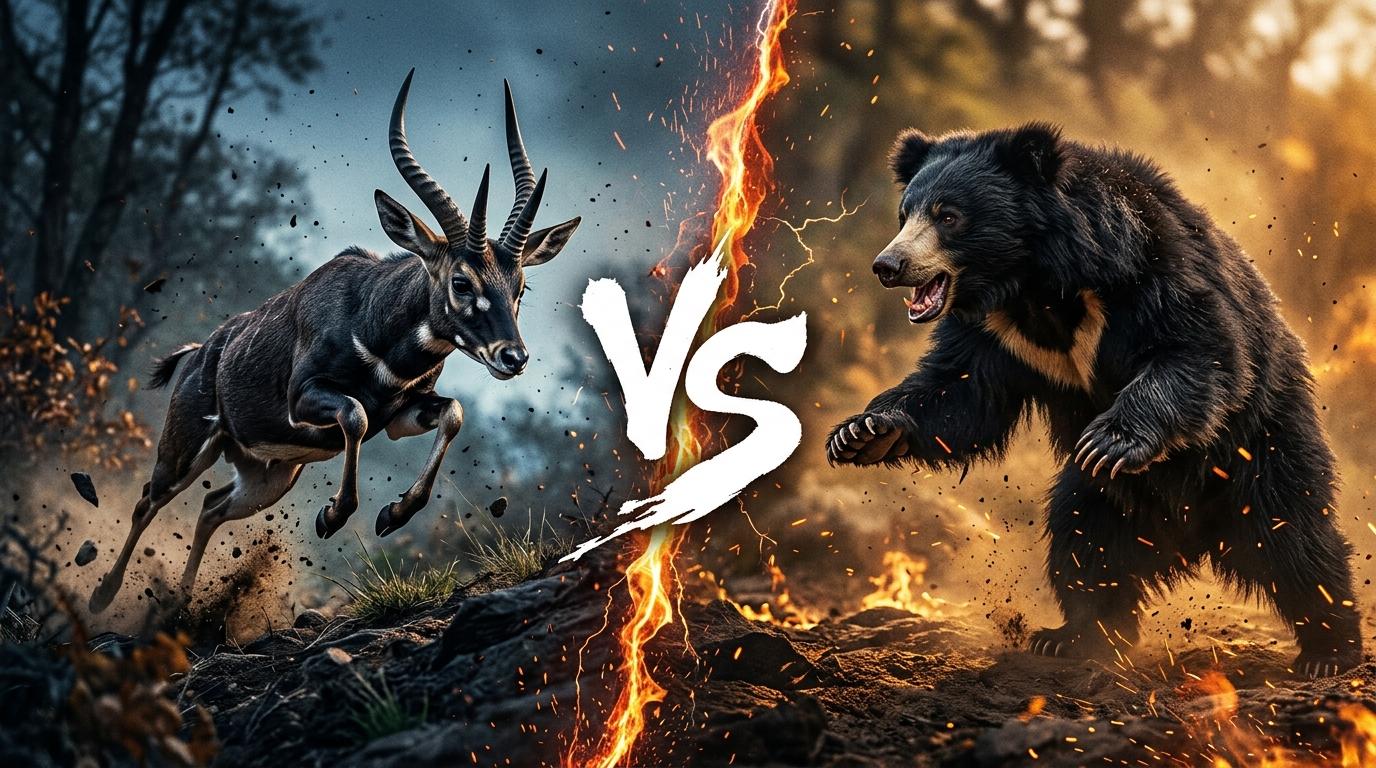
Four-horned Antelope vs Sloth Bear: Who Actually Wins?
Four-horned antelope vs sloth bear: who would win a fight? A biology-first breakdown of size, claws, speed, horns and behavior, with a clear verdict.
Four-horned Antelope vs Sloth Bear
Matchup winner
Sloth Bear
Quick verdict
Start with the direct answer, then use the structured comparison below to see what changes the outcome.
The sloth bear wins this matchup decisively. An adult sloth bear typically weighs 80–140 kg against a four-horned antelope's roughly 17–22 kg, which gives it five to seven times the mass. It carries 6–8 cm curved front claws built for tearing open termite mounds and rotten logs, and it has a reputation as one of South Asia's most reactive, defensive mammals, willing to charge tigers and humans when surprised. The four-horned antelope, or chousingha, is a small, shy browser. Its short horns (the rear pair rarely exceed about 10 cm, and females have none) are display and sparring tools, not weapons for fighting a bear. Its real strengths are stillness, cover-hugging and short bursts of flight. If the antelope can disengage, it survives. If it is forced to fight, the bear's mass, claws and close-range ferocity end it quickly.
Read the full explanation
Sloth bear wins: roughly 5–7x heavier, with long digging claws and an explosive defensive temper.
The four-horned antelope's horns are tiny and built for rival sparring, not predator defense.
The antelope's best outcome is escape. It is quicker over short dense-cover dashes and hard to spot when frozen.
Sloth bears are not dedicated hunters of antelope, so in the wild this clash is rare and usually ends with the antelope fleeing.
Reader vote
Who do you think wins?
Pick a side — no account needed. Results update live.
No votes yet — be the first to call it.
Editorial note
Why people disagree
'Bears are slow insect-eaters' undersells them. Sloth bears are diet specialists, but they are among the most aggressive defensive animals in India.
Body mass advantage
At a 5–7x weight gap, the lighter animal cannot absorb or redirect force. Every contact favors the bear.
Close-range weaponry
Claws evolved to rip apart hardened termite mounds translate into devastating slashing damage at close quarters.
Defensive aggression
The sloth bear's 'attack the threat' reflex means it closes distance rather than retreating.
Read the full explanation +
Four horns sound formidable, yet the chousingha is one of Asia's smallest bovids, and its horns are short spikes.
Some readers judge 'winning' as surviving the encounter. On that measure the antelope's escape-first strategy often succeeds, even though it would lose an actual fight.
Comparison FAQ
Short, direct answers to the next questions readers usually ask after the headline verdict.
Would a four-horned antelope beat a sloth bear in a fight?+
No. The sloth bear is roughly five to seven times heavier, has long curved claws, and is extremely aggressive when it feels threatened. The antelope would lose any real fight.
Which is stronger, a sloth bear or a four-horned antelope?+
The sloth bear is far stronger. Its powerful forelimbs and claws can tear apart rock-hard termite mounds, while the chousingha is a light, delicate browser.
Do sloth bears hunt four-horned antelopes?+
Rarely, if ever, as a deliberate strategy. Sloth bears eat mainly termites, ants, fruit and honey. Encounters are usually accidental.
Why is the four-horned antelope still dangerous or hard to beat?+
It is very hard to catch. Its camouflage, freezing behavior and fast, agile escapes mean most predators never get close. A cornered male can also jab with its sharp horns.
Is the sloth bear dangerous to humans?+
Yes. Sloth bears are responsible for many serious wildlife attacks in India, usually when surprised at close range.
Head-to-head species stats
These are the same core AnimalDex stat dimensions used on the dedicated animal pages, pulled side by side so the matchup is faster to scan.
Four-horned Antelope
Tier CSloth Bear
Tier CTrait-by-trait comparison
Only the categories that matter to this matchup are included. The goal is not filler stats, but the real design differences that change the result.
~17–22 kg, slender frame
Body mass advantage
Sloth Bear
~80–140 kg, shaggy and stocky
Body mass advantage
Sloth Bear
Short conical horns (males only), hooves
Close-range weaponry
Sloth Bear
6–8 cm curved claws, strong jaws
Close-range weaponry
Sloth Bear
Avoids conflict, freezes or bolts
Defensive aggression
Sloth Bear
Charges first when startled, even at tigers
Defensive aggression
Sloth Bear
Quick, jinking dashes into undergrowth
Burst escape
Four-horned Antelope
Fast short charges, but less agile turning
Burst escape
Four-horned Antelope
Cryptic coat, motionless hiding in dry forest
Cover craft
Four-horned Antelope
Noisy forager, relies on smell
Cover craft
Four-horned Antelope
Light bones, thin hide
Close-range durability
Sloth Bear
Thick shaggy coat, heavy musculature
Close-range durability
Sloth Bear
How the verdict forms
Verdict timeline
01 · Body mass advantage
Sloth Bear
02 · Close-range weaponry
Sloth Bear
03 · Defensive aggression
Sloth Bear
04 · Burst escape
Four-horned Antelope
05 · Cover craft
Four-horned Antelope
06 · Close-range durability
Sloth Bear
Change the conditions
Scenario breakdown
This is where shallow battle content usually fails. Terrain, spacing, timing, and engagement style can change the answer.
Scenario lean
Sloth Bear
Verdict confidence
82%
Bear wins if contact happens; antelope wins only by vanishing.
Dense dry deciduous scrub is home ground for both animals. The antelope's concealment may prevent detection entirely. But if the bear stumbles onto it at close range, the bear's startle-charge triggers immediately, and in tight undergrowth the antelope has little room to accelerate. Mass and claws decide it within seconds.
AnimalDex field profiles
Explore these animals
Four-horned Antelope
Tetracerus quadricornis
dry deciduous forest, scrub hill, and grassy woodland
Sloth Bear
Melursus ursinus
Dry forest, grassland edge, scrub forest, and rocky woodland.
Systems Intelligence & Hidden Purpose
See the animals behind this comparison as engineered biological systems: what each one is built to do, where it gains leverage, and why the matchup changes by scenario.
Specialized Hardware
small body with four short horns, chestnut forest coat, and quiet understory browsing give the Four-horned Antelope a body plan tuned for its niche.
Systems Script
Four-horned Antelopes operate through dry deciduous forest, scrub hill, and grassy woodland. Their design links movement, feeding, shelter, and timing into one workable survival system.
Strategic Insight
Harsh places reward efficiency, timing, and bodies that waste very little.
Specialized Hardware
Long shaggy black coat, pale chest patch, and flexible lips for sucking up insects give the Sloth Bear a body plan tuned for its niche.
Systems Script
Sloth Bears operate in dry forest, grassland edge, scrub forest, and rocky woodland. Their design helps them match food access, shelter, and timing inside that environment.
Strategic Insight
Useful power is the power that opens what looks closed.
Final take
The sloth bear is the clear winner. This is not a matchup of near-equals. It pits a small, cautious browser against a heavy, clawed, notoriously short-tempered omnivore. In any scenario where the two actually make physical contact, the bear's size and weaponry dominate.
Read the full explanation
The four-horned antelope deserves credit for a different kind of success. Its survival playbook of stillness, camouflage and rapid flight lets it share forests with tigers, leopards, dholes and bears. It wins by never letting the fight start.
Overall verdict: Sloth Bear, with high confidence.
Collect both animals in AnimalDex
Track the species behind this matchup, compare their real traits, and build the rivalry into your AnimalDex collection.
Related comparisons
Continue with nearby matchups to compare more real-world animal traits without dropping into junky who-wins filler.
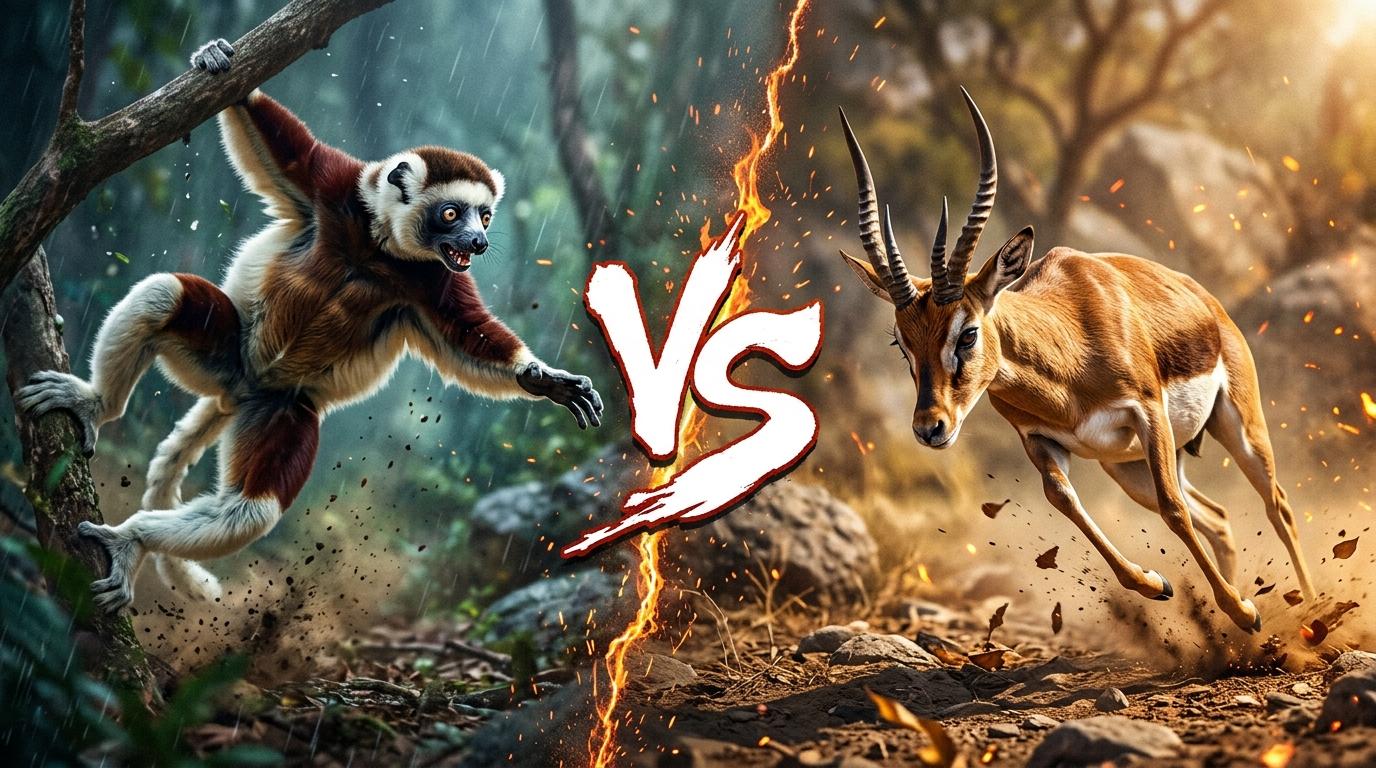
Coquerel's Sifaka vs Four-horned Antelope: Who Actually Wins?
The Four-horned Antelope wins this matchup clearly. It weighs roughly 17–22 kg against the sifaka's 3.5–4.5 kg, so it carries about four to five times the body mass. Males also have the only four-horned skull among living wild bovids: two short front spikes and two sharper rear horns of about 8–10 cm. The sifaka is a superb leaper, launching up to around 10 m between trunks, but its body is built for vertical clinging and gliding leaps, not for absorbing a butt or holding ground. On the forest floor, in open scrub, or at a waterhole, the antelope's mass, hooves and horn tips decide the encounter. The sifaka's real 'win condition' is to leave by going up a tree. That is a survival success, not a fight victory.
Read comparison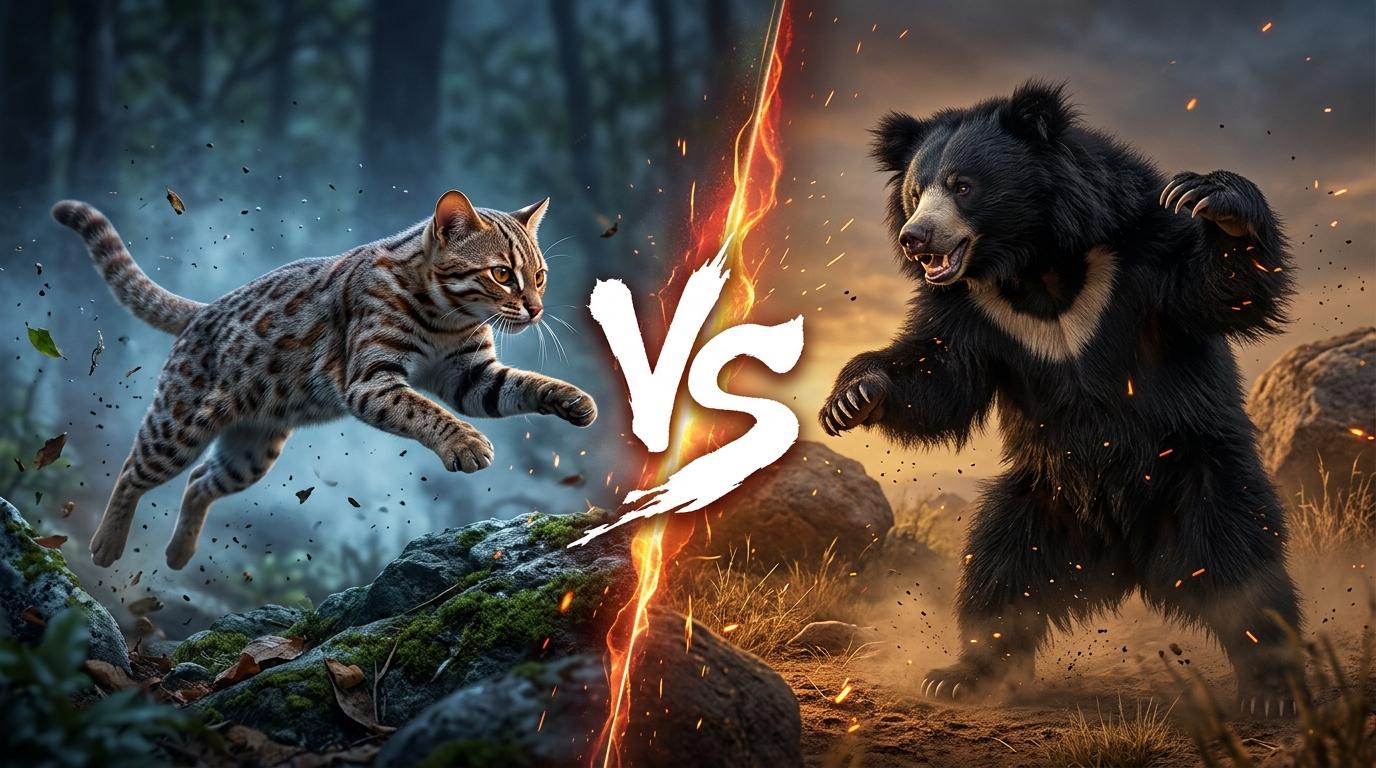
Rusty-spotted Cat vs Sloth Bear: Who Actually Wins?
The sloth bear wins, and it is not close. An adult sloth bear typically weighs 55–145 kg, while the rusty-spotted cat, one of the smallest wild cats on Earth, usually weighs about 0.9–1.6 kg. That puts the bear at roughly fifty to a hundred times the cat's mass. The bear also carries long, curved foreclaws built for tearing open termite mounds, a shaggy coat over thick skin, and a famously short temper that makes it one of South Asia's most defensive large mammals. The cat's real strengths are concealment, agility and fast reflexes. Those are tools for slipping away, not for overpowering a bear. In any forced confrontation the bear's mass, reach and armor-like fur end it almost immediately. The cat's best result is escaping up a tree or into dense cover before contact.
Read comparison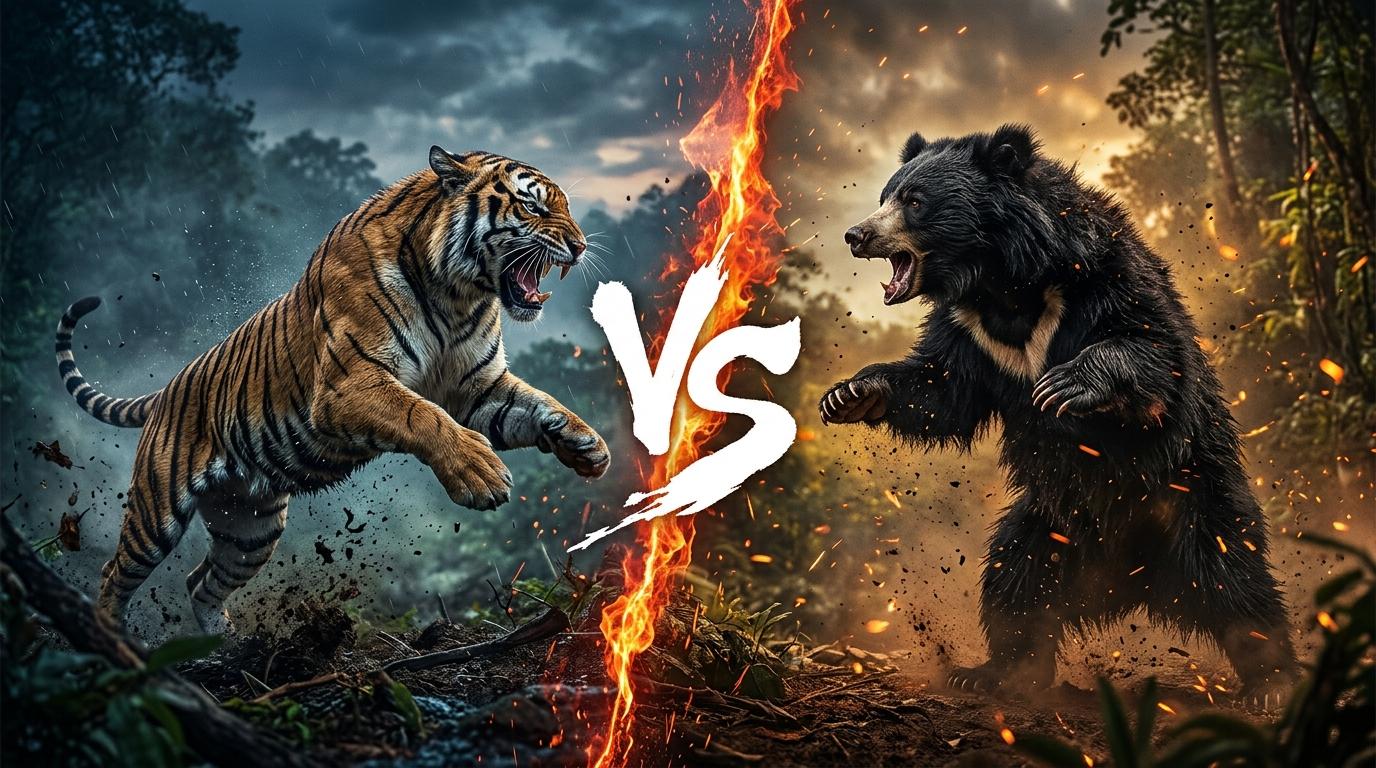
Bengal Tiger vs Sloth Bear: Who Actually Wins?
The Bengal tiger wins this matchup in most realistic encounters. A large male tiger often weighs 200–260 kg, while a big male sloth bear is closer to 90–140 kg. The tiger also has the predator's toolkit: stalking skill, explosive acceleration, a grappling build and a killing bite aimed at the throat or nape. Sloth bears are not easy prey, though. They have long, curved claws, a shaggy coat over loose skin, and a reputation as one of the most defensively aggressive animals in South Asia. Some tigers back off from a bear that stands its ground, and confrontations can injure a tiger badly. Even so, tigers do hunt sloth bears, and adult bears appear in their diet across central and northern India. The tiger's advantages in mass, timing and lethal technique decide the fight, but it pays a real price when it gets the first move wrong.
Read comparison
Discussion
What do you think?
Share your reasoning with other readers. Be civil and stick to the animals.
Sign in to join the discussion.
Sign inNo comments yet. Start the conversation.