


Frilled Lizard vs Green Tree Python: Who Actually Wins?
Frilled lizard vs green tree python: who wins? Compare size, bite, constriction, speed, and bluff to see why the python usually takes the fight and when the lizard escapes.
Frilled Lizard vs Green Tree Python
Matchup winner
Green Tree Python
Quick verdict
Start with the direct answer, then use the structured comparison below to see what changes the outcome.
The green tree python wins this matchup. An adult Morelia viridis is roughly 1.5 to 2 meters of muscle with a prehensile tail, long recurved front teeth, heat-sensing lip pits, and a coil-and-squeeze kill method built for small, warm-bodied prey in branches. The frilled lizard is a real competitor. It can be about 85 to 90 cm long, though most of that is tail. It is quick, bites hard for its size, and carries one of the most startling bluffs in the reptile world: a frill that snaps open to about 30 cm across, plus a wide pink gape and a hiss. That display is designed to make predators hesitate, but a python hunting by ambush and heat does not need to be intimidated to win. It only needs one well-timed strike. Once the python anchors with its tail and throws coils, the lizard's best weapons, speed and a bipedal sprint, are gone. In a sustained fight the python's mass, grip, and constriction decide it. The lizard's real path to victory is not winning the fight but ending it early by running.
Read the full explanation
Green tree python wins most real fights, thanks to its strike, grip, and constriction.
The frilled lizard's frill is a bluff. It is excellent at deterring predators and poor at stopping a committed constrictor.
On open ground the lizard's bipedal sprint lets it escape, which counts as surviving rather than winning.
Their ranges overlap in Cape York and southern New Guinea, so this is a plausible encounter.
Reader vote
Who do you think wins?
Pick a side — no account needed. Results update live.
No votes yet — be the first to call it.
Editorial note
Why people disagree
The frill makes the lizard look bigger and fiercer than it is, so many people overrate its fighting power.
Usable body mass
In a clinch, mass you can wrap and squeeze with matters far more than total length.
Explosive getaway
Speed is the lizard's survival card. It works only while the lizard has room to run.
Ambush control
The python is built to catch exactly this size of warm-bodied animal from cover.
Read the full explanation +
Green tree pythons look slender and decorative, which hides how strong and grippy they are in a canopy.
Some count escape as a win. Under that rule the lizard does far better than it does in a true fight.
Comparison FAQ
Short, direct answers to the next questions readers usually ask after the headline verdict.
Would a green tree python beat a frilled lizard?+
Yes, in most real fights. Its strike, tail anchor, and constriction overpower a lizard of this size, especially in trees.
Which is stronger, a frilled lizard or a green tree python?+
The green tree python. Its whole body is muscle used for gripping and squeezing, while the lizard's strength goes into running and clinging.
Could a green tree python eat a frilled lizard?+
A large adult could plausibly take a small-to-medium frilled lizard. These pythons do eat lizards along with rodents and birds.
Why is the frilled lizard still dangerous?+
It bites hard, lunges, and its sudden frill and hiss can startle attackers into a hesitation long enough for it to sprint to safety. Careless predators do lose it.
Is the frill used for fighting?+
Mostly not. It works as a display for deterring predators, signaling to rivals, and possibly regulating temperature. It is a bluff, not armor.
Head-to-head species stats
These are the same core AnimalDex stat dimensions used on the dedicated animal pages, pulled side by side so the matchup is faster to scan.
Frilled Lizard
Tier CGreen Tree Python
Tier BTrait-by-trait comparison
Only the categories that matter to this matchup are included. The goal is not filler stats, but the real design differences that change the result.
Light build, most length is tail
Usable body mass
Green Tree Python
Dense, muscular coils
Usable body mass
Green Tree Python
Fast bipedal sprinter
Explosive getaway
Frilled Lizard
Slow mover, quick short strike
Explosive getaway
Frilled Lizard
Sit-and-wait insect hunter
Ambush control
Green Tree Python
Heat-pit ambush predator of vertebrates
Ambush control
Green Tree Python
Frill, gape, hiss, lunges
Threat display
Frilled Lizard
S-coil, minimal bluff
Threat display
Frilled Lizard
Biting and scratching
Close-range control
Green Tree Python
Tail anchor plus constriction
Close-range control
Green Tree Python
Clinging claws
Canopy grip
Green Tree Python
Prehensile tail and coil perch
Canopy grip
Green Tree Python
How the verdict forms
Verdict timeline
01 · Usable body mass
Green Tree Python
02 · Explosive getaway
Frilled Lizard
03 · Ambush control
Green Tree Python
04 · Threat display
Frilled Lizard
05 · Close-range control
Green Tree Python
06 · Canopy grip
Green Tree Python
Change the conditions
Scenario breakdown
This is where shallow battle content usually fails. Terrain, spacing, timing, and engagement style can change the answer.
Scenario lean
Green Tree Python
Verdict confidence
82%
The python's home field
Among branches the python anchors its prehensile tail, reads the lizard's body heat, and strikes from an S-coil. The lizard cannot sprint bipedally on a narrow limb, and its frill does little against a predator that is not relying on sight and nerve. One bite and wrap ends the contest.
AnimalDex field profiles
Explore these animals
Frilled Lizard
Chlamydosaurus kingii
Open woodland, savannah forest, and seasonally dry tropical tree habitat.
Green Tree Python
Morelia viridis
Tropical rainforest and woodland with sturdy branch systems.
Systems Intelligence & Hidden Purpose
See the animals behind this comparison as engineered biological systems: what each one is built to do, where it gains leverage, and why the matchup changes by scenario.
Specialized Hardware
Expandable neck frill, bipedal sprint escape, and tree-ready claw structure make this lizard rapid-escalation hardware for exposed woodland edges.
Systems Script
Frilled lizards survive by turning visibility into a deterrence tool before a chase becomes expensive. They are a reminder that defense is often about changing the opponent's math early.
Strategic Insight
A good warning system resolves conflict before you spend premium energy on full engagement.
Specialized Hardware
Bright green adult body, often rests in saddle-like branch coils, and triangular head and heat-sensing pits give the Green Tree Python a body plan tuned for its niche.
Systems Script
Green Tree Pythons operate in tropical rainforest and woodland with sturdy branch systems. Their design helps them match food access, shelter, and timing inside that environment.
Strategic Insight
A good position can do much of the work before the movement even begins.
Final take
The green tree python is the overall winner. Its anatomy amounts to a single integrated solution: grip, sense, strike, wrap. A frilled-lizard-sized animal falls squarely inside the problem it was built to solve.
Read the full explanation
The frilled lizard is no pushover. Its bluff and sprint are elite anti-predator tools, and on open ground it will often walk away, or rather run away, unharmed. In a committed fight, though, bluff and speed are exit strategies, not weapons.
Collect both animals in AnimalDex
Track the species behind this matchup, compare their real traits, and build the rivalry into your AnimalDex collection.
Related comparisons
Continue with nearby matchups to compare more real-world animal traits without dropping into junky who-wins filler.
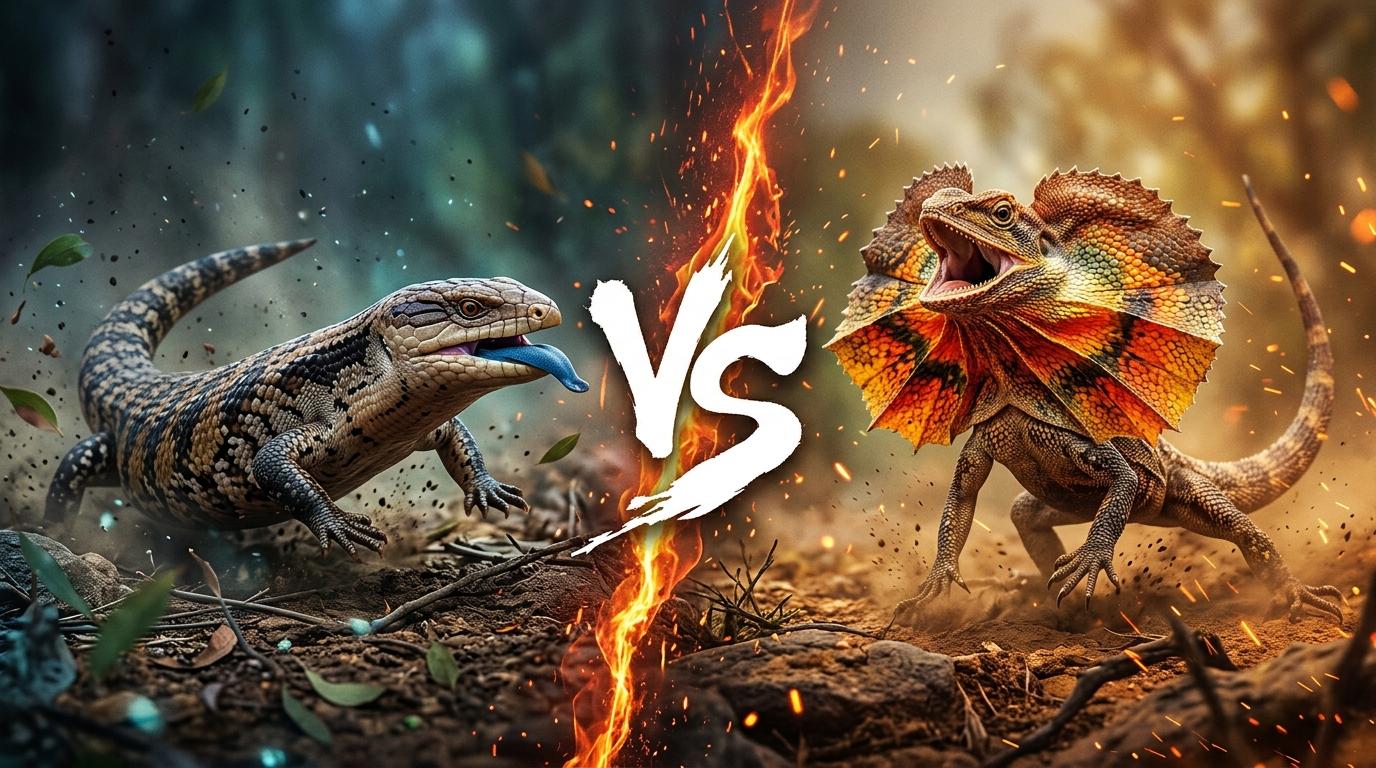
Blue-tongued Skink vs Frilled Lizard: Who Actually Wins?
The Eastern Blue-tongued Skink wins a committed fight, though not by much. The Frilled Lizard is longer, faster and far more theatrical. Its gaping mouth, hissing and umbrella frill can stop many predators in their tracks. But much of that length is tail, and its main weapons are intimidation and escape. The skink is built like a small armored log. Overlapping bony osteoderms sit under its scales, and its thick-boned skull and short, powerful jaws are made to crush snail shells and beetles. Once it bites, it tends to clamp and hold. In any frame where the frilled lizard cannot simply run or climb away, the skink's compact armor and crushing grip beat a defense built mostly on display. In open country with trees nearby, the frilled lizard usually avoids the fight entirely. That is a smart survival choice, but it is not a win.
Read comparison
Eastern Blue-tongued Skink vs Green Tree Python: Who Actually Wins?
The green tree python wins this matchup in most realistic encounters. An adult Morelia viridis is typically 1.5–2 m long and often outweighs an Eastern Blue-tongued Skink. It strikes from an anchored coil with long, recurved front teeth. Once a constrictor's coils close around a squat, short-legged lizard, the contest shifts to the python's terms. The skink has no limb leverage, no speed to break free, and no way to stop the squeeze. The skink is not a pushover, though. Its body is reinforced with bony osteoderms, its crushing bite clamps hard and holds on, and its blue-tongue threat display is a genuine deterrent. A hesitant or poorly positioned python can take a painful bite and back off. But the python controls range, angle, and the finishing mechanism, and the skink can only make the fight costly.
Read comparison
Discussion
What do you think?
Share your reasoning with other readers. Be civil and stick to the animals.
Sign in to join the discussion.
Sign inNo comments yet. Start the conversation.