

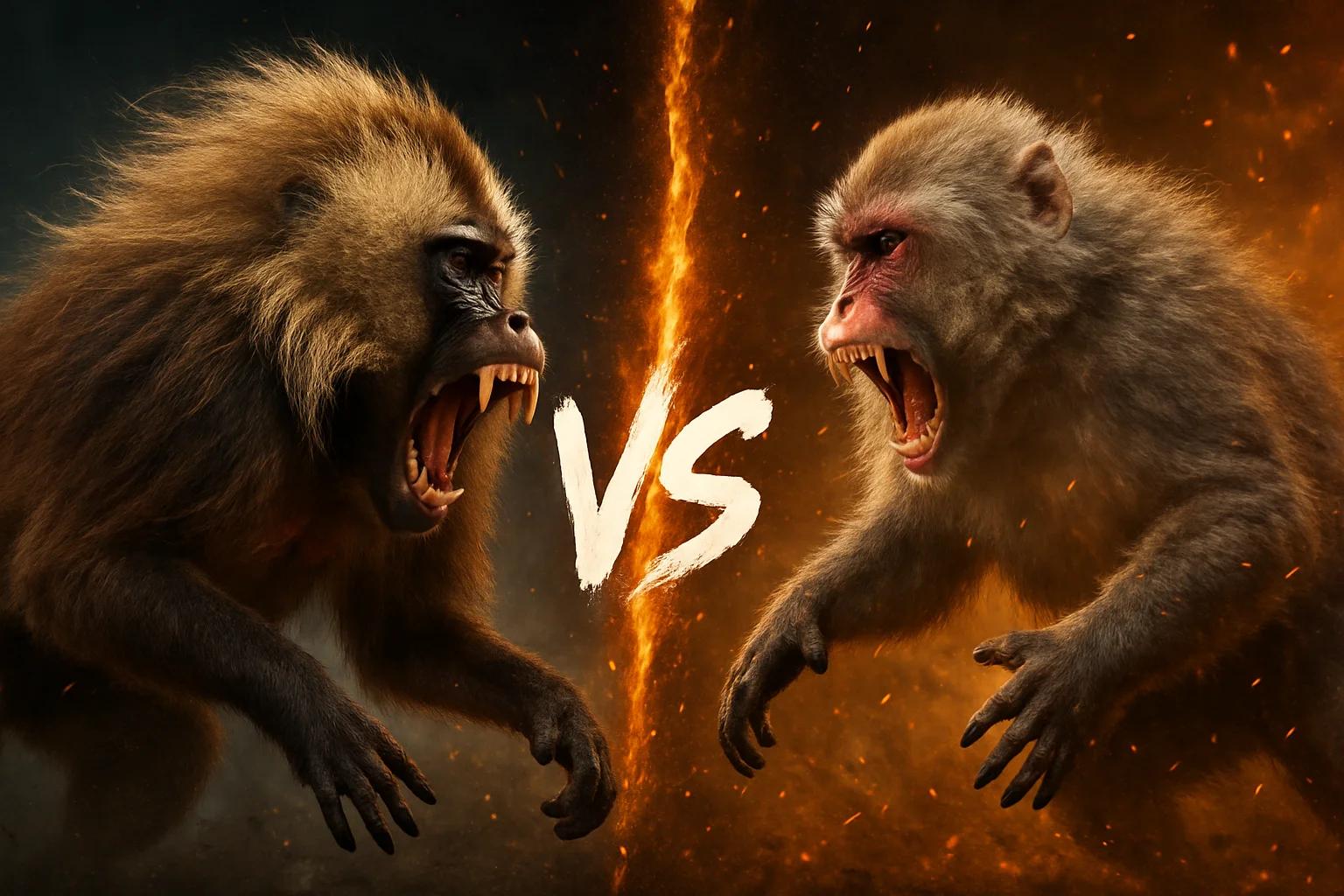
Gelada vs Japanese Macaque: Who Actually Wins?
Gelada vs Japanese macaque compared on size, canines, bite, and fighting style. See who wins a one-on-one clash and why the macaque still stays dangerous.
Gelada vs Japanese Macaque
Matchup winner
Gelada
Quick verdict
Start with the direct answer, then use the structured comparison below to see what changes the outcome.
The gelada wins most one-on-one clashes. Adult male geladas weigh roughly 18–20 kg against about 10–14 kg for a big male Japanese macaque, and they carry some of the longest canines of any primate, which they show off in their famous lip-flip threat. Gelada males spend their lives in loud, physical standoffs with rival males over their family units, so they arrive with more mass, a heavier bite, and a body built for face-to-face contests. The Japanese macaque is the sharper problem-solver: quicker in trees, very good at reading the social situation, and tough enough to survive snowy mountain winters. But in a direct contest of weight and teeth, the gelada's hardware decides it.
Read the full explanation
Gelada wins overall, mostly because adult males outweigh macaques by about 40–60%.
The gelada's dagger-like canines and heavy jaw beat the macaque's smaller bite.
The Japanese macaque wins on intelligence, climbing, and avoiding a fight, especially in forest.
On open ground with no easy way out, the gelada is the clear favorite.
Reader vote
Who do you think wins?
Pick a side — no account needed. Results update live.
No votes yet — be the first to call it.
Editorial note
Why people disagree
Geladas eat mostly grass, so people assume they are gentle. In reality the males are some of the most heavily armed primates alive.
Explosive power
The extra mass lets the gelada shove, pin, and absorb hits that would knock a macaque off balance.
Weapon load
A longer canine on a heavier skull causes much more damage with each bite.
Tactical cognition
The macaque is better at spotting a bad matchup early and choosing not to take it.
Read the full explanation +
Japanese macaques look tough in snow-monkey footage. Their cold-weather toughness is real, but it does not stand in for body mass in a fight.
Intelligence scores favor the macaque, but a fight decided in seconds rewards canines and weight more than clever planning.
Comparison FAQ
Short, direct answers to the next questions readers usually ask after the headline verdict.
Would a gelada beat a Japanese macaque in a fight?+
Yes, in most cases. The gelada's size and canine advantage make it the favorite, especially on open ground.
Which is stronger, a gelada or a Japanese macaque?+
The gelada. Males are significantly heavier and more muscular through the shoulders and jaw.
Why is the Japanese macaque still dangerous?+
Its canines are sharp, it reacts fast, and it is very smart about choosing its moment. In trees it can harass a gelada and stay out of reach, and its bites can still cause serious wounds.
Are geladas aggressive even though they eat grass?+
Males can be. Their diet is mostly grass, but competition between males over family units is intense, and their canines are weapons used in those contests.
Do geladas and Japanese macaques ever meet in the wild?+
No. Geladas live in the Ethiopian highlands and Japanese macaques live in Japan. This is a hypothetical matchup.
Head-to-head species stats
These are the same core AnimalDex stat dimensions used on the dedicated animal pages, pulled side by side so the matchup is faster to scan.
Gelada
Tier BJapanese Macaque
Tier BTrait-by-trait comparison
Only the categories that matter to this matchup are included. The goal is not filler stats, but the real design differences that change the result.
Heavy-shouldered 18–20 kg male
Explosive power
Gelada
Compact 10–14 kg frame
Explosive power
Gelada
Very long canines, strong jaw
Weapon load
Gelada
Sharp but shorter canines
Weapon load
Gelada
Socially skilled, reads vocal signals well
Tactical cognition
Japanese Macaque
Strong innovator, learns tools and tricks
Tactical cognition
Japanese Macaque
Cliff-scrambler, mostly on the ground
Vertical escape
Japanese Macaque
Agile in trees and on rock
Vertical escape
Japanese Macaque
Thick mane and cape protect the neck
Close-range durability
Gelada
Dense winter coat, harsh-climate grit
Close-range durability
Gelada
Lip-flip that bares the gums and canines
Threat display
Gelada
Open-mouth stare, lunges
Threat display
Gelada
How the verdict forms
Verdict timeline
01 · Explosive power
Gelada
02 · Weapon load
Gelada
03 · Tactical cognition
Japanese Macaque
04 · Vertical escape
Japanese Macaque
05 · Close-range durability
Gelada
06 · Threat display
Gelada
Change the conditions
Scenario breakdown
This is where shallow battle content usually fails. Terrain, spacing, timing, and engagement style can change the answer.
Scenario lean
Gelada
Verdict confidence
82%
Gelada wins decisively.
This is the gelada's home terrain. With no trees to escape into, size and canines decide the contest. The gelada closes the distance, uses its mane as a shield, and outweighs the macaque in any grapple.
AnimalDex field profiles
Explore these animals
Gelada
Theropithecus gelada
high grassland and cliff edges of mountain plateau
Japanese Macaque
Macaca fuscata
temperate forest, mountain woodland, and snowy park edge
Systems Intelligence & Hidden Purpose
See the animals behind this comparison as engineered biological systems: what each one is built to do, where it gains leverage, and why the matchup changes by scenario.
Specialized Hardware
grass-eating monkey diet, cliffside troop living, and red chest patch give the Gelada a body plan tuned for its niche.
Systems Script
Geladas operate through high grassland and cliff edges of mountain plateau Their design links movement, shelter, feeding, and survival into one workable system.
Strategic Insight
Even a simple food source can support a rich social world if it is plentiful and well used.
Final take
The gelada is the clear overall winner. It is bigger, has longer canines, and is better protected around the neck, and male gelada life is built around face-to-face competition with rivals. Those advantages decide nearly every fight on open or rocky ground.
Read the full explanation
The Japanese macaque's strengths are intelligence, climbing, and adaptability. Those traits help it survive, but they do not win a stand-up fight. It wins by deciding where a fight happens and leaving before it turns bad.
Collect both animals in AnimalDex
Track the species behind this matchup, compare their real traits, and build the rivalry into your AnimalDex collection.
Discussion
What do you think?
Share your reasoning with other readers. Be civil and stick to the animals.
Sign in to join the discussion.
Sign inNo comments yet. Start the conversation.