

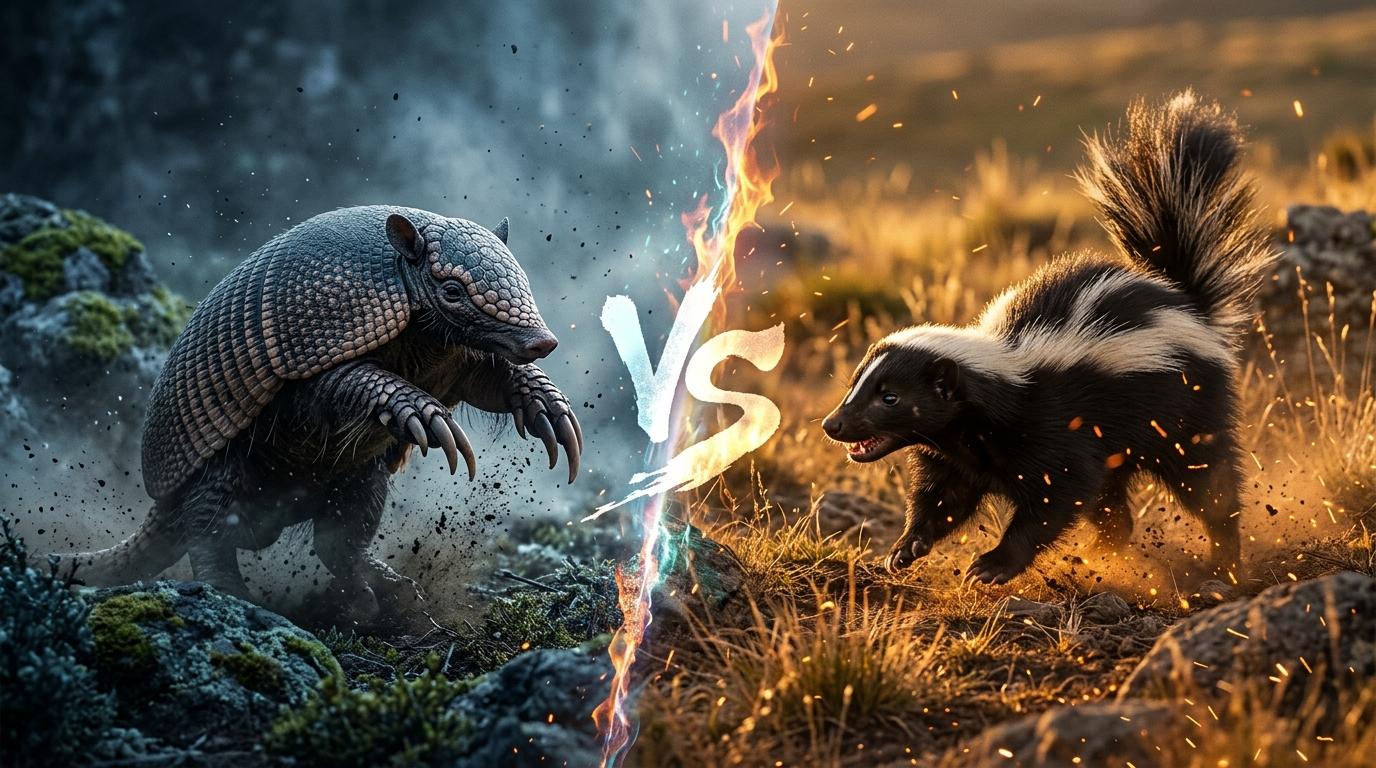
Giant Armadillo vs Patagonian Hog-nosed Skunk: Who Actually Wins?
Giant armadillo vs Patagonian hog-nosed skunk: who would win? Armor, digging claws, chemical defense and size compared, with a clear verdict, scenario breakdowns and FAQs.
Giant Armadillo vs Patagonian Hog-nosed Skunk
Matchup winner
Giant Armadillo
Quick verdict
Start with the direct answer, then use the structured comparison below to see what changes the outcome.
The giant armadillo wins, and it is not especially close. At roughly 30–50 kg, it outweighs the 1–4.5 kg Patagonian hog-nosed skunk by about ten to twenty times. Its body is wrapped in overlapping bony armor, and its forefeet carry the largest claws of any living mammal, a sickle-like third claw up to about 20 cm long that is built to rip open rock-hard termite mounds. The skunk's real weapon is its spray. That sulfur-based thiol mist could make the armadillo, which relies heavily on smell, back off or abandon an encounter. It cannot damage the armadillo's armor or stop a body that heavy. The skunk can make the meeting deeply unpleasant, but it has no way to win a physical contest, so the armadillo takes almost every realistic frame on size, armor and digging-limb power.
Read the full explanation
Giant armadillo wins: about 10–20x heavier, fully armored, with record-size claws.
The skunk's spray is a deterrent, not a damage weapon, and it can't get through bony armor.
The best case for the skunk is the armadillo choosing to leave, not the skunk overpowering it.
Neither animal is a fighter by temperament. Both would rather avoid a confrontation.
Reader vote
Who do you think wins?
Pick a side — no account needed. Results update live.
No votes yet — be the first to call it.
Editorial note
Why people disagree
Skunk spray has a fearsome reputation. People assume anything that makes bears and pumas retreat must 'beat' an armadillo, but driving an animal away is not the same as winning a fight.
Mass advantage
A gap of ten times or more in body mass decides most physical contests before tactics come into play.
Close-range durability
The skunk's small teeth and claws have almost nothing soft to reach on the armadillo.
Excavation-grade striking power
Limbs that tear apart hardened termite mounds can deliver serious force against a light-bodied animal.
Read the full explanation +
Armadillos look slow and passive. Many people don't realize a giant armadillo is a 1.5 m, dog-sized digging machine and not the small, familiar nine-banded species.
They don't actually meet in the wild. The giant armadillo lives in tropical and subtropical lowlands, while this skunk lives in cold Patagonian steppe, so every matchup is hypothetical and invites guesswork.
Comparison FAQ
Short, direct answers to the next questions readers usually ask after the headline verdict.
Would a giant armadillo beat a Patagonian hog-nosed skunk in a fight?+
Yes. The giant armadillo would win almost any physical fight thanks to a huge size advantage, a bony protective shell and enormous digging claws.
Which animal is stronger?+
The giant armadillo, by a wide margin. It weighs roughly 30–50 kg against the skunk's 1–4.5 kg, and its forelimbs are powerful enough to break open hardened termite mounds.
Can skunk spray stop a giant armadillo?+
It can make one retreat, especially because armadillos depend heavily on smell. It cannot injure the armadillo's armored body or physically stop it.
Why is the skunk still dangerous even though it loses?+
Its thiol spray can be aimed from a few meters away, causes intense irritation and lingers for a long time. That makes the skunk a costly animal to bother, which is why large predators often avoid it.
Do giant armadillos and Patagonian hog-nosed skunks meet in the wild?+
Essentially no. The giant armadillo lives in tropical and subtropical lowlands, while this skunk lives in Patagonia's cold steppes and scrub, so the matchup is hypothetical.
Is either animal aggressive?+
No. Both prefer to avoid conflict. The armadillo digs in or flees, and the skunk warns first and sprays only when pressed.
Head-to-head species stats
These are the same core AnimalDex stat dimensions used on the dedicated animal pages, pulled side by side so the matchup is faster to scan.
Giant Armadillo
Tier APatagonian Hog-nosed Skunk
Tier BTrait-by-trait comparison
Only the categories that matter to this matchup are included. The goal is not filler stats, but the real design differences that change the result.
~30–50 kg, up to ~1.5 m long
Mass advantage
Giant Armadillo
~1–4.5 kg, cat-sized
Mass advantage
Giant Armadillo
Bony osteoderm shell over back and sides
Close-range durability
Giant Armadillo
Fur and skin only
Close-range durability
Giant Armadillo
Largest claws of any living mammal, built for termite mounds
Excavation-grade striking power
Giant Armadillo
Long digging claws scaled for grubs and soil
Excavation-grade striking power
Giant Armadillo
None
Chemical deterrence
Patagonian Hog-nosed Skunk
Aimed thiol spray that can reach a few meters
Chemical deterrence
Patagonian Hog-nosed Skunk
Ponderous above ground, quick to dig in
Reaction speed
Patagonian Hog-nosed Skunk
Slightly quicker, nimble at close range
Reaction speed
Patagonian Hog-nosed Skunk
Can bury itself rapidly in soil
Bailout options
Giant Armadillo
Can spray and retreat into a burrow
Bailout options
Giant Armadillo
How the verdict forms
Verdict timeline
01 · Mass advantage
Giant Armadillo
02 · Close-range durability
Giant Armadillo
03 · Excavation-grade striking power
Giant Armadillo
04 · Chemical deterrence
Patagonian Hog-nosed Skunk
05 · Reaction speed
Patagonian Hog-nosed Skunk
06 · Bailout options
Giant Armadillo
Change the conditions
Scenario breakdown
This is where shallow battle content usually fails. Terrain, spacing, timing, and engagement style can change the answer.
Scenario lean
Giant Armadillo
Verdict confidence
82%
The armadillo shrugs off the skunk's harassment and holds its ground or digs in.
In tight cover the skunk sprays early, as skunks do when they feel cornered. The irritant would likely bother the armadillo's sensitive nose and eyes, but the shell protects its body, and the armadillo can root itself into soil within moments. The skunk has no way to finish a fight like this. If the armadillo turns its claws on it, the mismatch in mass becomes severe.
AnimalDex field profiles
Explore these animals
Giant Armadillo
Priodontes maximus
savannah woodland, tropical forest, and seasonally flooded plain
Patagonian Hog-nosed Skunk
Conepatus humboldtii
steppe, scrubland, and open Patagonian plain
Systems Intelligence & Hidden Purpose
See the animals behind this comparison as engineered biological systems: what each one is built to do, where it gains leverage, and why the matchup changes by scenario.
Specialized Hardware
massive armored digging body, huge front claws, and night-active burrow engineering give the Giant Armadillo a body plan tuned for its niche.
Systems Script
Giant Armadillos operate through savannah woodland, tropical forest, and seasonally flooded plain. Their design links movement, feeding, shelter, and timing into one workable survival system.
Strategic Insight
Dense environments reward precision, patience, and the ability to read layered cover.
Specialized Hardware
pig-like rooting snout, bold black-and-white coat, and chemical defense spray give the Patagonian Hog-nosed Skunk a body plan tuned for its niche.
Systems Script
Patagonian Hog-nosed Skunks operate through steppe, scrubland, and open Patagonian plain. Their design links movement, feeding, shelter, and timing into one workable survival system.
Strategic Insight
Harsh places reward efficiency, timing, and bodies that waste very little.
Final take
The giant armadillo is the clear winner. It is a heavy, armored excavator whose forelimbs are built to open some of the hardest natural structures in South America, and nothing about a small skunk's body can threaten that design.
Read the full explanation
The Patagonian hog-nosed skunk still deserves respect. Its spray is a precise chemical defense that can turn away predators many times its size. It can make a giant armadillo leave, and in a contest over food that may be all it needs. In a true head-to-head, though, deterrence loses to armor plus mass.
Collect both animals in AnimalDex
Track the species behind this matchup, compare their real traits, and build the rivalry into your AnimalDex collection.
Discussion
What do you think?
Share your reasoning with other readers. Be civil and stick to the animals.
Sign in to join the discussion.
Sign inNo comments yet. Start the conversation.