

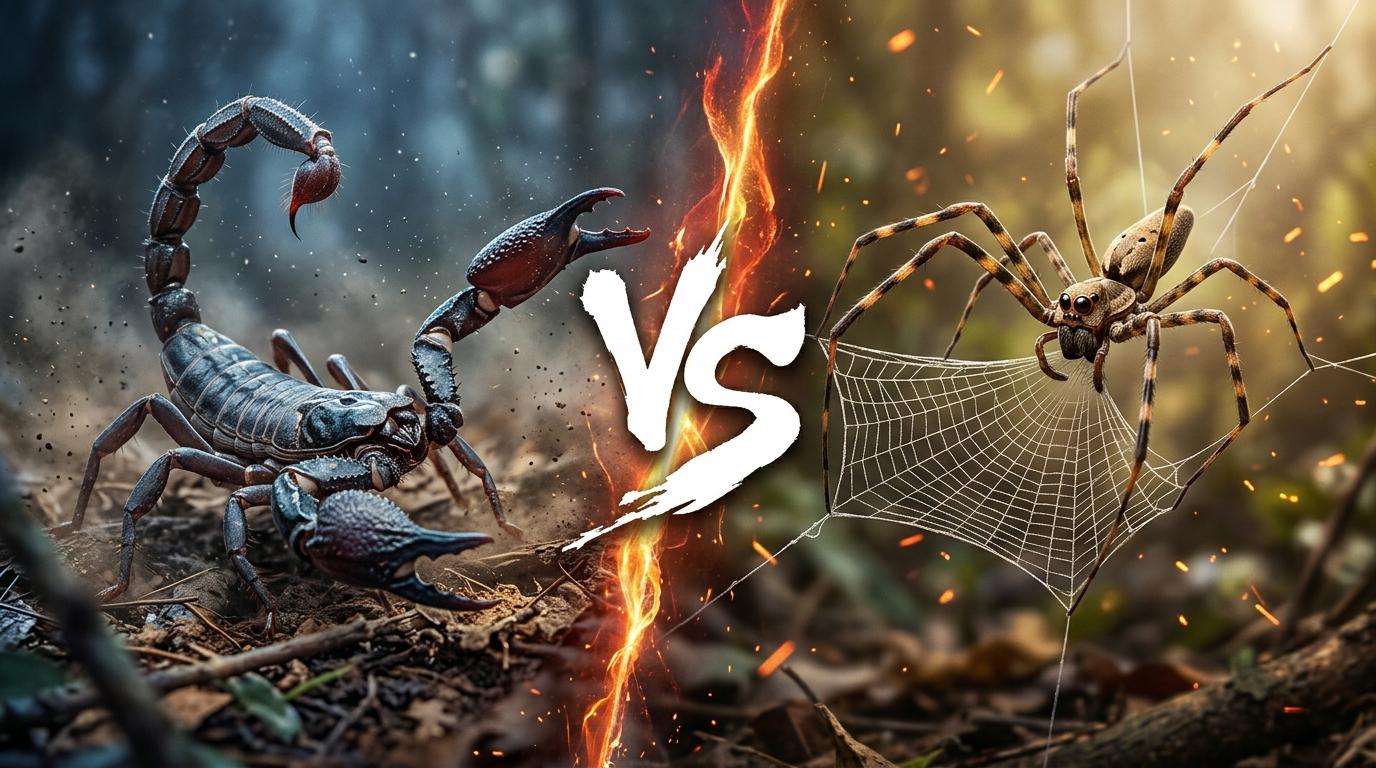
Giant Forest Scorpion vs Ogre-faced Spider: Who Actually Wins?
Giant Forest Scorpion vs Ogre-faced Spider: armored pincers and a heavy tail meet a net-casting night hunter with enormous eyes. Here is who wins and why.
Giant Forest Scorpion vs Ogre-faced Spider
Matchup winner
Giant Forest Scorpion
Quick verdict
Start with the direct answer, then use the structured comparison below to see what changes the outcome.
The Giant Forest Scorpion wins, and it is not close in a direct confrontation. Heterometrus swammerdami is one of the largest scorpions alive, with adults commonly reaching 15–20 cm and built around thick, crushing pedipalps and a hardened exoskeleton. Deinopis spinosa is a slender, stick-like spider roughly 2–2.5 cm long whose whole strategy depends on hanging motionless and casting a silk net over passing prey. The ogre-faced spider's huge posterior median eyes make it one of the best low-light hunters among invertebrates, but its net is sized for crickets, ants and moths, not a heavily armored animal many times its mass. Once the scorpion's pincers close, the spider has no armor, leverage or venom strong enough to change the outcome. The spider wins only by never being found.
Read the full explanation
Giant Forest Scorpion wins any real physical encounter through size, armor and crushing claws.
The scorpion relies on its pincers more than its venom, which is relatively mild to humans but more than enough for small arthropods.
Ogre-faced Spider's net-casting and night vision are elite tools for prey capture, not for defense against a predator this large.
The spider's best result is avoiding contact through camouflage and an elevated perch.
Reader vote
Who do you think wins?
Pick a side — no account needed. Results update live.
No votes yet — be the first to call it.
Editorial note
Why people disagree
Some readers assume spiders out-venom scorpions. Venom matters far less than delivery, and the spider cannot get a meaningful bite past the scorpion's armor before it is pinned.
Crushing power
Heterometrus kills mostly with its claws, so it never has to rely on a precise sting.
Close-range durability
The spider has nothing that resists a pinch, while its own bite struggles to find a soft target.
Mass advantage
The size gap is large enough that the spider barely counts as a peer opponent and sits closer to prey scale.
Read the full explanation +
The ogre-faced spider's sensory hardware looks futuristic, so people overrate it. Seeing in near-darkness does not overcome a size gap of this scale.
They rarely share space. The scorpion works the forest floor and burrows, while the spider hangs in vegetation, so a 'fight' mostly depends on who ends up where.
Comparison FAQ
Short, direct answers to the next questions readers usually ask after the headline verdict.
Would a Giant Forest Scorpion beat an Ogre-faced Spider?+
Yes. In nearly any direct encounter the scorpion pins and crushes the spider with its pincers.
Which is stronger?+
The Giant Forest Scorpion, by a wide margin. It is many times heavier, and its claws are built for crushing.
Is the scorpion's sting dangerous to humans?+
Heterometrus venom is generally mild for humans, usually causing local pain. These scorpions rely more on their claws than their sting.
Why is the Ogre-faced Spider still dangerous?+
To its own prey it is lethal. It is a precise night ambusher whose cast net and venomous bite efficiently take insects in near-total darkness.
Do they meet in the wild?+
They are native to different regions. Heterometrus swammerdami lives in South Asia, while Deinopis spinosa is found in the Americas, including the southeastern United States, so this matchup is hypothetical.
Head-to-head species stats
These are the same core AnimalDex stat dimensions used on the dedicated animal pages, pulled side by side so the matchup is faster to scan.
Giant Forest Scorpion
Tier DOgre-faced Spider
Tier DTrait-by-trait comparison
Only the categories that matter to this matchup are included. The goal is not filler stats, but the real design differences that change the result.
Massive, thick pedipalp claws
Crushing power
Giant Forest Scorpion
Small chelicerae built for subduing insects
Crushing power
Giant Forest Scorpion
Heavily sclerotized, broad exoskeleton
Close-range durability
Giant Forest Scorpion
Thin, elongated, fragile body
Close-range durability
Giant Forest Scorpion
Up to around 20 cm, heavy-bodied
Mass advantage
Giant Forest Scorpion
About 2–2.5 cm, twig-thin
Mass advantage
Giant Forest Scorpion
Poor eyesight; relies on touch and vibration
Low-light perception
Ogre-faced Spider
Enormous light-gathering eyes
Low-light perception
Ogre-faced Spider
Sit-and-wait at the burrow entrance
Ambush control
Ogre-faced Spider
Precision net-casting from a suspended perch
Ambush control
Ogre-faced Spider
Tail stinger, a backup to the claws
Venom delivery
Giant Forest Scorpion
Bite usable only after prey is netted
Venom delivery
Giant Forest Scorpion
How the verdict forms
Verdict timeline
01 · Crushing power
Giant Forest Scorpion
02 · Close-range durability
Giant Forest Scorpion
03 · Mass advantage
Giant Forest Scorpion
04 · Low-light perception
Ogre-faced Spider
05 · Ambush control
Ogre-faced Spider
06 · Venom delivery
Giant Forest Scorpion
Change the conditions
Scenario breakdown
This is where shallow battle content usually fails. Terrain, spacing, timing, and engagement style can change the answer.
Scenario lean
Giant Forest Scorpion
Verdict confidence
82%
Scorpion grabs and crushes.
On the forest floor the spider loses its suspended net-casting position. The scorpion's vibration-sensing pectines and the fine sensory hairs on its pincers pick up movement, and a single grab ends the encounter. Without its perch, the spider has no workable attack.
AnimalDex field profiles
Explore these animals
Giant Forest Scorpion
Heterometrus swammerdami
humid forest floor, plantation edge, and tropical scrub
Ogre-faced Spider
Deinopis spinosa
forest edge and leafy understory
Systems Intelligence & Hidden Purpose
See the animals behind this comparison as engineered biological systems: what each one is built to do, where it gains leverage, and why the matchup changes by scenario.
Specialized Hardware
massive black clawed body, thick defensive pincers, and night burrow waiting give the Giant Forest Scorpion a body plan tuned for its niche.
Systems Script
Giant Forest Scorpions operate through humid forest floor, plantation edge, and tropical scrub. Their design links movement, feeding, shelter, and timing into one workable survival system.
Strategic Insight
Dense environments reward precision, patience, and the ability to read layered cover.
Specialized Hardware
oversized forward eyes, handheld net-like silk web, and nighttime net-casting strike give the Ogre-faced Spider a body plan tuned for its niche.
Systems Script
Ogre-faced Spiders operate through forest edge and leafy understory. Their design links movement, feeding, shelter, and timing into one workable survival system.
Strategic Insight
Dense environments reward precision, patience, and the ability to read layered cover.
Final take
The Giant Forest Scorpion is the clear winner. Armor, claw strength and an overwhelming size advantage beat specialist sensory gear in any frame where the two actually make contact.
Read the full explanation
The Ogre-faced Spider is the more remarkable engineer. It weaves its net and holds it between its front legs, hears through sensitive leg organs, and sees in near-darkness. Those tools are tuned for catching insects, though, and its survival against larger predators depends on going unnoticed rather than fighting back.
Collect both animals in AnimalDex
Track the species behind this matchup, compare their real traits, and build the rivalry into your AnimalDex collection.
Related comparisons
Continue with nearby matchups to compare more real-world animal traits without dropping into junky who-wins filler.
Harvestman vs Ogre-faced Spider: Who Actually Wins?
The ogre-faced spider wins. Deinopis is a dedicated nocturnal predator. Its enormous rear-facing median eyes are among the most light-sensitive of any spider, and it holds a stretchy, woolly cribellate silk net between its front legs to cast over prey. Once a target is wrapped, it delivers a venomous bite. The harvestman is a scrappy, chemically armed scavenger-predator, but it has no venom, no silk, and only two small eyes. Its best tools are defensive: foul secretions from its ozopore glands and legs it can shed on purpose that keep twitching as decoys. Those tricks often let a harvestman escape, but escaping is not winning. When the spider lands its net cleanly in the dark, the encounter usually ends on its terms.
Read comparison
Discussion
What do you think?
Share your reasoning with other readers. Be civil and stick to the animals.
Sign in to join the discussion.
Sign inNo comments yet. Start the conversation.