

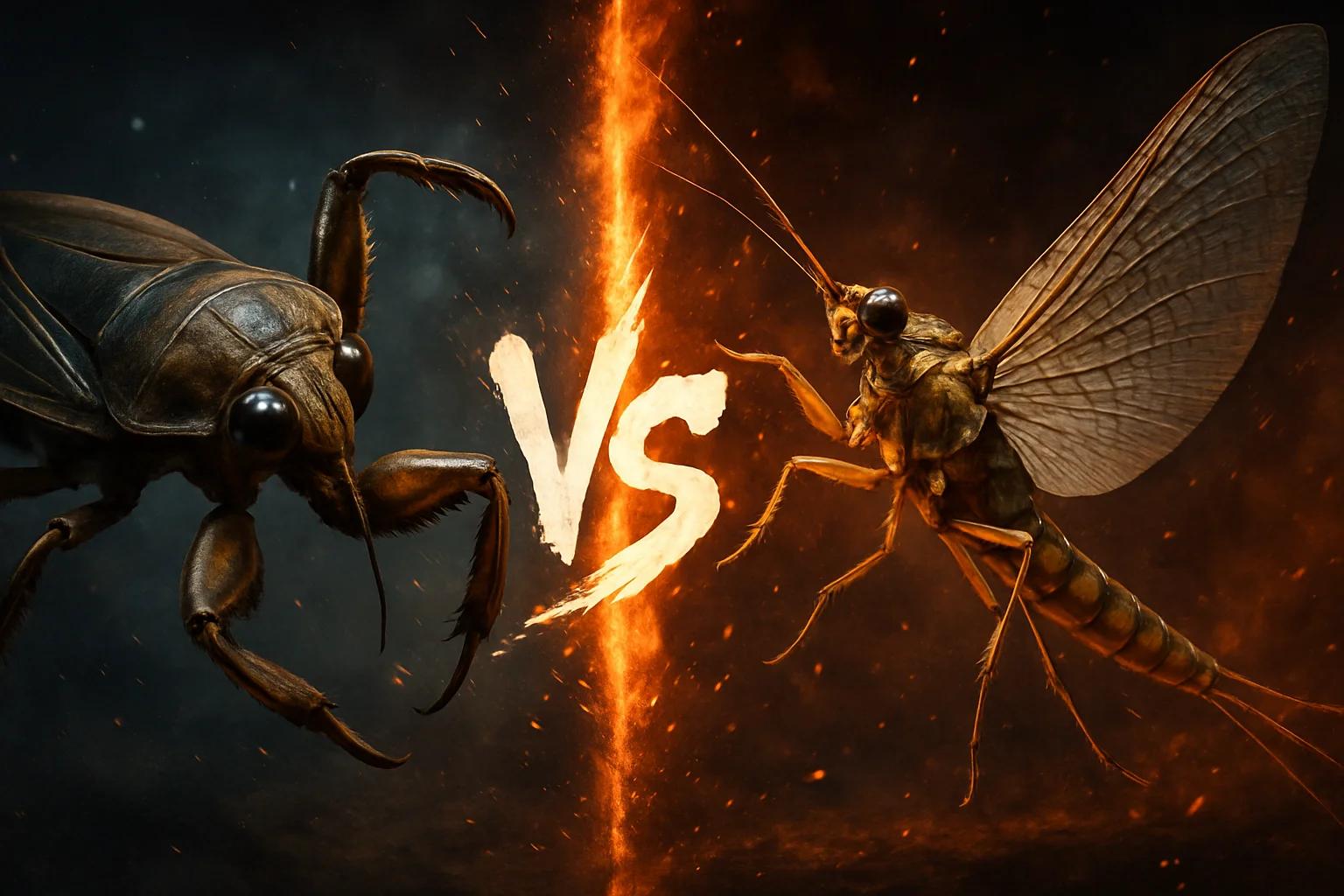
Giant Water Bug vs Giant Burrowing Mayfly: Who Actually Wins?
Giant water bug vs giant burrowing mayfly: a biology-first breakdown of venom, grip, burrowing, swarming, and why the 'toe-biter' wins almost every encounter.
Giant Water Bug vs Giant Burrowing Mayfly
Matchup winner
Giant Water Bug
Quick verdict
Start with the direct answer, then use the structured comparison below to see what changes the outcome.
The giant water bug wins, and it isn't close. Lethocerus americanus is a sit-and-wait aquatic predator up to about 6 cm long. It has raptorial forelegs built to clamp prey and a piercing beak that injects digestive saliva, and it routinely kills tadpoles, small fish, and frogs much larger than itself. Hexagenia limbata is a filter- and deposit-feeding nymph that spends a year or more in U-shaped burrows in lake mud. Its adults live only a day or two and cannot eat at all. The mayfly nymph has no weapons, no venom, and no meaningful bite. Its only real defenses are staying buried and relying on sheer numbers. In nearly every realistic water-column meeting, the bug grabs, pierces, and liquefies the nymph within minutes. The mayfly's only 'wins' come from never being found.
Read the full explanation
Giant water bug wins decisively: grasping forelegs plus a venomous, digestive beak versus a soft-bodied detritus feeder.
The mayfly nymph's best defense is its mud burrow, not fighting back.
Adult mayflies don't even have working mouthparts, so they can only flee or fly.
Mayflies 'win' at the population level through mass emergence, not one-on-one.
Reader vote
Who do you think wins?
Pick a side — no account needed. Results update live.
No votes yet — be the first to call it.
Editorial note
Why people disagree
Size confusion: both are called 'giant,' and big mayfly swarms look overwhelming, but individual mayflies are fragile and harmless.
Killing tools
The water bug has a complete capture-and-kill kit. The nymph has nothing to answer it with.
Ambush control
The bug controls when contact happens. The nymph can only hope it never does.
Body mass & armor
Roughly double the length and far more sclerotized, the bug can't be hurt by anything the mayfly does.
Read the full explanation +
Burrow logic: some argue a buried nymph can't be caught, which is true. Avoiding a fight isn't winning one, though.
Ecological importance gets mistaken for combat strength. Mayflies are keystone food for fish, but that makes them prey, not fighters.
Comparison FAQ
Short, direct answers to the next questions readers usually ask after the headline verdict.
Would a giant water bug beat a giant burrowing mayfly?+
Yes. The water bug grabs with raptorial forelegs and injects digestive saliva through its beak. The mayfly nymph has no weapons and would be killed quickly.
Which is stronger, the giant water bug or the mayfly?+
The giant water bug, by a wide margin. It is larger, more heavily built, and strong enough to subdue small fish and frogs.
Can a mayfly bite or sting?+
No. Nymphs feed on organic detritus and adults have non-functional mouthparts. Mayflies are harmless to predators and people.
Why does the mayfly still matter if it always loses?+
Its burrowing makes individuals hard to find, and its mass emergences overwhelm predators. It stays 'dangerous' to predators' odds of eating it, not through fighting. Mayflies are also key indicators of clean water.
Is the giant water bug dangerous to humans?+
Its bite is very painful, which is why it's nicknamed the 'toe-biter,' but it isn't medically dangerous to people.
Head-to-head species stats
These are the same core AnimalDex stat dimensions used on the dedicated animal pages, pulled side by side so the matchup is faster to scan.
Giant Water Bug
Tier BGiant Burrowing Mayfly
Tier CTrait-by-trait comparison
Only the categories that matter to this matchup are included. The goal is not filler stats, but the real design differences that change the result.
Raptorial forelegs + piercing venomous rostrum
Killing tools
Giant Water Bug
None; gill-fanning detritus feeder
Killing tools
Giant Water Bug
Motionless vegetation stalker, breathes via snorkel tubes
Ambush control
Giant Water Bug
Hidden in U-shaped mud burrow
Ambush control
Giant Water Bug
Flattened, hardened ~5–6 cm body
Body mass & armor
Giant Water Bug
Soft, elongated ~2–3 cm nymph
Body mass & armor
Giant Water Bug
Camouflaged among plants and debris
Concealment
Giant Burrowing Mayfly
Fully buried in sediment for months
Concealment
Giant Burrowing Mayfly
Strong swimmer and flyer
Escape options
Giant Water Bug
Undulating swim; short-lived adult flight
Escape options
Giant Water Bug
Low-density solitary predator
Population resilience
Giant Burrowing Mayfly
Emerges by the millions, visible on radar
Population resilience
Giant Burrowing Mayfly
How the verdict forms
Verdict timeline
01 · Killing tools
Giant Water Bug
02 · Ambush control
Giant Water Bug
03 · Body mass & armor
Giant Water Bug
04 · Concealment
Giant Burrowing Mayfly
05 · Escape options
Giant Water Bug
06 · Population resilience
Giant Burrowing Mayfly
Change the conditions
Scenario breakdown
This is where shallow battle content usually fails. Terrain, spacing, timing, and engagement style can change the answer.
Scenario lean
Giant Water Bug
Verdict confidence
82%
Giant water bug wins easily.
Weed beds are the water bug's home turf. It hangs head-down among stems and strikes at anything that moves within reach. A nymph swimming between burrows here gets seized, pierced, and digested from the inside. The mayfly has no sensory warning system or defensive response that changes the outcome.
AnimalDex field profiles
Explore these animals
Giant Water Bug
Lethocerus americanus
Ponds, marshes, slow streams, and still freshwater habitat.
Giant Burrowing Mayfly
—
Habitat details are not published on a dedicated AnimalDex species page yet.
Species guide coming soon.
Systems Intelligence & Hidden Purpose
See the animals behind this comparison as engineered biological systems: what each one is built to do, where it gains leverage, and why the matchup changes by scenario.
Specialized Hardware
Flattened brown aquatic body, powerful grasping front legs, and strong rear legs for swimming give the Giant Water Bug a body plan tuned for its niche.
Systems Script
Giant Water Bugs operate in ponds, marshes, slow streams, and still freshwater habitat. Their design helps them match food access, shelter, and timing inside that environment.
Strategic Insight
Control of the first contact can decide the whole contest.
Final take
The giant water bug is one of North America's most capable freshwater insect predators, and the giant burrowing mayfly is one of its most important prey-type organisms. This matchup pits a specialized killer against a specialized survivor, and in direct contact the killer wins almost every time.
Read the full explanation
The mayfly's genius is strategic, not tactical. It hides for a year in mud, then emerges in such vast synchronized waves that predators can't eat them all. That's a population-level victory. In a one-on-one 'who would win,' the giant water bug takes it.
Collect both animals in AnimalDex
Track the species behind this matchup, compare their real traits, and build the rivalry into your AnimalDex collection.
Discussion
What do you think?
Share your reasoning with other readers. Be civil and stick to the animals.
Sign in to join the discussion.
Sign inNo comments yet. Start the conversation.