

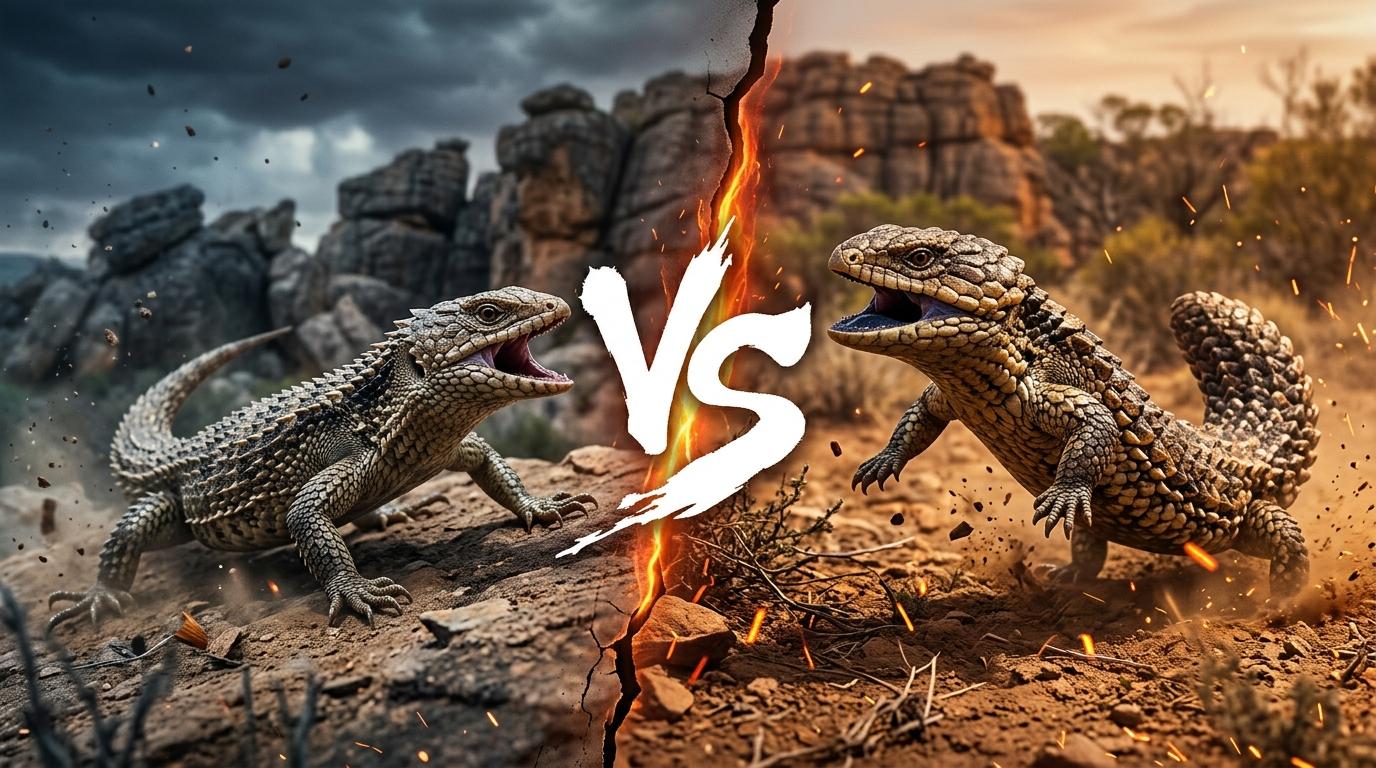
Gidgee Skink vs Shingleback Skink: Who Actually Wins?
Gidgee skink vs shingleback skink: who would win? A biology-first breakdown of spines, bite, armor, agility, crevice defense and which Australian skink comes out on top.
Gidgee Skink vs Shingleback Skink
Matchup winner
Gidgee Skink
Quick verdict
Start with the direct answer, then use the structured comparison below to see what changes the outcome.
The Gidgee Skink (Egernia stokesii) takes this matchup, but only narrowly. The Shingleback (Tiliqua rugosa) is the heavier, bulkier lizard, with a strong crushing bite and pinecone-like armor. What tips the contest is how the Gidgee fights. It moves faster and reacts quicker, and every keeled scale and its short, flattened tail carry stiff spines. It is also built around crevice warfare: it wedges into rock and inflates its body until it is almost impossible to extract or bite cleanly. A Shingleback relies on slow, steady deterrence, gaping its blue tongue and clamping when something gets close. That works superbly against predators that hesitate. It works less well against a nimble, spiny rival that can pick its moment, reach shelter, and refuse to give up a clean grip. In most realistic contexts the Gidgee controls when and where contact happens, and in a skink-scale dispute that is usually the whole fight.
Read the full explanation
Overall winner: Gidgee Skink, by agility, spiny armor and crevice control.
The Shingleback is heavier and bites hard, so it wins a slow, open-ground grapple.
Near rock cover, the Gidgee wedges in and inflates, which becomes almost unbeatable.
Real encounters are rare and mostly end with posturing and retreat, not injury.
Reader vote
Who do you think wins?
Pick a side — no account needed. Results update live.
No votes yet — be the first to call it.
Editorial note
Why people disagree
Size intuition favors the Shingleback. It is the chunkier, heavier lizard, so many assume weight wins outright.
Explosive power
In small-lizard disputes, the animal that strikes or retreats first sets the terms.
Crushing bite
The Shingleback's clamp is its best weapon if it lands a grip on a soft target.
Close-range durability
Both are well armored, but spines punish an attacker, while smooth bulk only absorbs the blow.
Read the full explanation +
The blue-tongue threat display looks intimidating, but it is a bluff-first defense built for predators, not for a contest against a rival.
The Gidgee's spines are easy to overlook in photos, yet they turn every bite attempt into a painful, low-reward mouthful.
Comparison FAQ
Short, direct answers to the next questions readers usually ask after the headline verdict.
Would a Gidgee Skink beat a Shingleback Skink?+
Usually, yes. Near cover the Gidgee wins clearly. In open ground with nowhere to retreat, the heavier Shingleback has the edge.
Which skink is stronger?+
The Shingleback is stronger in raw terms. It has more mass and a broader, harder-crushing bite. The Gidgee makes up the difference with speed, spines and defensive positioning.
Why is the Shingleback still dangerous even though it loses overall?+
Its bite clamps hard and holds on, and its thick armor shrugs off light attacks. Any opponent that lets it get a grip in the open will regret it.
Do these skinks actually fight in the wild?+
Rarely. Their ranges overlap in parts of Australia, but encounters mostly end with displays and retreat. Real fighting happens mainly between rivals of the same species.
Head-to-head species stats
These are the same core AnimalDex stat dimensions used on the dedicated animal pages, pulled side by side so the matchup is faster to scan.
Gidgee Skink
Tier CShingleback Skink
Tier CTrait-by-trait comparison
Only the categories that matter to this matchup are included. The goal is not filler stats, but the real design differences that change the result.
Quick bursts, fast lunges
Explosive power
Gidgee Skink
Slow, deliberate movement
Explosive power
Gidgee Skink
Solid bite for its size
Crushing bite
Shingleback Skink
Broad jaws built for snails and tough food
Crushing bite
Shingleback Skink
Spiny keeled scales and a spiked tail
Close-range durability
Gidgee Skink
Thick, cone-like osteoderm armor
Close-range durability
Gidgee Skink
Compact, lighter frame
Body mass
Shingleback Skink
Heavy, stout body
Body mass
Shingleback Skink
Crevice-wedging and body inflation
Ambush and refuge control
Gidgee Skink
Shelters under litter and shrubs
Ambush and refuge control
Gidgee Skink
Alert, socially attuned
Tactical awareness
Gidgee Skink
Steady, display-driven
Tactical awareness
Gidgee Skink
How the verdict forms
Verdict timeline
01 · Explosive power
Gidgee Skink
02 · Crushing bite
Shingleback Skink
03 · Close-range durability
Gidgee Skink
04 · Body mass
Shingleback Skink
05 · Ambush and refuge control
Gidgee Skink
06 · Tactical awareness
Gidgee Skink
Change the conditions
Scenario breakdown
This is where shallow battle content usually fails. Terrain, spacing, timing, and engagement style can change the answer.
Scenario lean
Gidgee Skink
Verdict confidence
82%
Gidgee wins decisively.
With rock crevices nearby, the Gidgee does what it evolved to do. It slips in, braces its spiny scales against the stone and puffs up. The Shingleback's blunt head and broad bite find only spikes, so it has no way to pry the Gidgee loose.
AnimalDex field profiles
Explore these animals
Gidgee Skink
Egernia stokesii
rocky outcrop, arid woodland, and dry shrubland
Shingleback Skink
Tiliqua rugosa
dry scrub, open woodland, and arid grass edge
Systems Intelligence & Hidden Purpose
See the animals behind this comparison as engineered biological systems: what each one is built to do, where it gains leverage, and why the matchup changes by scenario.
Specialized Hardware
heavily armored rough scales, deep crevice colony life, and short stout body give the Gidgee Skink a body plan tuned for its niche.
Systems Script
Gidgee Skinks operate through rocky outcrop, arid woodland, and dry shrubland. Their design links movement, feeding, shelter, and timing into one workable survival system.
Strategic Insight
Harsh places reward efficiency, timing, and bodies that waste very little.
Specialized Hardware
short stump tail, pinecone-like heavy scales, and slow bluffing movement give the Shingleback Skink a body plan tuned for its niche.
Systems Script
Shingleback Skinks operate through dry scrub, open woodland, and arid grass edge. Their design links movement, feeding, shelter, and timing into one workable survival system.
Strategic Insight
Harsh places reward efficiency, timing, and bodies that waste very little.
Final take
The Gidgee Skink is the overall winner, but not because it is stronger. It wins because its whole body plan is a fortress-and-escape system. Spines, speed and crevice-wedging let it decide whether a fight happens at all.
Read the full explanation
The Shingleback is no pushover. It is a heavy, armored lizard with a real bite, and caught in the open it can bully the lighter Gidgee. It simply depends on opponents being intimidated, and a spiny, cover-savvy rival rarely is.
Collect both animals in AnimalDex
Track the species behind this matchup, compare their real traits, and build the rivalry into your AnimalDex collection.
Discussion
What do you think?
Share your reasoning with other readers. Be civil and stick to the animals.
Sign in to join the discussion.
Sign inNo comments yet. Start the conversation.