


Gila Monster vs Sidewinder: Who Actually Wins?
Gila monster vs sidewinder: a heavy, armored venomous lizard against a fast desert rattlesnake. See who wins, scenario by scenario, and why the loser stays dangerous.
Gila Monster vs Sidewinder
Matchup winner
Gila Monster
Quick verdict
Start with the direct answer, then use the structured comparison below to see what changes the outcome.
The Gila monster wins this desert matchup. It is the heavier animal, often roughly two to four times a sidewinder's mass, and its skin is studded with bony osteoderms that act as partial armor. It also has a clamp-and-hold bite that the sidewinder cannot shake off once the lizard connects. The sidewinder is far quicker and carries hemotoxic venom, but it is one of the smaller rattlesnakes, and its venom is milder than that of its larger relatives. Its fangs have to find soft tissue on a slow but stubborn, thick-bodied opponent. In a forced close-quarters encounter, the lizard's mass, grip, and durability outlast the snake's speed. The sidewinder's real edge is that it rarely has to fight at all. On open sand it can simply leave.
Read the full explanation
Gila monster wins most forced encounters on mass, armor-like skin, and a locking bite.
Sidewinder is faster and strikes first, but its small size limits how much venom and damage it can deliver.
On open dunes the sidewinder escapes, which counts as a survival win but not a fight win.
Both are venomous, so neither walks away guaranteed unharmed.
Reader vote
Who do you think wins?
Pick a side — no account needed. Results update live.
No votes yet — be the first to call it.
Editorial note
Why people disagree
Rattlesnake reputation makes people assume the snake wins automatically, but the sidewinder is a small, lighter-venomed rattler.
Body mass and leverage
In a grappling-range encounter, extra mass lets the lizard pin, hold, and absorb punishment.
Strike speed
The sidewinder almost always lands the first blow, which is its best path to an upset.
Venom delivery
Snake venom arrives faster, but the dose from a small sidewinder is limited.
Read the full explanation +
The Gila monster looks sluggish, and speed is often mistaken for fighting power in a matchup this close to the ground.
Their venoms work differently: the snake injects fast with a strike, while the lizard chews venom in over time. That makes it hard to compare who poisons whom more effectively.
Comparison FAQ
Short, direct answers to the next questions readers usually ask after the headline verdict.
Would a Gila monster beat a sidewinder in a fight?+
Usually yes. Its greater mass, armored skin, and locking bite give it the edge once the encounter is forced at close range.
Which is stronger, a Gila monster or a sidewinder?+
The Gila monster. It is several times heavier and has far stronger jaws, while the sidewinder's strengths are speed and venom, not raw power.
Why is the sidewinder still dangerous to a Gila monster?+
Its hemotoxic venom causes tissue damage and bleeding. A well-placed strike on soft tissue could seriously injure or weaken the lizard, especially if the snake bites first.
Is the Gila monster immune to rattlesnake venom?+
There is no solid evidence that it is immune. Its main protection comes from its size and its thick, osteoderm-studded skin, not from proven venom resistance.
Which venom is more dangerous to humans?+
Both can cause severe pain and medical emergencies, and both need prompt care. Gila monster bites are very painful but rarely fatal. Sidewinder bites are also rarely fatal but should always be treated by a professional.
Head-to-head species stats
These are the same core AnimalDex stat dimensions used on the dedicated animal pages, pulled side by side so the matchup is faster to scan.
Gila Monster
Tier CSidewinder
Tier CTrait-by-trait comparison
Only the categories that matter to this matchup are included. The goal is not filler stats, but the real design differences that change the result.
Stocky, roughly 350–700 g
Body mass and leverage
Gila Monster
Slender, roughly 100–250 g
Body mass and leverage
Gila Monster
Slow, deliberate lunges
Strike speed
Sidewinder
Rapid coiled strikes
Strike speed
Sidewinder
Grooved teeth, venom worked in by chewing
Venom delivery
Sidewinder
Hollow fangs, fast hemotoxic injection
Venom delivery
Sidewinder
Bony osteoderms in thick, beaded skin
Close-range durability
Gila Monster
Thin skin, delicate build
Close-range durability
Gila Monster
Locks on and refuses to let go
Bite-and-hold control
Gila Monster
Strike-and-release style
Bite-and-hold control
Gila Monster
Slow walker, relies on burrows
Escape mobility
Sidewinder
Sidewinding glides fast over loose sand
Escape mobility
Sidewinder
How the verdict forms
Verdict timeline
01 · Body mass and leverage
Gila Monster
02 · Strike speed
Sidewinder
03 · Venom delivery
Sidewinder
04 · Close-range durability
Gila Monster
05 · Bite-and-hold control
Gila Monster
06 · Escape mobility
Sidewinder
Change the conditions
Scenario breakdown
This is where shallow battle content usually fails. Terrain, spacing, timing, and engagement style can change the answer.
Scenario lean
Gila Monster
Verdict confidence
82%
Gila monster, decisively.
Tight quarters remove the sidewinder's mobility advantage. The lizard can absorb a strike on its armored, fleshy body, close the distance, and clamp down. Once it is locked on, its mass and grip neutralize the snake's coil and strike.
AnimalDex field profiles
Explore these animals
Gila Monster
Heloderma suspectum
Desert scrub, rocky foothills, and arid thorn country.
Sidewinder
Crotalus cerastes
sand dune, desert wash, and hot arid plain
Systems Intelligence & Hidden Purpose
See the animals behind this comparison as engineered biological systems: what each one is built to do, where it gains leverage, and why the matchup changes by scenario.
Specialized Hardware
Beaded scales and stout body, orange-and-black warning pattern, and short strong legs and thick tail give the Gila Monster a body plan tuned for its niche.
Systems Script
Gila Monsters operate in desert scrub, rocky foothills, and arid thorn country. Their design helps them match food access, shelter, and timing inside that environment.
Strategic Insight
A system does not need speed if it already communicates danger clearly.
Specialized Hardware
sidewinding desert movement, heat-sensing pits, and horn-like scales above eyes give the Sidewinder a body plan tuned for its niche.
Systems Script
Sidewinders operate through sand dune, desert wash, and hot arid plain Their design links movement, shelter, and feeding into one workable survival system.
Strategic Insight
The right movement pattern can make a difficult platform usable.
Final take
This matchup comes down to mass against speed, and at this scale mass wins when the fight is forced. The Gila monster is built like a small tank. It has partial bony armor, a heavy body, and a bite designed to stay on. The sidewinder is a precision instrument made for quick strikes and quick exits.
Read the full explanation
Pick the Gila monster as the overall winner, but respect the sidewinder's choice. In the real desert the snake's best move is to avoid the lizard entirely, and its terrain usually lets it do that.
Collect both animals in AnimalDex
Track the species behind this matchup, compare their real traits, and build the rivalry into your AnimalDex collection.
Related comparisons
Continue with nearby matchups to compare more real-world animal traits without dropping into junky who-wins filler.
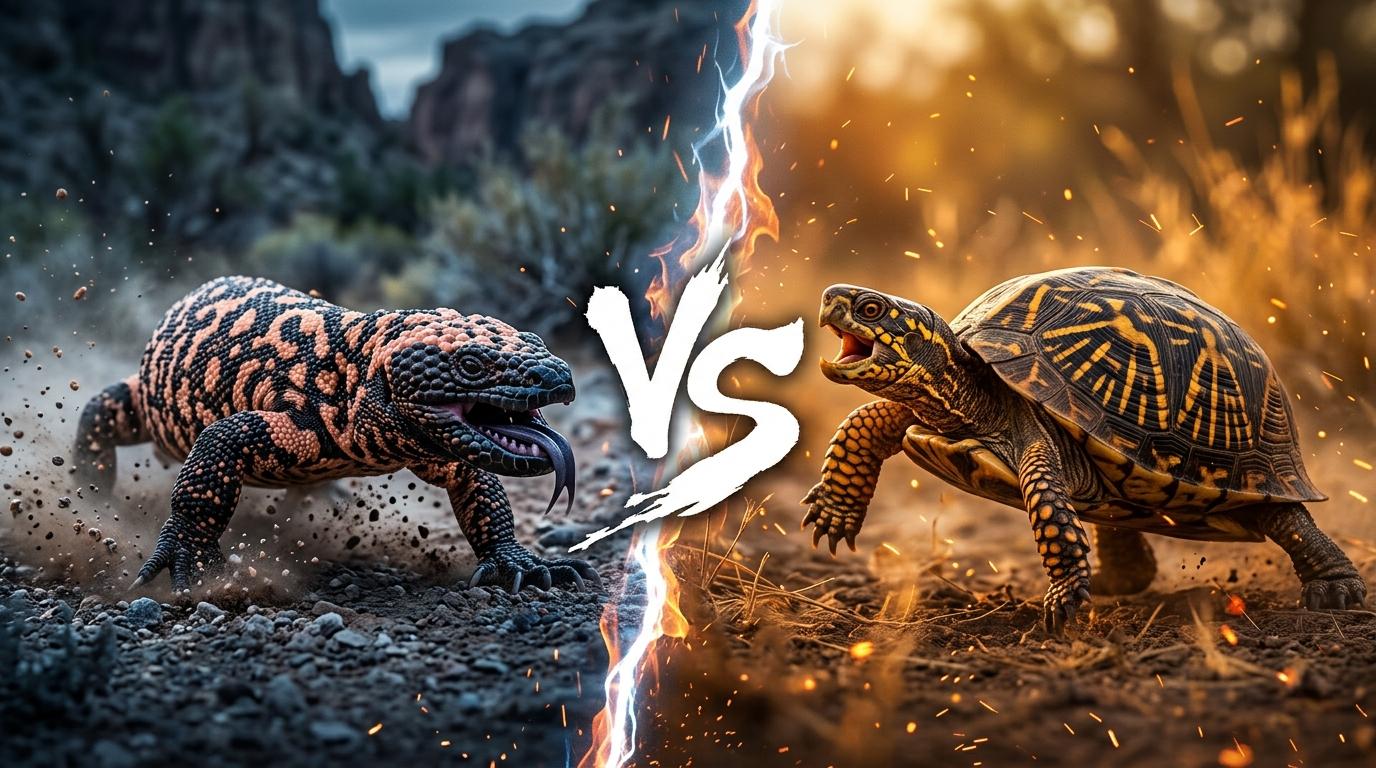
Gila Monster vs Ornate Box Turtle: Who Actually Wins?
The Gila monster wins this matchup. It is roughly three to four times heavier than an ornate box turtle, has a crushing, locking bite backed by neurotoxic venom, and is a known predator of reptile eggs and small vertebrates. The ornate box turtle's best weapon is not offense at all. Its hinged plastron lets it seal itself almost completely inside its shell, so the Gila monster's realistic victory is control and domination of the encounter rather than a quick kill. If the turtle closes up in time, the lizard usually gives up and walks off. If it is caught exposed, or if the contest is over food, shelter, or a nest, the heavier, venom-armed lizard holds the clear edge.
Read comparison
Discussion
What do you think?
Share your reasoning with other readers. Be civil and stick to the animals.
Sign in to join the discussion.
Sign inNo comments yet. Start the conversation.