

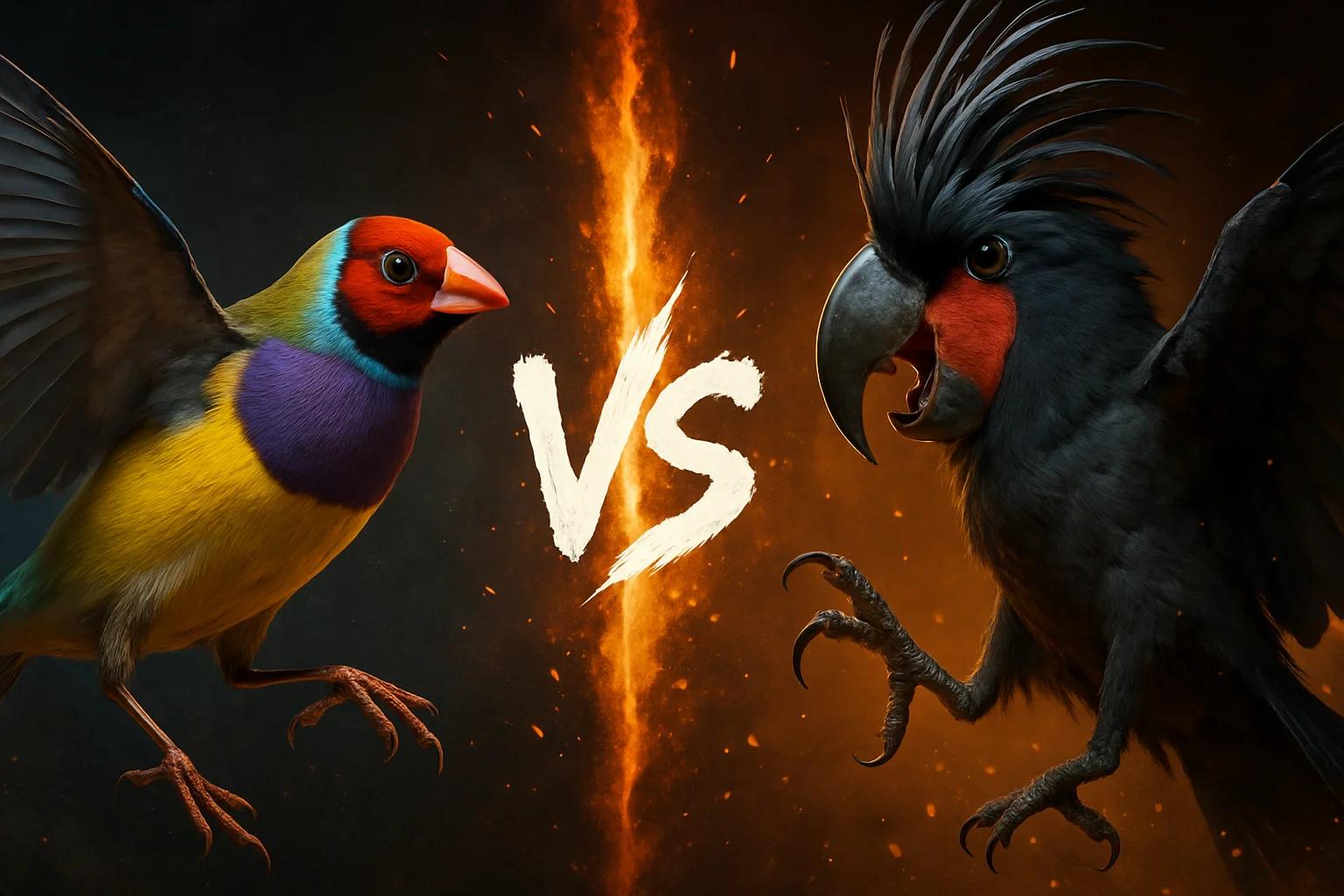
Gouldian Finch vs Palm Cockatoo: Who Actually Wins?
Gouldian Finch vs Palm Cockatoo: a biology-first look at size, beak power, agility and behavior to see which Australasian bird would win a confrontation.
Gouldian Finch vs Palm Cockatoo
Matchup winner
Palm Cockatoo
Quick verdict
Start with the direct answer, then use the structured comparison below to see what changes the outcome.
The Palm Cockatoo wins, and it isn't close. At roughly 900–1,000 g against a Gouldian Finch's 14–16 g, the cockatoo outweighs its rival about sixty-fold and carries one of the most powerful beaks in the bird world, a nut-cracking tool built to split palm and kanari nuts. The finch's real assets are fast, darting flight, flock vigilance and the instinct to flee early. Those help it survive, but they cannot win a contest. In any situation where the two are forced together, the cockatoo controls the space. In the wild, though, the finch's best play is the one it always makes: leaving before contact happens.
Read the full explanation
Palm Cockatoo wins decisively thanks to a ~60x weight advantage and a crushing beak.
Gouldian Finch's only real edge is agility and early escape, not fighting ability.
The two rarely meet in the wild. Finches use grassy savanna and cockatoos favor rainforest and woodland edges in Cape York and New Guinea.
Palm Cockatoos are seed and nut eaters, not predators, so a real 'fight' would be a dominance clash, not a hunt.
Reader vote
Who do you think wins?
Pick a side — no account needed. Results update live.
No votes yet — be the first to call it.
Editorial note
Why people disagree
Some readers overrate the finch's speed. Agility wins escapes, not confrontations.
Raw size and mass
A sixty-fold mass gap means the finch has no way to physically contest the cockatoo.
Beak weaponry
The cockatoo's beak is built to split some of the hardest nuts in the region. Applied to a small bird, that force would be overwhelming.
Evasive flight
The finch's one meaningful advantage is that it can disengage before the cockatoo commits.
Read the full explanation +
People assume a parrot that eats nuts can't be dangerous, but a beak that cracks kanari nuts would end any physical contest instantly.
The finch's dazzling colors read as 'warning coloration' to some readers, but they are mate-signaling, not a toxin or defense.
Comparison FAQ
Short, direct answers to the next questions readers usually ask after the headline verdict.
Would a Gouldian Finch beat a Palm Cockatoo?+
No. The Palm Cockatoo wins easily because of its roughly sixty-fold weight advantage and its powerful nut-cracking beak.
Which bird is stronger?+
The Palm Cockatoo, by a huge margin. Its beak can split very hard nuts, and it is one of the largest cockatoos in the world.
Would a Palm Cockatoo attack a finch?+
Rarely. It eats seeds and nuts and isn't a predator. A real conflict would most likely be a cockatoo chasing a finch off food, water or a nest hollow.
Why is the Gouldian Finch still hard to beat?+
Its fast, darting flight and flock vigilance let it escape before contact. Catching it is far harder than defeating it.
Do they live in the same places?+
They overlap only marginally in northern Australia. Finches use tropical grassland, while Palm Cockatoos favor rainforest edges in Cape York and New Guinea.
Head-to-head species stats
These are the same core AnimalDex stat dimensions used on the dedicated animal pages, pulled side by side so the matchup is faster to scan.
Gouldian Finch
Tier BPalm Cockatoo
Tier BTrait-by-trait comparison
Only the categories that matter to this matchup are included. The goal is not filler stats, but the real design differences that change the result.
~14–16 g, 12–14 cm
Raw size and mass
Palm Cockatoo
~900–1,000 g, 55–60 cm
Raw size and mass
Palm Cockatoo
Tiny conical seed-husking beak
Beak weaponry
Palm Cockatoo
Massive hooked nut-cracker
Beak weaponry
Palm Cockatoo
Quick, darting, flock-coordinated
Evasive flight
Gouldian Finch
Strong but heavier, less nimble
Evasive flight
Gouldian Finch
Instinctive flock vigilance
Problem-solving and display
Palm Cockatoo
Tool-using drummer, complex displays
Problem-solving and display
Palm Cockatoo
Minimal, relies on flight
Intimidation display
Palm Cockatoo
Erect crest, flushing red cheek patch, loud calls
Intimidation display
Palm Cockatoo
Flocks share predator detection
Group resilience
Gouldian Finch
Pairs or small groups
Group resilience
Gouldian Finch
How the verdict forms
Verdict timeline
01 · Raw size and mass
Palm Cockatoo
02 · Beak weaponry
Palm Cockatoo
03 · Evasive flight
Gouldian Finch
04 · Problem-solving and display
Palm Cockatoo
05 · Intimidation display
Palm Cockatoo
06 · Group resilience
Gouldian Finch
Change the conditions
Scenario breakdown
This is where shallow battle content usually fails. Terrain, spacing, timing, and engagement style can change the answer.
Scenario lean
Palm Cockatoo
Verdict confidence
82%
Cockatoo dominates in close quarters.
Dense vegetation cancels the finch's open-air agility. With nowhere to accelerate, the bird with the reach, mass and beak controls every exchange. The finch's best result is slipping away through gaps the cockatoo can't follow.
AnimalDex field profiles
Explore these animals
Gouldian Finch
Erythrura gouldiae
tropical savannah, open woodland, and grassland waterhole
Palm Cockatoo
Probosciger aterrimus
rainforest, savannah woodland, and tall tropical forest edge
Systems Intelligence & Hidden Purpose
See the animals behind this comparison as engineered biological systems: what each one is built to do, where it gains leverage, and why the matchup changes by scenario.
Specialized Hardware
purple chest and green back, bright tri-color face, and grass-seed flocking give the Gouldian Finch a body plan tuned for its niche.
Systems Script
Gouldian Finchs operate through tropical savannah, open woodland, and grassland waterhole. Their design links movement, feeding, shelter, and timing into one workable survival system.
Strategic Insight
Dense environments reward precision, patience, and the ability to read layered cover.
Specialized Hardware
sooty black body, huge curved bill, and branch-drumming display behavior give the Palm Cockatoo a body plan tuned for its niche.
Systems Script
Palm Cockatoos operate through rainforest, savannah woodland, and tall tropical forest edge. Their design links movement, feeding, shelter, and timing into one workable survival system.
Strategic Insight
Dense environments reward precision, patience, and the ability to read layered cover.
Final take
The Palm Cockatoo is the clear winner. It holds overwhelming advantages in mass, weaponry and intimidation, and it wins every scenario where contact or ownership matters.
Read the full explanation
The Gouldian Finch's strength is a survival strategy: be small, fast, vigilant and gone. That keeps it alive, but it does not make it a fighter. Its only 'win' comes from refusing the contest.
Collect both animals in AnimalDex
Track the species behind this matchup, compare their real traits, and build the rivalry into your AnimalDex collection.
Related comparisons
Continue with nearby matchups to compare more real-world animal traits without dropping into junky who-wins filler.
Palm Cockatoo vs Sulphur-crested Cockatoo: Who Actually Wins?
The Palm Cockatoo wins a one-on-one contest. It is among the largest cockatoos, with big birds approaching 1 kg against roughly 750–900 g for a typical Sulphur-crested. It also carries what is widely considered the most massive bill of any cockatoo, a structure built to crack palm and kanari nuts that most parrots cannot open. In a direct dispute over a perch or nest hollow, that bill and frame give it the deciding edge in leverage and intimidation. The Sulphur-crested Cockatoo is not a pushover. It is bolder, louder, more agile and quicker to escalate, and it is a flock specialist. Where it can recruit allies, the matchup flips. Strip the contest down to two birds, and the heavier hardware wins.
Read comparison
Discussion
What do you think?
Share your reasoning with other readers. Be civil and stick to the animals.
Sign in to join the discussion.
Sign inNo comments yet. Start the conversation.