

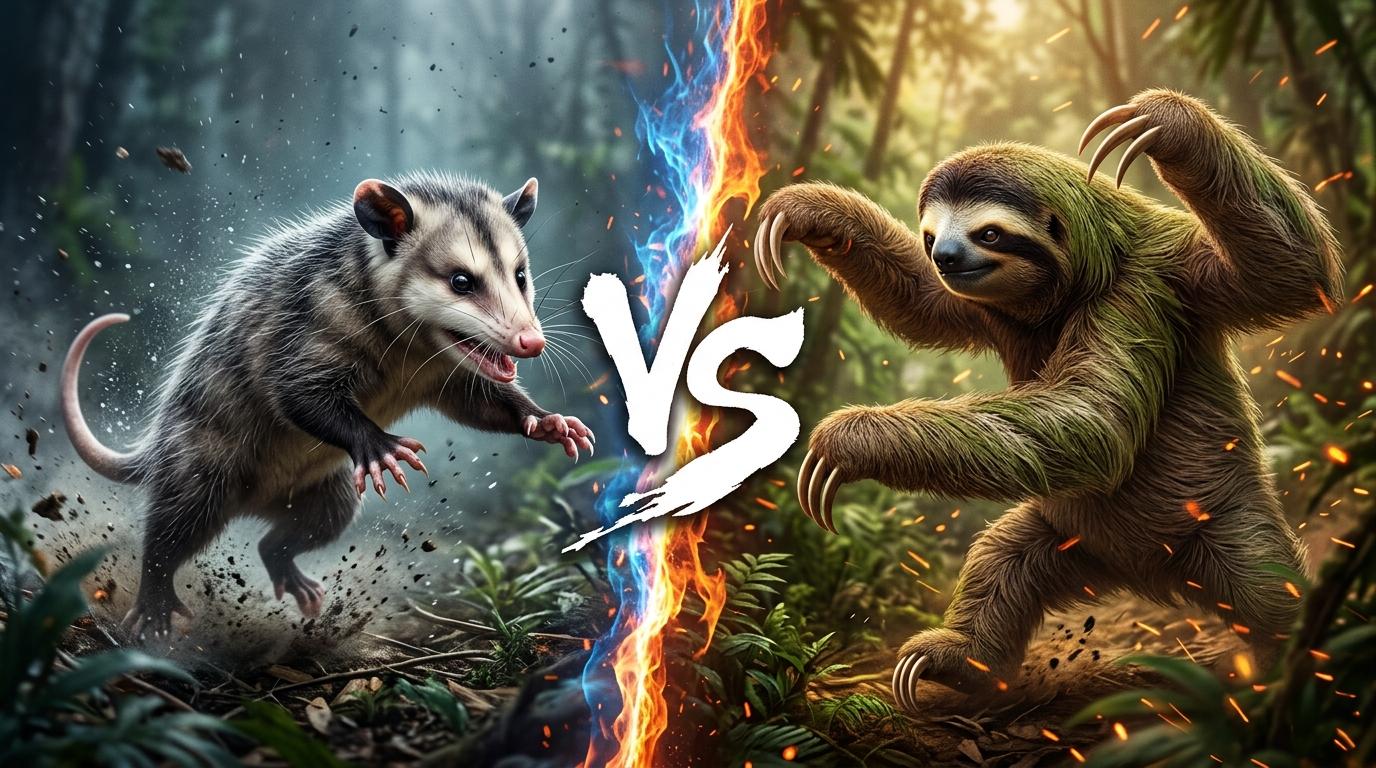
Gray Four-eyed Opossum vs Brown-throated Sloth: Who Actually Wins?
Gray four-eyed opossum vs brown-throated sloth: an agile, aggressive nocturnal hunter against a slow, heavy-clawed canopy specialist. See who wins, and why size and claws beat speed here.
Gray Four-eyed Opossum vs Three-toed Sloth
Matchup winner
Three-toed Sloth
Quick verdict
Start with the direct answer, then use the structured comparison below to see what changes the outcome.
The Brown-throated Sloth wins this one. On paper the Gray Four-eyed Opossum looks like the fighter. It is faster, twitchier, and a genuine predator that kills frogs, insects, birds, and small mammals. But an adult sloth weighs roughly 2–6 kg, while the opossum weighs about 0.2–0.7 kg, so the sloth is several times heavier. The sloth also carries 7–10 cm hooked claws on powerful forelimbs, a grip strong enough to hang asleep for hours, and a dense, shaggy coat over tough skin that blunts small bites. The opossum's real weapons are a fast bite and a fierce attitude, and those are built for prey far smaller than an adult sloth. It can harass, it can dodge, and it can escape at will, but it has no realistic way to finish the job. The sloth only needs to land one hooked swipe or lock its grip to end the exchange. Speed decides whether a fight starts. Mass and claws decide how it ends.
Read the full explanation
Winner: Brown-throated Sloth, mainly because of size and weaponry.
The sloth is several times heavier and has long hooked claws. The opossum's bite is built for much smaller prey.
The opossum controls the tempo and can always disengage, but it cannot kill an adult sloth.
Sloth babies or sick sloths are a different story. Healthy adults are effectively off the opossum's menu.
Reader vote
Who do you think wins?
Pick a side — no account needed. Results update live.
No votes yet — be the first to call it.
Editorial note
Why people disagree
The stat-line trap: the opossum scores higher on speed and 'dominance,' so people assume aggression wins. In small mammals, though, a severalfold weight gap usually outweighs attitude.
Body mass advantage
A weight gap this large means the opossum cannot pin, drag, or overpower the sloth.
Striking weapons
Claws give the sloth reach and real wounding potential before the opossum can close in.
Tempo control
The opossum decides whether a confrontation happens at all and can leave whenever it likes.
Read the full explanation +
The 'harmless sloth' myth: sloths look passive, but their forelimb claws are serious defensive tools, and a cornered sloth swipes with surprising force.
Defining 'win': if winning means surviving and leaving, the faster opossum often 'wins' by default. If winning means dominating the confrontation, the sloth does.
Comparison FAQ
Short, direct answers to the next questions readers usually ask after the headline verdict.
Would a gray four-eyed opossum beat a brown-throated sloth?+
No. A healthy adult sloth wins. The opossum is faster and more aggressive, but the sloth is several times heavier and has 7–10 cm claws that the opossum can't safely get past.
Which is stronger, the opossum or the sloth?+
The sloth. Its forelimb and grip strength, built for hanging for hours, far exceeds anything a sub-kilogram opossum can produce.
Does the four-eyed opossum ever eat sloths?+
There's no good evidence that it preys on healthy adults. Its diet centers on insects, frogs, small birds, small mammals, and fruit. A very young or dying sloth is theoretically within reach, but adults are not realistic prey.
Why is the opossum still dangerous even though it loses?+
It is a quick, determined biter with sharp teeth and a real predatory drive. It controls when and where encounters happen, can inflict painful nips on slower animals, and on the forest floor it holds the mobility advantage.
Why are sloths better fighters than they look?+
Their claws are defensive weapons, their fur absorbs bites, and their grip lets them anchor and strike at the same time. Slow does not mean defenseless.
Head-to-head species stats
These are the same core AnimalDex stat dimensions used on the dedicated animal pages, pulled side by side so the matchup is faster to scan.
Gray Four-eyed Opossum
Tier CThree-toed Sloth
Tier CTrait-by-trait comparison
Only the categories that matter to this matchup are included. The goal is not filler stats, but the real design differences that change the result.
~0.2–0.7 kg, lean and compact
Body mass advantage
Three-toed Sloth
~2–6 kg, dense and long-limbed
Body mass advantage
Three-toed Sloth
Sharp teeth, quick snapping bite
Striking weapons
Three-toed Sloth
7–10 cm hooked foreclaws
Striking weapons
Three-toed Sloth
Fast, nocturnal, quick to dart and retreat
Tempo control
Gray Four-eyed Opossum
Extremely slow, deliberate movement
Tempo control
Gray Four-eyed Opossum
Thin coat, small frame
Close-range durability
Three-toed Sloth
Thick shaggy fur over tough skin
Close-range durability
Three-toed Sloth
Active hunter of small vertebrates
Predatory drive
Gray Four-eyed Opossum
Folivore with no attack instinct
Predatory drive
Gray Four-eyed Opossum
Prehensile tail, decent climber
Grip and anchor strength
Three-toed Sloth
Locking grip that can hold for hours
Grip and anchor strength
Three-toed Sloth
How the verdict forms
Verdict timeline
01 · Body mass advantage
Three-toed Sloth
02 · Striking weapons
Three-toed Sloth
03 · Tempo control
Gray Four-eyed Opossum
04 · Close-range durability
Three-toed Sloth
05 · Predatory drive
Gray Four-eyed Opossum
06 · Grip and anchor strength
Three-toed Sloth
Change the conditions
Scenario breakdown
This is where shallow battle content usually fails. Terrain, spacing, timing, and engagement style can change the answer.
Scenario lean
Three-toed Sloth
Verdict confidence
82%
The sloth's home turf is a fortress.
Anchored by three limbs, the sloth can swing one clawed arm freely. The opossum climbs well but must approach along narrow branches, straight into the claw arc. With grip strength and reach on its side, the sloth wins easily.
AnimalDex field profiles
Explore these animals
Gray Four-eyed Opossum
Philander opossum
rainforest, secondary woodland, and streamside forest
Three-toed Sloth
Bradypus variegatus
Lowland rainforest, secondary forest, and humid tropical woodland with continuous canopy.
Systems Intelligence & Hidden Purpose
See the animals behind this comparison as engineered biological systems: what each one is built to do, where it gains leverage, and why the matchup changes by scenario.
Specialized Hardware
pale eyebrow eye-spots, prehensile tail, and night fruit-and-insect foraging give the Gray Four-eyed Opossum a body plan tuned for its niche.
Systems Script
Gray Four-eyed Opossums operate through rainforest, secondary woodland, and streamside forest. Their design links movement, feeding, shelter, and timing into one workable survival system.
Strategic Insight
Dense environments reward precision, patience, and the ability to read layered cover.
Specialized Hardware
Curved claws, hanging limb structure, and exceptionally slow energy use make three-toed sloths built for invisibility through understatement.
Systems Script
Sloths reduce predation pressure by refusing the pace most predators expect. They are reminders that ecosystems also make room for organisms whose main move is not being worth noticing.
Strategic Insight
Sometimes the strongest defense is lowering your signal below the threshold that triggers attention.
Final take
The Brown-throated Sloth takes this matchup. Not because it is a fighter, but because biology stacked the deck: several times the body weight, long hooked claws, a locking grip, and a protective coat. The Gray Four-eyed Opossum is the more aggressive, more capable hunter. It simply hunts in a weight class far below an adult sloth.
Read the full explanation
The opossum's best result is control rather than victory. It can harass, outpace, and walk away untouched, especially on the forest floor. Against a healthy adult sloth anchored in the canopy, it has no winning line. The sloth wins by being too big, too clawed, and too well-attached to bother.
Collect both animals in AnimalDex
Track the species behind this matchup, compare their real traits, and build the rivalry into your AnimalDex collection.
Related comparisons
Continue with nearby matchups to compare more real-world animal traits without dropping into junky who-wins filler.
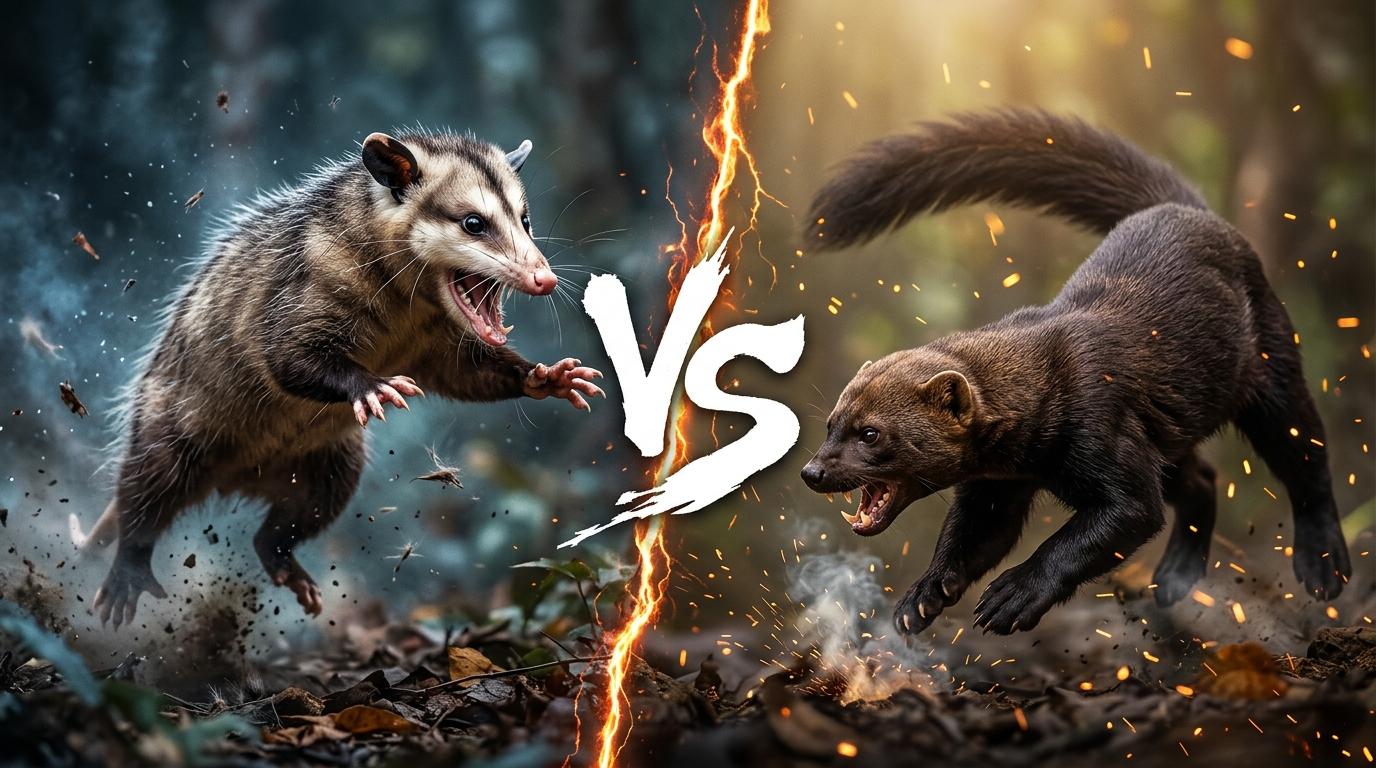
Gray Four-eyed Opossum vs Tayra: Who Actually Wins?
The tayra wins clearly. This large Neotropical weasel weighs roughly 3–6 kg and has a long, muscular body, strong neck, and a bite built for killing rodents, birds, and small mammals. The gray four-eyed opossum (Philander opossum) weighs about 0.2–0.7 kg. It is a quick, aggressive marsupial with a mouth full of sharp teeth, but it gives up close to a tenfold mass gap. The tayra climbs as well as it runs, so it can follow the opossum into trees and along the ground. It also behaves like a hunter that finishes what it starts. The opossum's best tools are a fast gape-and-hiss threat display, real bites, and escape into water or tangled cover. Those make it a costly target, not a threat to win.
Read comparison
Discussion
What do you think?
Share your reasoning with other readers. Be civil and stick to the animals.
Sign in to join the discussion.
Sign inNo comments yet. Start the conversation.