


Great Hornbill vs Ultramarine Lorikeet: Who Actually Wins?
Great Hornbill vs Ultramarine Lorikeet: a biology-first breakdown of size, bill power, agility, and escape skill, with a clear verdict on who wins.
Great Hornbill vs Ultramarine Lorikeet
Matchup winner
Great Hornbill
Quick verdict
Start with the direct answer, then use the structured comparison below to see what changes the outcome.
The Great Hornbill wins, and the margin is enormous. At roughly 2–4 kg and well over a meter long, it outweighs the 30–40 g Ultramarine Lorikeet by about 60 to 100 times. Its massive casqued bill is a long-reach tool that already handles fruit, lizards, rodents, and small birds. The lorikeet is a tiny Marquesan nectar specialist. It has a sharp hooked beak, quick reflexes, and tight maneuvering, but nothing that can hurt a bird this large. If they actually make contact, the hornbill controls the encounter. The lorikeet's only real victory condition is to never be caught.
Read the full explanation
The Great Hornbill wins decisively. It holds a 60–100x mass advantage and a long-reach bill.
Hornbills are omnivores that do take small vertebrates, so the matchup isn't purely hypothetical biology.
The lorikeet's best weapons are acceleration, tight turns, and dense cover.
In any sustained close contact, the lorikeet has no realistic path to winning.
Reader vote
Who do you think wins?
Pick a side — no account needed. Results update live.
No votes yet — be the first to call it.
Editorial note
Why people disagree
Some readers assume the hornbill's bill is heavy and clumsy. The casque is actually lightweight, honeycombed bone, and the bill is precise enough to toss and catch fruit.
Body mass & frame
Mass decides small-bird contact. The hornbill can pin, shake, or simply overpower a bird this light.
Weapon reach
The hornbill can strike from well outside the lorikeet's reach, so the lorikeet must close the distance just to land a bite.
Aerial agility
This is the lorikeet's lifeline. It can out-turn and out-accelerate the hornbill in branches.
Read the full explanation +
Parrot fans point to the lorikeet's bite and intelligence. But a 35 g bird's bite can't seriously harm a bird weighing several kilograms.
'Who wins' gets confused with 'who escapes.' The lorikeet can often avoid the fight, but escaping doesn't count as winning it.
Comparison FAQ
Short, direct answers to the next questions readers usually ask after the headline verdict.
Would a Great Hornbill beat an Ultramarine Lorikeet in a fight?+
Yes, decisively. The hornbill is about 60–100 times heavier and has a far longer reach, so any sustained contact ends in its favor.
Which bird is stronger?+
The Great Hornbill, by a huge margin. Its body mass, neck strength, and bill dwarf anything a 35 g lorikeet can produce.
Why is the Ultramarine Lorikeet still dangerous or hard to beat?+
It is fast, agile, and alert, and its hooked beak can bite sharply when it is grabbed. In dense foliage it can usually escape before a hornbill ever gets close.
Do hornbills actually eat small birds?+
Great Hornbills are mainly fruit eaters, but they also take small vertebrates, including lizards, rodents, and occasionally small birds or nestlings.
Where do these birds live?+
Great Hornbills live in forests across India and Southeast Asia. Ultramarine Lorikeets are restricted to a few islands in French Polynesia's Marquesas and are endangered.
Head-to-head species stats
These are the same core AnimalDex stat dimensions used on the dedicated animal pages, pulled side by side so the matchup is faster to scan.
Great Hornbill
Tier AUltramarine Lorikeet
Tier BTrait-by-trait comparison
Only the categories that matter to this matchup are included. The goal is not filler stats, but the real design differences that change the result.
About 2–4 kg, 95–130 cm long
Body mass & frame
Great Hornbill
About 30–40 g, around 18 cm
Body mass & frame
Great Hornbill
Massive casqued bill, roughly 25–30 cm
Weapon reach
Great Hornbill
Short, sharp hooked parrot beak
Weapon reach
Great Hornbill
Slow, heavy flapping flight with loud wingbeats
Aerial agility
Ultramarine Lorikeet
Fast, darting, tight turns through foliage
Aerial agility
Ultramarine Lorikeet
Omnivore that takes lizards, rodents, and small birds
Predatory experience
Great Hornbill
Nectar and pollen feeder with a brush-tipped tongue
Predatory experience
Great Hornbill
Alert, deliberate forager
Situational awareness
Ultramarine Lorikeet
Quick-reacting, social, vigilant parrot
Situational awareness
Ultramarine Lorikeet
Large body, thick plumage, tough bill
Close-range durability
Great Hornbill
Fragile, tiny-bodied
Close-range durability
Great Hornbill
How the verdict forms
Verdict timeline
01 · Body mass & frame
Great Hornbill
02 · Weapon reach
Great Hornbill
03 · Aerial agility
Ultramarine Lorikeet
04 · Predatory experience
Great Hornbill
05 · Situational awareness
Ultramarine Lorikeet
06 · Close-range durability
Great Hornbill
Change the conditions
Scenario breakdown
This is where shallow battle content usually fails. Terrain, spacing, timing, and engagement style can change the answer.
Scenario lean
Ultramarine Lorikeet
Verdict confidence
82%
The lorikeet survives by vanishing into foliage.
Dense branches cancel the hornbill's reach and punish its large wingspan. The lorikeet can thread gaps a 1.5 m-wingspan bird cannot follow, so escape is very likely. This is the lorikeet's only 'win,' and it comes from avoiding the fight rather than winning it.
AnimalDex field profiles
Explore these animals
Great Hornbill
Buceros bicornis
evergreen forest, riverine woodland, and tall tropical canopy
Ultramarine Lorikeet
Vini ultramarina
island forest, coconut grove, and flowering tropical woodland
Systems Intelligence & Hidden Purpose
See the animals behind this comparison as engineered biological systems: what each one is built to do, where it gains leverage, and why the matchup changes by scenario.
Specialized Hardware
massive yellow casque bill, black-and-white wings, and fruit-carrying canopy flight give the Great Hornbill a body plan tuned for its niche.
Systems Script
Great Hornbills operate through evergreen forest, riverine woodland, and tall tropical canopy. Their design links movement, feeding, shelter, and timing into one workable survival system.
Strategic Insight
Dense environments reward precision, patience, and the ability to read layered cover.
Specialized Hardware
deep ultramarine-blue plumage, brush-tipped nectar tongue, and flowering-canopy flock movement give the Ultramarine Lorikeet a body plan tuned for its niche.
Systems Script
Ultramarine Lorikeets operate through island forest, coconut grove, and flowering tropical woodland. Their design links movement, feeding, shelter, and timing into one workable survival system.
Strategic Insight
Dense environments reward precision, patience, and the ability to read layered cover.
Final take
The Great Hornbill wins this matchup clearly. It is one of Asia's largest forest birds, armed with a long-reach bill and an omnivore's willingness to seize small animals. The Ultramarine Lorikeet is a jewel-sized nectar specialist from the Marquesas Islands. Its whole body plan is built for hovering through blossoms, not for fighting.
Read the full explanation
The lorikeet still has an edge in one place: canopy cover, where speed, tight turns, and vigilance let it disappear. That is a survival skill rather than a combat one, and survival is exactly what this endangered island bird has had to master.
Collect both animals in AnimalDex
Track the species behind this matchup, compare their real traits, and build the rivalry into your AnimalDex collection.
Related comparisons
Continue with nearby matchups to compare more real-world animal traits without dropping into junky who-wins filler.
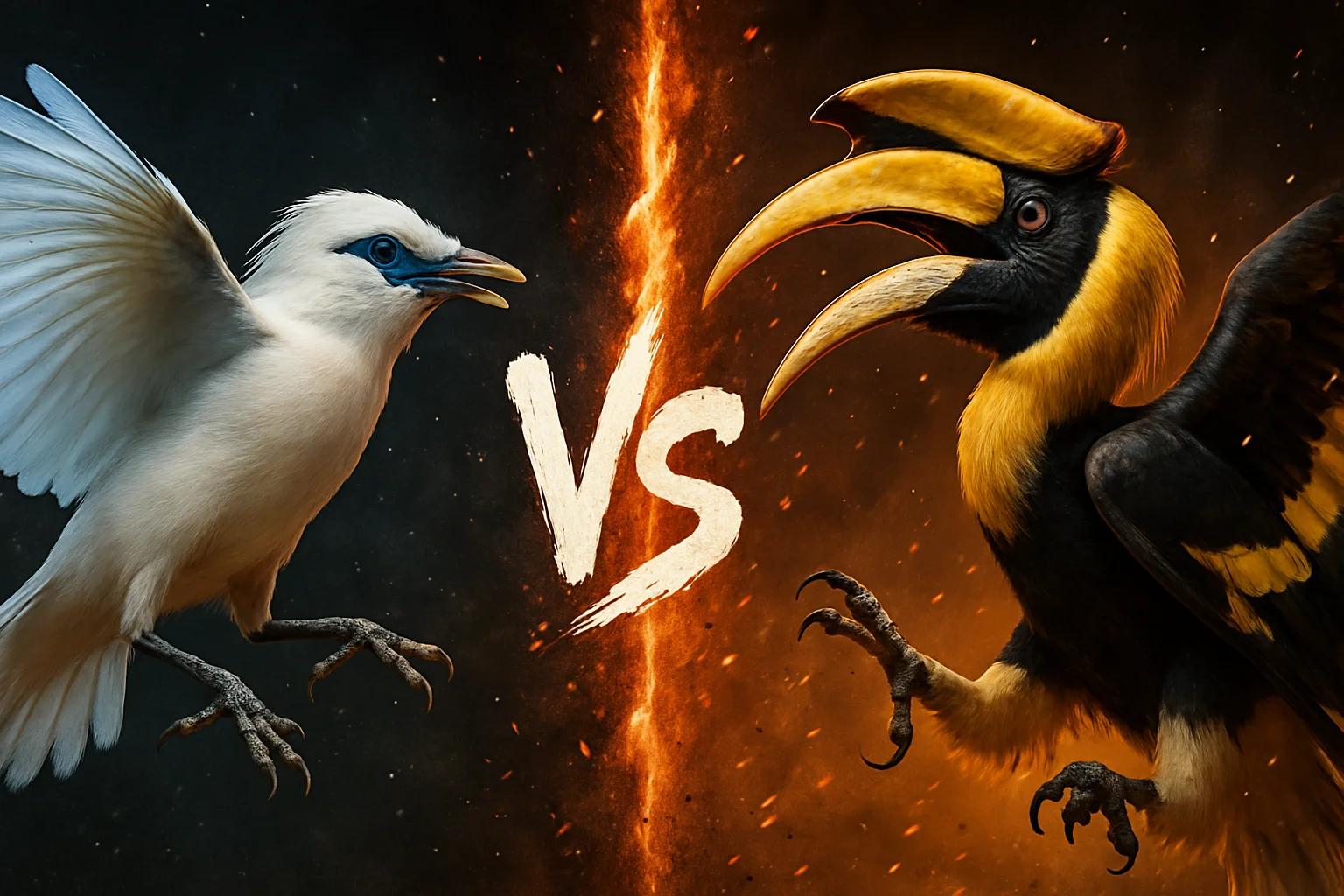
Bali Myna vs Great Hornbill: Who Actually Wins?
The Great Hornbill wins clearly. At roughly 2–3 kg and up to about 1.3 m long, it outweighs the 25 cm, roughly 90 g Bali Myna by more than twenty to one. It also carries a massive casqued bill that can crush fruit pits and seize small animals. The myna is quick, alert and agile in cover, but it has no weapon that can seriously threaten a bird this large. Hornbills also prey on small vertebrates, including nestlings, so the size gap is not just about weight. It is the difference between predator and potential prey. The myna's best outcome is evasion, not victory.
Read comparison
Discussion
What do you think?
Share your reasoning with other readers. Be civil and stick to the animals.
Sign in to join the discussion.
Sign inNo comments yet. Start the conversation.