

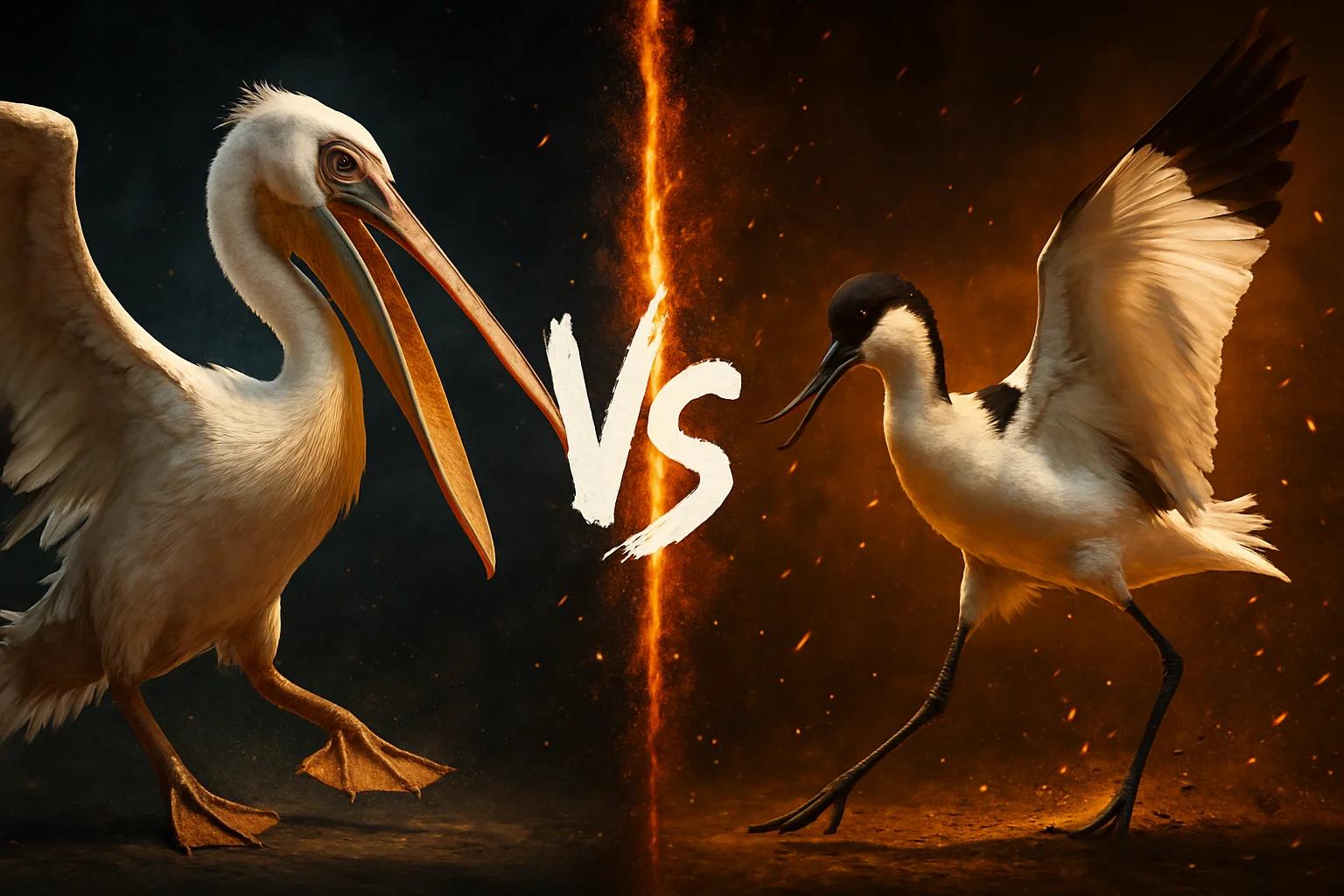
Great White Pelican vs Pied Avocet: Who Actually Wins?
Great White Pelican vs Pied Avocet: a biology-first breakdown of size, speed, defense and behavior to settle who would win in a confrontation.
Great White Pelican vs Pied Avocet
Matchup winner
Great White Pelican
Quick verdict
Start with the direct answer, then use the structured comparison below to see what changes the outcome.
The Great White Pelican wins this matchup clearly. At roughly 9–11 kg with a wingspan near 3 meters, it outweighs a 300-gram Pied Avocet by about thirty to one, and its long hooked bill and heavy body make it physically untouchable for the smaller wader. The avocet has real tools: it is quicker on the wing and more agile, and it is famous for loud, swooping mob attacks that drive gulls, crows and even people away from its nests. But mobbing is built to harass and distract, not to injure something pelican-sized. In any direct contest the pelican simply absorbs the noise and holds its ground. The avocet's best result is to make the pelican leave, never to beat it.
Read the full explanation
Great White Pelican wins: around 30 times heavier, with a massive bill and frame.
Pied Avocet is faster and more agile, and an aggressive nest defender.
Avocet mobbing can drive off intruders but cannot seriously hurt a pelican.
Neither species hunts the other, so real clashes are rare territorial standoffs.
Reader vote
Who do you think wins?
Pick a side — no account needed. Results update live.
No votes yet — be the first to call it.
Editorial note
Why people disagree
Avocets are famously fierce around their nests, so people overrate how much damage that fierceness can do to a giant bird.
Raw mass and frame
A thirty-fold weight gap settles almost every physical exchange before it starts.
Bill as a weapon
The avocet's bill is a precision feeding tool, not a stabbing weapon.
Aerial agility
Agility lets the avocet harass safely, but it doesn't turn into damage.
Read the full explanation +
Pelicans look clumsy on land, which hides how much mass and leverage stand behind that bill.
Some people count 'made the pelican leave' as a win, but driving an animal off is not the same as beating it.
Comparison FAQ
Short, direct answers to the next questions readers usually ask after the headline verdict.
Would a Great White Pelican beat a Pied Avocet in a fight?+
Yes. The pelican is about 30 times heavier and has a powerful bill. The avocet cannot cause meaningful harm.
Which bird is stronger?+
The Great White Pelican, by an enormous margin, thanks to its body mass, wing power and bill leverage.
Is the Pied Avocet still dangerous?+
To intruders near its nest, yes. Avocets mob aggressively with loud dives that drive off gulls, crows and even people. They win by harassment, not by injury.
Do pelicans eat avocets?+
Not normally. Great White Pelicans eat mainly fish, so the two species rarely come into conflict.
Head-to-head species stats
These are the same core AnimalDex stat dimensions used on the dedicated animal pages, pulled side by side so the matchup is faster to scan.
Great White Pelican
Tier CPied Avocet
Tier CTrait-by-trait comparison
Only the categories that matter to this matchup are included. The goal is not filler stats, but the real design differences that change the result.
9–11 kg, ~3 m wingspan
Raw mass and frame
Great White Pelican
~0.3 kg, slender wader
Raw mass and frame
Great White Pelican
Long bill with a hooked tip, strong jabs and grabs
Bill as a weapon
Great White Pelican
Thin upcurved bill made for sweeping water
Bill as a weapon
Great White Pelican
Superb soarer but slow to turn
Aerial agility
Pied Avocet
Quick, tight dives and fast turns
Aerial agility
Pied Avocet
Colony crowding and size-based deterrence
Defensive aggression
Pied Avocet
Loud, persistent group mobbing
Defensive aggression
Pied Avocet
Thick plumage over a large body
Close-range durability
Great White Pelican
Light frame with delicate legs
Close-range durability
Great White Pelican
Webbed feet, stable floating platform
Footing in shallows
Great White Pelican
Long legs, nimble wading
Footing in shallows
Great White Pelican
How the verdict forms
Verdict timeline
01 · Raw mass and frame
Great White Pelican
02 · Bill as a weapon
Great White Pelican
03 · Aerial agility
Pied Avocet
04 · Defensive aggression
Pied Avocet
05 · Close-range durability
Great White Pelican
06 · Footing in shallows
Great White Pelican
Change the conditions
Scenario breakdown
This is where shallow battle content usually fails. Terrain, spacing, timing, and engagement style can change the answer.
Scenario lean
Great White Pelican
Verdict confidence
82%
The pelican holds the ground and ends any close exchange.
In knee-deep water, the pelican's stable floating platform and bill reach dominate. The avocet can feint and dart away, but every close approach puts it within range of a bird that outweighs it massively.
AnimalDex field profiles
Explore these animals
Great White Pelican
Pelecanus onocrotalus
Large lakes, lagoons, wetlands, estuaries, and coastal shallows.
Pied Avocet
Recurvirostra avosetta
estuary, salt pan, and lagoon shallows
Systems Intelligence & Hidden Purpose
See the animals behind this comparison as engineered biological systems: what each one is built to do, where it gains leverage, and why the matchup changes by scenario.
Specialized Hardware
Large pale body and broad wings, huge bill with throat pouch, and often fishes in cooperative groups give the Great White Pelican a body plan tuned for its niche.
Systems Script
Great White Pelicans operate in large lakes, lagoons, wetlands, estuaries, and coastal shallows. Their design helps them match food access, shelter, and timing inside that environment.
Strategic Insight
Shared positioning can make a hard catch easier for everyone.
Specialized Hardware
upcurved needle-thin bill, black-and-white wading body, and side-sweeping shallows feeding give the Pied Avocet a body plan tuned for its niche.
Systems Script
Pied Avocets operate through estuary, salt pan, and lagoon shallows. Their design links movement, feeding, shelter, and timing into one workable survival system.
Strategic Insight
Where water controls movement, position and timing often matter more than speed.
Final take
The Great White Pelican is the clear winner. Its size, bill and durability put it in a different weight class, and no amount of avocet speed closes that gap.
Read the full explanation
The Pied Avocet still deserves respect. Its fierce, coordinated nest defense is one of the boldest shows of attitude among shorebirds, and it can genuinely drive away much larger intruders. It wins the argument about who leaves, but never the physical contest.
Collect both animals in AnimalDex
Track the species behind this matchup, compare their real traits, and build the rivalry into your AnimalDex collection.
Discussion
What do you think?
Share your reasoning with other readers. Be civil and stick to the animals.
Sign in to join the discussion.
Sign inNo comments yet. Start the conversation.