


Green Lacewing vs Wasp Mantidfly: Who Actually Wins?
Common Green Lacewing vs Wasp Mantidfly: a biology-first look at raptorial forelegs, size, speed and defenses to settle which insect wins a fight.
Green Lacewing vs Mantidfly
Matchup winner
Mantidfly
Quick verdict
Start with the direct answer, then use the structured comparison below to see what changes the outcome.
The Wasp Mantidfly (Climaciella brunnea) wins this matchup clearly. It is the larger, faster, more heavily armed insect. Its mantis-style raptorial forelegs are built to snatch and pin flying prey, and its paper-wasp mimicry signals danger to anything watching. The Common Green Lacewing (Chrysoperla carnea) is a superb pest-control specialist, but the adult is a delicate nectar-and-pollen feeder with no grasping weapons. Its real predatory power belongs to its larva, the 'aphid lion.' In an adult-versus-adult contest, the lacewing's best tools are escape: ultrasound-sensitive wings, a defensive odor and a quick drop. The mantidfly's best tool is a strike. A strike beats a dodge most of the time.
Read the full explanation
Winner: Wasp Mantidfly. Raptorial forelegs plus a size and speed edge decide it.
Adult green lacewings mostly eat nectar, pollen and honeydew. They have no capture weapons.
The lacewing's best outcome is escaping, not winning.
Lacewing larvae are fierce predators, but they are not the adult duel being judged here.
Reader vote
Who do you think wins?
Pick a side — no account needed. Results update live.
No votes yet — be the first to call it.
Editorial note
Why people disagree
Lacewing fans picture the aphid-lion larva, which is a true killer, rather than the gentle adult.
Strike hardware
Only one of these insects is built to seize another insect in midair or on a leaf.
Body mass & reach
Extra size lets the mantidfly overpower struggling prey and hold it down.
Burst speed
The snap closes faster than a lacewing can react at close range.
Read the full explanation +
Mantidflies look so much like wasps that people assume a sting. They have none, so their threat is grip, not venom.
Both are lacewing-order relatives (Neuroptera), so some readers expect an even fight between cousins. Their adult lifestyles are completely different.
Comparison FAQ
Short, direct answers to the next questions readers usually ask after the headline verdict.
Would a Wasp Mantidfly beat a Green Lacewing?+
Yes. In most realistic encounters, the mantidfly seizes and eats the lacewing using its raptorial forelegs.
Which insect is stronger?+
The Wasp Mantidfly. It is larger and built for grasping. The adult lacewing is lightly built for flying and feeding.
Does the Wasp Mantidfly sting?+
No. It only mimics a paper wasp. Its danger to other insects comes from its grasping forelegs, not from venom.
Why is the green lacewing still dangerous?+
Its larva, the aphid lion, is a voracious predator with hollow sickle jaws. As an adult, the lacewing escapes many attackers using ultrasound hearing, a drop reflex and a defensive odor.
Can a lacewing ever win?+
Only by escaping, usually in open air where it has room to dodge.
Head-to-head species stats
These are the same core AnimalDex stat dimensions used on the dedicated animal pages, pulled side by side so the matchup is faster to scan.
Green Lacewing
Tier CMantidfly
Tier CTrait-by-trait comparison
Only the categories that matter to this matchup are included. The goal is not filler stats, but the real design differences that change the result.
No raptorial legs; small chewing mouthparts
Strike hardware
Mantidfly
Mantis-like folding raptorial forelegs
Strike hardware
Mantidfly
Slender and fragile, about 1.5 cm
Body mass & reach
Mantidfly
Stockier wasp-sized frame, about 2–2.5 cm
Body mass & reach
Mantidfly
Fluttery, slow flier
Burst speed
Mantidfly
Fast foreleg snap with agile flight
Burst speed
Mantidfly
Ultrasound-hearing wings, drop reflex, foul odor
Escape kit
Green Lacewing
Relies on wasp mimicry over evasion
Escape kit
Green Lacewing
Camouflage green
Deterrence signaling
Mantidfly
Convincing paper-wasp disguise
Deterrence signaling
Mantidfly
How the verdict forms
Verdict timeline
01 · Strike hardware
Mantidfly
02 · Body mass & reach
Mantidfly
03 · Burst speed
Mantidfly
04 · Escape kit
Green Lacewing
05 · Deterrence signaling
Mantidfly
Change the conditions
Scenario breakdown
This is where shallow battle content usually fails. Terrain, spacing, timing, and engagement style can change the answer.
Scenario lean
Mantidfly
Verdict confidence
82%
The mantidfly's ambush posture dominates.
In foliage, the mantidfly can sit still with its forelegs cocked, just as mantises do. A lacewing that lands within reach gets seized before its escape reflexes can help, and close quarters remove its biggest advantage, which is room to flee.
AnimalDex field profiles
Explore these animals
Green Lacewing
Chrysoperla carnea
garden, meadow, and woodland edge
Mantidfly
Climaciella brunnea
meadow edge, garden, and woodland margin
Systems Intelligence & Hidden Purpose
See the animals behind this comparison as engineered biological systems: what each one is built to do, where it gains leverage, and why the matchup changes by scenario.
Specialized Hardware
delicate green body, golden eyes, and aphid-hunting larval jaws give the Green Lacewing a body plan tuned for its niche.
Systems Script
Green Lacewings operate through garden, meadow, and woodland edge. Their design links movement, feeding, shelter, and timing into one workable survival system.
Strategic Insight
Dense environments reward precision, patience, and the ability to read layered cover.
Specialized Hardware
mantis-like raptorial forelegs, lacewing-style wings, and wasp-mimicking body pattern give the Mantidfly a body plan tuned for its niche.
Systems Script
Mantidflys operate through meadow edge, garden, and woodland margin. Their design links movement, feeding, shelter, and timing into one workable survival system.
Strategic Insight
Dense environments reward precision, patience, and the ability to read layered cover.
Final take
The Wasp Mantidfly wins because it is a hunter and the adult green lacewing is not. Raptorial forelegs, greater mass and a faster strike make the result lopsided whenever the two make contact.
Read the full explanation
The lacewing still deserves respect. Its larvae are among the best natural aphid controllers in gardens, and the adult's bat-detecting hearing and escape reflexes keep it alive against many predators. Its best outcome against the mantidfly is getting away, not winning the fight.
Collect both animals in AnimalDex
Track the species behind this matchup, compare their real traits, and build the rivalry into your AnimalDex collection.
Related comparisons
Continue with nearby matchups to compare more real-world animal traits without dropping into junky who-wins filler.
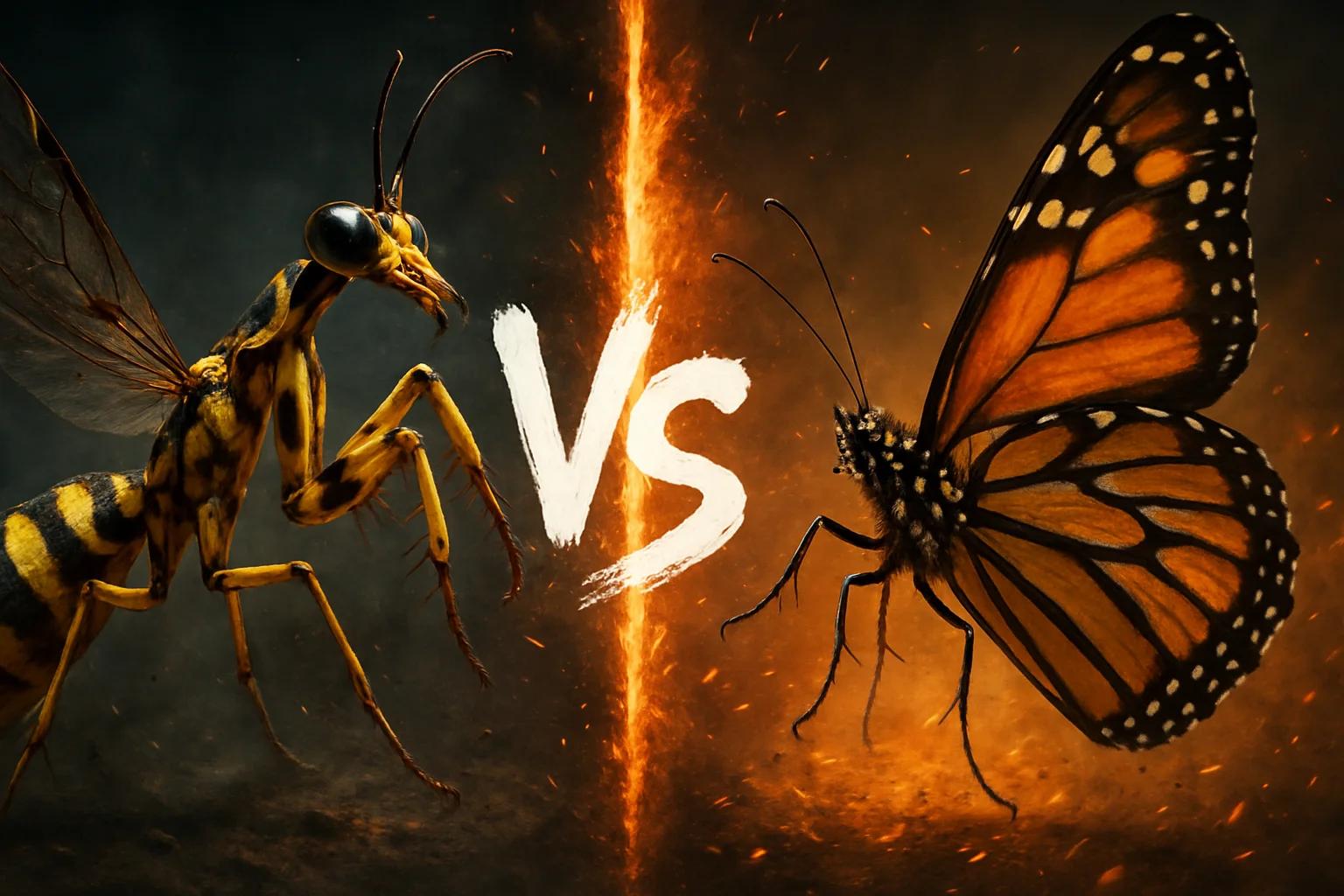
Wasp Mantidfly vs Monarch Butterfly: Who Actually Wins?
The Wasp Mantidfly wins. Climaciella brunnea is a true predator. It has spined, mantis-like raptorial forelegs built to snap shut on soft-bodied insects, and a paper-wasp disguise that keeps its own enemies at a distance. The Monarch Butterfly is not a fighter at all. Its strengths are speed on the wing, endurance over long distances, and cardenolide toxins it stores from milkweed, which make it a bad meal for birds. In any close contact the mantidfly holds the only real weapon. One caveat matters a great deal, though. Adult mantidflies are small, roughly 1–2.5 cm, and they usually hunt flies and small bees, while a monarch's wingspan of about 9–10 cm makes it awkward prey to grip and hold. The mantidfly controls the encounter, but it is not built to bring down a monarch, and it is unlikely to eat one.
Read comparison
Wasp Mantidfly vs Zebra Swallowtail: Who Actually Wins?
The Wasp Mantidfly wins. It is a built predator that looks like a paper wasp and carries folding, spined raptorial forelegs designed to snap shut on soft-bodied insects. The Zebra Swallowtail is a nectar-feeding butterfly with no weapons, no bite, and no grappling ability. Its strengths are long, swept wings, fast erratic flight, and a chemical defense picked up from pawpaw plants when it was a caterpillar. In any frame where the two actually make contact, such as a flower head, a perch, or a sunny resting spot, the mantidfly holds the only offensive tool. The swallowtail's realistic best outcome is to avoid contact altogether. That makes the butterfly good at escaping, but it does not make it the winner.
Read comparison
Green Lacewing vs Zebra Swallowtail: Who Actually Wins?
The zebra swallowtail wins. An adult Eurytides marcellus has a wingspan of roughly 6–10 cm, several times that of a common green lacewing, which spans about 3 cm. It is a strong, fast, darting flier that controls airspace at flowers and puddling sites through sheer mass and momentum. The adult green lacewing is not the aphid-hunter its reputation suggests. Adult Chrysoperla carnea feed mainly on nectar, pollen, and honeydew, and their only real weapons are a foul-smelling defensive secretion and bat-detecting ears tuned for escape. In any adult-versus-adult contest, the swallowtail displaces, outflies, and outlasts the lacewing. The lacewing's danger lives in its larva, the 'aphid lion,' which can pierce and drain soft insect eggs and tiny caterpillars. That is a real threat to a swallowtail's next generation, but it is not enough to flip the matchup.
Read comparison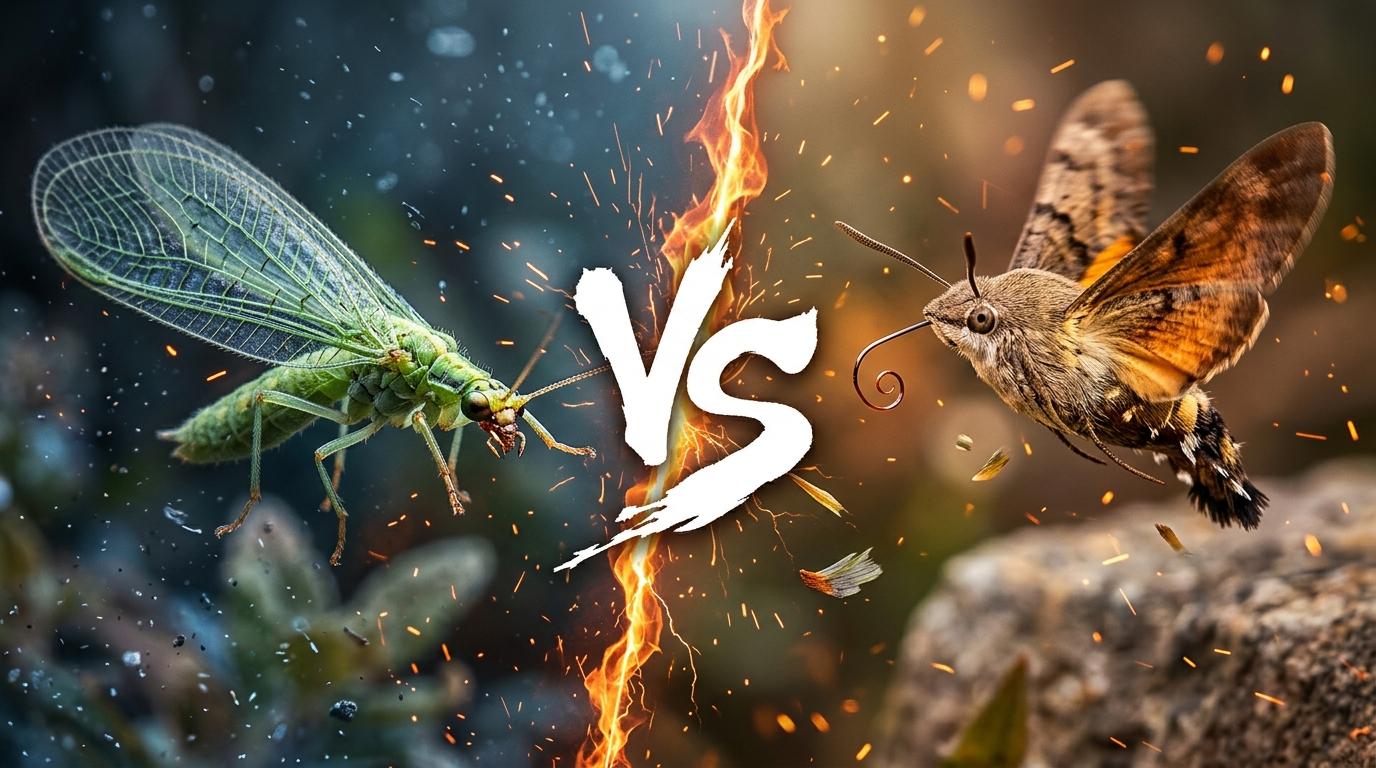
Common Green Lacewing vs Hummingbird Hawk-Moth: Who Actually Wins?
The Hummingbird Hawk-Moth wins this matchup clearly. With a 40–45 mm wingspan, a dense, scale-armored body, and one of the most powerful hovering flight engines among insects, it outclasses the adult Common Green Lacewing in mass, speed, and control of airspace. The adult lacewing is a delicate, slow-fluttering insect that feeds mainly on nectar, pollen, and honeydew. It carries no real weapons, so its main defenses are camouflage, ultrasound-sensitive hearing for detecting bats, and a foul-smelling chemical deterrent. In any adult-versus-adult encounter, the hawk-moth simply out-muscles, out-flies, and out-lasts it. The lacewing's real threat lives in its larval stage. The bristly 'aphid lion' has hollow, sickle-shaped jaws and preys on soft-bodied insects, including moth eggs and tiny caterpillars. That predator keeps the lacewing interesting, but it doesn't change who wins between adults.
Read comparison
Discussion
What do you think?
Share your reasoning with other readers. Be civil and stick to the animals.
Sign in to join the discussion.
Sign inNo comments yet. Start the conversation.