

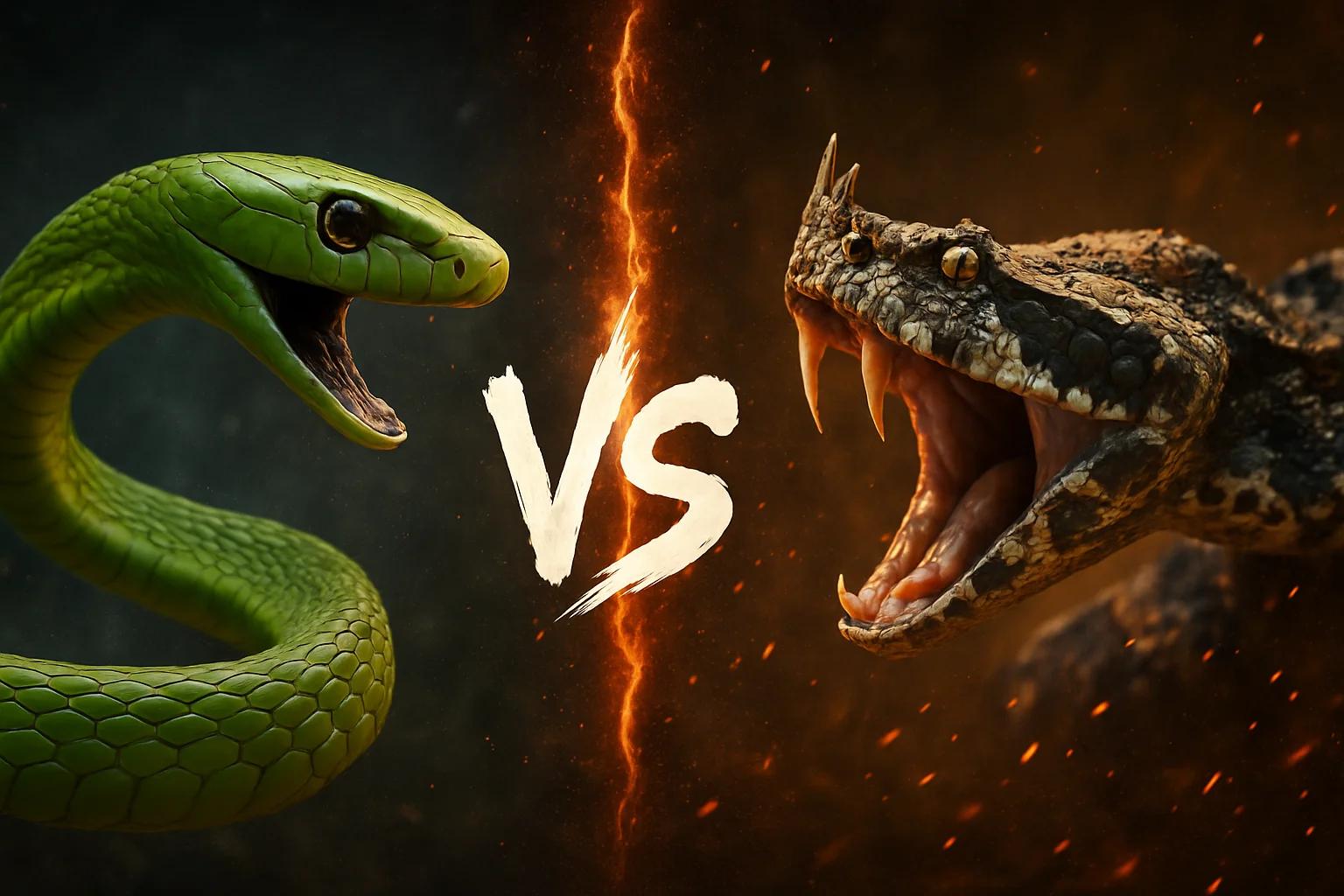
Eastern Green Mamba vs Rhinoceros Viper: Who Actually Wins?
Eastern green mamba vs rhinoceros viper: who would win? A biology-first breakdown of speed, venom, ambush, and durability between two African forest snakes.
Green Mamba vs Rhinoceros Viper
Matchup winner
Green Mamba
Quick verdict
Start with the direct answer, then use the structured comparison below to see what changes the outcome.
The Eastern green mamba wins most realistic encounters. It is longer, faster, and far more mobile. It can see a threat, strike from range, and get out of reach before a slow, heavy-bodied viper can line up a counterstrike. The rhinoceros viper has huge fangs, a fast close-range strike, and a mostly tissue-destroying venom. But it is a sit-and-wait ambusher built to hit prey that walks into it, not to chase or duel a nimble, alert snake. The mamba carries fast-acting neurotoxic venom and fights on its own terms, usually by avoiding the fight entirely. That makes it the stronger overall bet. If the mamba blunders straight into the viper's strike zone on the forest floor, it can still lose badly.
Read the full explanation
Winner: Eastern green mamba, mainly through speed, reach, and the choice to engage or escape.
The rhinoceros viper strikes very quickly at close range and has some of the longest fangs among African vipers, but it barely moves otherwise.
Mamba venom is mainly neurotoxic and can act quickly. Viper venom mainly destroys tissue and blood-clotting, which takes longer to stop a rival.
In reality, neither snake hunts the other. Both would usually avoid contact.
Reader vote
Who do you think wins?
Pick a side — no account needed. Results update live.
No votes yet — be the first to call it.
Editorial note
Why people disagree
Fang size feels decisive. The viper's long fangs and heavy venom glands look scarier than a slender mamba's head.
Strike reach
Reach lets the mamba hit first or stay outside the viper's danger zone.
Mobility and escape
The snake that controls distance controls whether a fight happens at all.
Fang hardware
If the viper lands a full bite, it delivers serious venom deep into tissue.
Read the full explanation +
Some people rate ambush lethality above mobility. Others argue a snake that can't move can't win a fight it didn't choose.
Their habitats overlap only loosely. The mamba lives in the trees and the viper on the leaf litter, so any 'fight' setup is somewhat artificial.
Comparison FAQ
Short, direct answers to the next questions readers usually ask after the headline verdict.
Would a green mamba beat a rhinoceros viper?+
Usually, yes. The mamba's speed, reach, and quick-acting neurotoxic venom give it the edge in most situations.
Which snake is stronger?+
The rhinoceros viper is heavier and more muscular for its length, with bigger fangs. The mamba is longer and far more agile. Raw bulk goes to the viper, but useful fighting ability goes to the mamba.
Which is more venomous?+
Both are medically significant. Mamba venom is mainly neurotoxic and can act quickly. Rhinoceros viper venom mainly destroys tissue and disrupts blood. In a duel, faster-acting venom matters more.
Why is the rhinoceros viper still dangerous if it loses?+
Its camouflage, very fast close-range strike, and long fangs mean any snake or person that steps within range can take a serious bite. Losing a hypothetical duel doesn't make it harmless.
Do they fight in the wild?+
Rarely, if ever. They use different layers of the forest and neither regularly preys on the other.
Head-to-head species stats
These are the same core AnimalDex stat dimensions used on the dedicated animal pages, pulled side by side so the matchup is faster to scan.
Green Mamba
Tier CRhinoceros Viper
Tier BTrait-by-trait comparison
Only the categories that matter to this matchup are included. The goal is not filler stats, but the real design differences that change the result.
Long, slender body strikes from distance
Strike reach
Green Mamba
Short, stocky lunge
Strike reach
Green Mamba
Fast, agile climber
Mobility and escape
Green Mamba
Slow, deliberate crawler
Mobility and escape
Green Mamba
Short fixed front fangs
Fang hardware
Rhinoceros Viper
Long hinged fangs, deep venom delivery
Fang hardware
Rhinoceros Viper
Mainly neurotoxic, can act quickly
Venom speed
Green Mamba
Mainly tissue- and blood-damaging, slower to incapacitate
Venom speed
Green Mamba
Active forager, alert
Ambush control
Rhinoceros Viper
Elite camouflage, patient waiting
Ambush control
Rhinoceros Viper
Light, slim build
Close-range durability
Rhinoceros Viper
Thick, heavy body
Close-range durability
Rhinoceros Viper
How the verdict forms
Verdict timeline
01 · Strike reach
Green Mamba
02 · Mobility and escape
Green Mamba
03 · Fang hardware
Rhinoceros Viper
04 · Venom speed
Green Mamba
05 · Ambush control
Rhinoceros Viper
06 · Close-range durability
Rhinoceros Viper
Change the conditions
Scenario breakdown
This is where shallow battle content usually fails. Terrain, spacing, timing, and engagement style can change the answer.
Scenario lean
Rhinoceros Viper
Verdict confidence
82%
The viper's home turf favors it.
On the forest floor, the viper's camouflage and fast close-range strike turn any mistake into a disaster. If the mamba moves within striking distance without seeing it, the viper's long fangs can land first and deep. This is the viper's best realistic scenario.
AnimalDex field profiles
Explore these animals
Green Mamba
Dendroaspis angusticeps
coastal forest, evergreen woodland, and dense tree cover
Rhinoceros Viper
Bitis nasicornis
rainforest floor, swamp forest, and dense humid cover
Systems Intelligence & Hidden Purpose
See the animals behind this comparison as engineered biological systems: what each one is built to do, where it gains leverage, and why the matchup changes by scenario.
Specialized Hardware
slender bright-green body, tree-focused fast movement, and high-alert visual posture give the Green Mamba a body plan tuned for its niche.
Systems Script
Green Mambas operate through coastal forest, evergreen woodland, and dense tree cover. Their design links movement, feeding, shelter, and timing into one workable survival system.
Strategic Insight
Dense environments reward precision, patience, and the ability to read layered cover.
Specialized Hardware
horn-like nasal scales, bold mosaic camouflage, and still leaf-litter ambush give the Rhinoceros Viper a body plan tuned for its niche.
Systems Script
Rhinoceros Vipers operate through rainforest floor, swamp forest, and dense humid cover. Their design links movement, feeding, shelter, and timing into one workable survival system.
Strategic Insight
Dense environments reward precision, patience, and the ability to read layered cover.
Final take
The Eastern green mamba is the overall winner because it decides whether and where an encounter happens. Mobility, reach, and fast-acting venom beat raw fang size in most setups.
Read the full explanation
The rhinoceros viper is not a pushover. On its own leaf litter, a careless mamba could be struck before it ever notices the viper. Its win condition is narrow but real.
Collect both animals in AnimalDex
Track the species behind this matchup, compare their real traits, and build the rivalry into your AnimalDex collection.
Discussion
What do you think?
Share your reasoning with other readers. Be civil and stick to the animals.
Sign in to join the discussion.
Sign inNo comments yet. Start the conversation.