


Grizzly Bear vs Pika: Who Actually Wins?
Grizzly bear vs pika: who would win? A biology-first look at size, power, escape tactics, and why the tiny pika survives anyway.
Grizzly Bear vs Pika
Matchup winner
Grizzly Bear
Quick verdict
Start with the direct answer, then use the structured comparison below to see what changes the outcome.
The grizzly bear wins decisively. At roughly 180–360 kg against a pika's 120–180 g, the bear outweighs its opponent more than a thousand to one, and it carries forelimbs built to flip boulders and excavate burrows. In any direct confrontation the outcome is not close. The pika's real game is avoidance: talus-slope refuges, sharp alarm calls, and fast darts into rock gaps too narrow for a bear's paw. That buys survival, not victory. Grizzlies do dig out small mammals such as ground squirrels and marmots, and a pika caught in the open has no defense that matters against that much mass and reach.
Read the full explanation
Grizzly bear wins overwhelmingly on size, power, and reach.
A pika's only win condition is escaping into talus rock gaps.
Grizzlies routinely excavate small mammals, so rock cover is not always safe.
The pika is a survival specialist, not a fighter.
Reader vote
Who do you think wins?
Pick a side — no account needed. Results update live.
No votes yet — be the first to call it.
Editorial note
Why people disagree
Some readers count a successful escape as a 'win,' but escape is not the same as winning a confrontation.
Explosive power
A single swipe from the bear ends any contact instantly.
Mass advantage
A mass gap of over a thousand to one means the pika has no defensive margin.
Refuge mastery
This is the pika's only real edge, and it is about evasion, not combat.
Read the full explanation +
Pikas in deep boulder fields can be nearly unreachable, so terrain makes the matchup feel closer than it is.
A grizzly rarely bothers chasing something this small when roots, berries, or larger rodents offer better calories.
Comparison FAQ
Short, direct answers to the next questions readers usually ask after the headline verdict.
Would a grizzly bear beat a pika?+
Yes, easily. Any physical contact ends in the bear's favor almost instantly.
How much stronger is a grizzly than a pika?+
Immensely. A grizzly outweighs a pika more than a thousand times over and can flip rocks that are many times a pika's size.
Why is the pika still hard to catch?+
It stays close to talus refuges, keeps constant watch, and dives into rock gaps the bear cannot reach. Those habits make it costly to hunt.
Do grizzlies eat pikas?+
Only occasionally. Grizzlies prefer larger rodents and plant foods because they yield more calories for the effort.
Head-to-head species stats
These are the same core AnimalDex stat dimensions used on the dedicated animal pages, pulled side by side so the matchup is faster to scan.
Grizzly Bear
Tier BPika
Tier CTrait-by-trait comparison
Only the categories that matter to this matchup are included. The goal is not filler stats, but the real design differences that change the result.
Boulder-flipping forelimbs, bursts near 55 km/h
Explosive power
Grizzly Bear
Quick hops between rocks
Explosive power
Grizzly Bear
180–360 kg
Mass advantage
Grizzly Bear
About 150 g
Mass advantage
Grizzly Bear
Large body cannot enter rock gaps
Refuge mastery
Pika
Talus-slope specialist with many bolt holes
Refuge mastery
Pika
Long claws and a hump of digging muscle
Excavation control
Grizzly Bear
Shallow nesting among rocks
Excavation control
Grizzly Bear
Keen nose, average eyesight
Early warning
Pika
Constant vigilance and loud alarm calls
Early warning
Pika
Thick fat, heavy fur, and dense bone
Close-range durability
Grizzly Bear
Fragile body
Close-range durability
Grizzly Bear
How the verdict forms
Verdict timeline
01 · Explosive power
Grizzly Bear
02 · Mass advantage
Grizzly Bear
03 · Refuge mastery
Pika
04 · Excavation control
Grizzly Bear
05 · Early warning
Pika
06 · Close-range durability
Grizzly Bear
Change the conditions
Scenario breakdown
This is where shallow battle content usually fails. Terrain, spacing, timing, and engagement style can change the answer.
Scenario lean
Pika
Verdict confidence
82%
The pika usually escapes.
Deep boulder fields create networks of gaps far too narrow for a bear's paw. Unless the rocks are small enough to flip, the pika survives by staying hidden. This is a survival outcome, not a combat victory.
AnimalDex field profiles
Explore these animals
Grizzly Bear
Ursus arctos horribilis
mountain forest, river valley, alpine meadow, and northern scrub
Pika
Ochotona spp.
talus slope, alpine meadow, and cool mountain rock field
Systems Intelligence & Hidden Purpose
See the animals behind this comparison as engineered biological systems: what each one is built to do, where it gains leverage, and why the matchup changes by scenario.
Specialized Hardware
Shoulder hump of digging muscle, long claws, a keen nose, and fat reserves for hibernation.
Systems Script
Turns over soil while digging for roots and rodents, spreads seeds through berry eating, and moves salmon nutrients into forests.
Strategic Insight
Raw capacity is most powerful when paired with flexible, opportunistic foraging.
Specialized Hardware
Compact, heat-sensitive body, sharp alarm calls, quick reflexes in rock fields, and haypile caching behavior.
Systems Script
Cuts and stores alpine vegetation, feeds weasels and raptors, and serves as an early indicator of climate-driven habitat change.
Strategic Insight
When you cannot win a fight, early warning and preparation are the strategy.
Final take
The grizzly bear is the clear winner. Its strength, reach, and digging ability overwhelm a pika in every contest except one: when the pika is buried deep in stable rock.
Read the full explanation
The pika's genius is that it never fights. It survives through vigilance, alarm calls, and terrain choice, which is a lesson in strategy rather than strength.
Collect both animals in AnimalDex
Track the species behind this matchup, compare their real traits, and build the rivalry into your AnimalDex collection.
Related comparisons
Continue with nearby matchups to compare more real-world animal traits without dropping into junky who-wins filler.
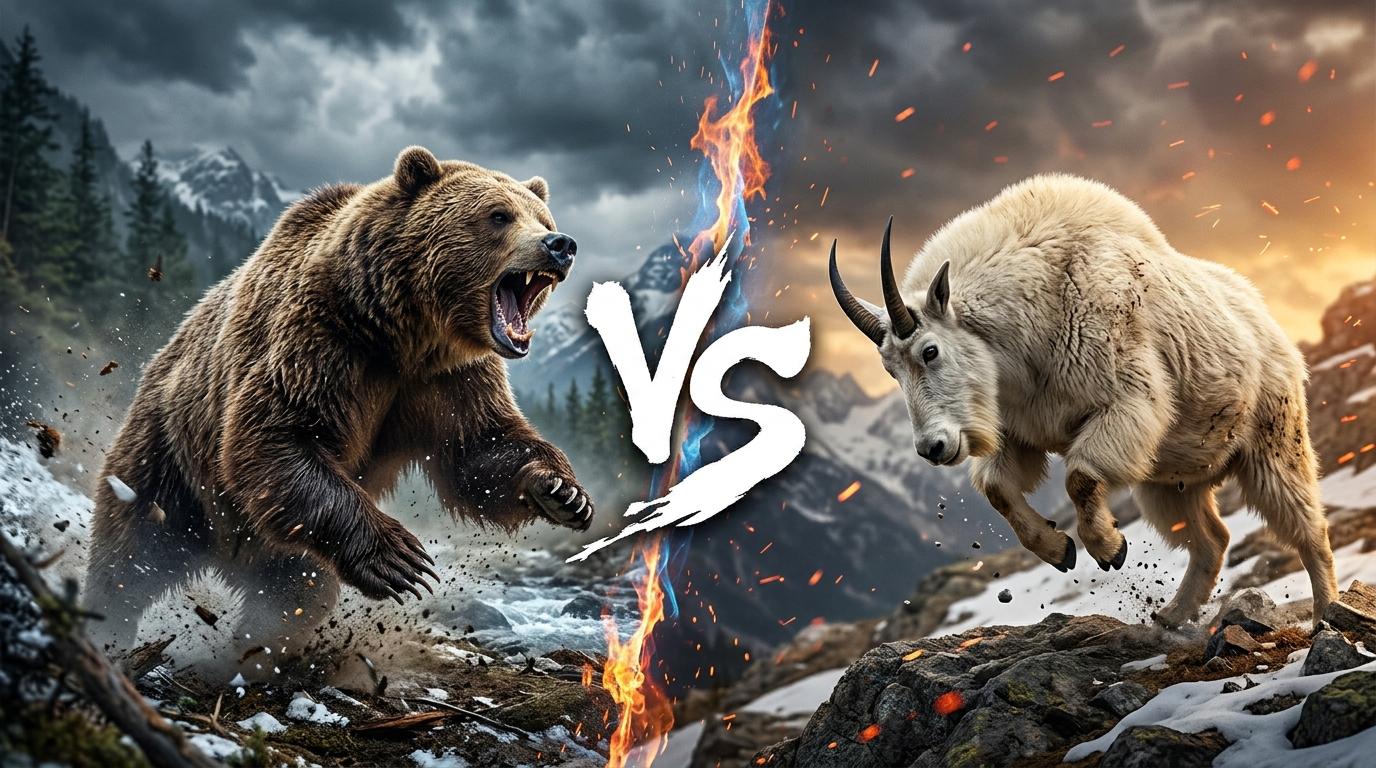
Grizzly Bear vs Mountain Goat: Who Actually Wins?
The grizzly bear wins clearly. An adult grizzly typically weighs 180–360 kg, against roughly 45–140 kg for a mountain goat. It also has the strongest forelimbs in North America, long digging claws, and a bite built for crushing bone. On level or moderately sloped ground, the goat's short, dagger-like horns can wound, but they cannot stop a bear that outweighs it three to five times. The goat's real defense is not fighting at all. It escapes onto cliffs and ledges where the bear cannot follow. Grizzlies do kill mountain goats, especially kids, injured animals, and goats caught on accessible slopes. But they win by reaching the goat, not by out-climbing it.
Read comparison
Discussion
What do you think?
Share your reasoning with other readers. Be civil and stick to the animals.
Sign in to join the discussion.
Sign inNo comments yet. Start the conversation.