

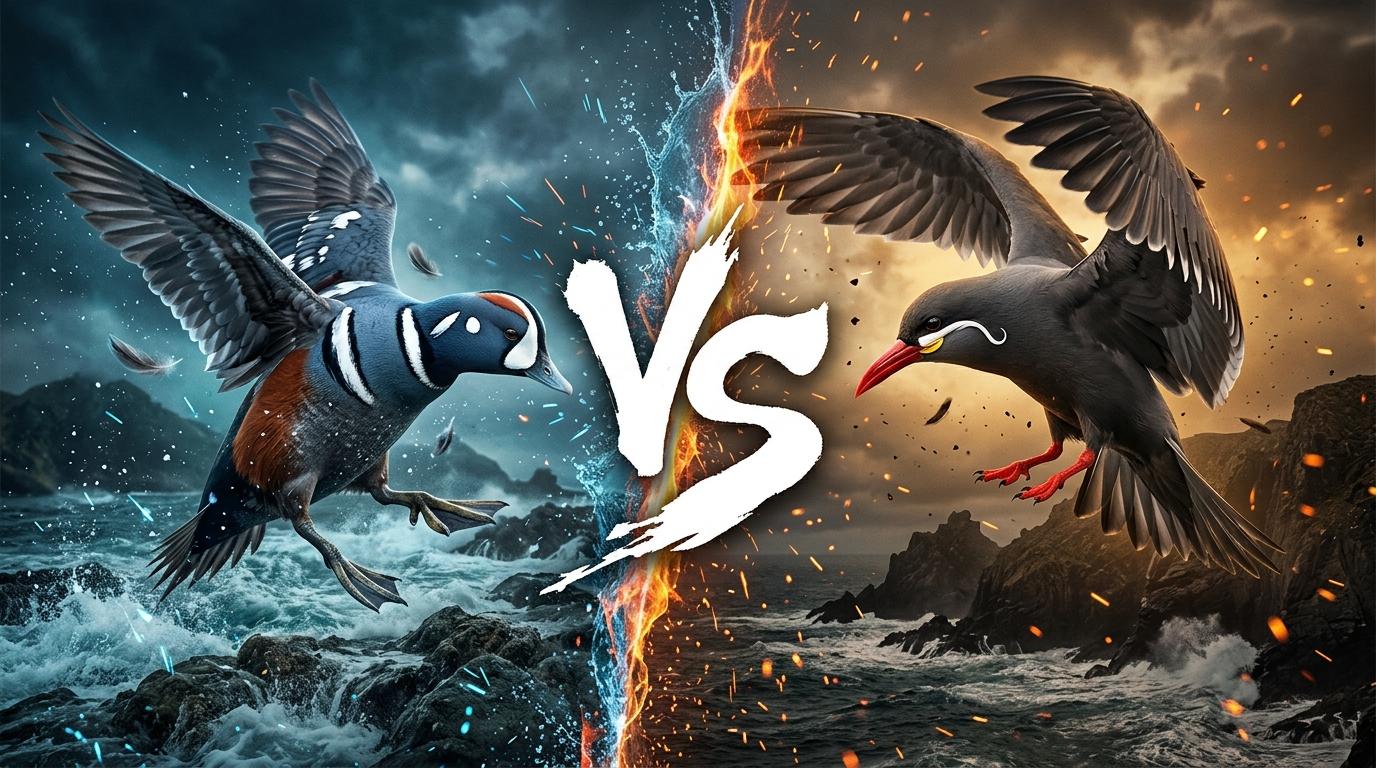
Harlequin Duck vs Inca Tern: Who Actually Wins?
Harlequin Duck vs Inca Tern compared on size, durability, speed, and fighting style. A biology-first look at which seabird would win a confrontation and why.
Harlequin Duck vs Inca Tern
Matchup winner
Harlequin Duck
Quick verdict
Start with the direct answer, then use the structured comparison below to see what changes the outcome.
The Harlequin Duck wins this matchup. It is heavier than the Inca Tern, roughly 500–700 g against about 180–210 g. Its dense, compact body is built to survive being tumbled through whitewater rapids and pounding surf. That bulk, plus a stout bill and real territorial aggression on breeding streams, gives it the edge in any close-range, grounded, or on-water contest. The Inca Tern is the more agile flier and the sharper aerial maneuverer, and its pointed red bill can deliver stinging jabs. But a tern's fighting style is hit-and-retreat harassment, not grappling. Once a confrontation becomes physical, the duck's mass and toughness decide it.
Read the full explanation
Harlequin Duck wins overall, mainly on body mass and durability.
It weighs roughly three times as much as the Inca Tern and is built to absorb violent impacts in turbulent water.
The Inca Tern rules the air with superior agility and can harass the duck from above without real risk.
On water or rock, where contact actually happens, the duck's compact power wins out.
Reader vote
Who do you think wins?
Pick a side — no account needed. Results update live.
No votes yet — be the first to call it.
Editorial note
Why people disagree
Terns look fierce and dive aggressively at intruders, so people overrate how much damage those jabs actually do to a dense-feathered diving duck.
Body mass and frame
In bird confrontations, mass decides who gets pushed off a perch or held down in the water. The duck holds a decisive weight margin.
Close-range durability
Harlequins are known for healed bone fractures from life in whitewater. A bird that shrugs off river boulders can absorb tern pecks.
Aerial agility
The tern controls whether and when engagement happens in open air, but agility alone does not overpower a heavier opponent.
Read the full explanation +
The Inca Tern's striking white mustache plumes and dark body make it look like a more dramatic, dominant bird than its light frame supports.
Some argue an aerial bird can simply refuse to fight, which is true, but refusing a fight is not winning one.
Comparison FAQ
Short, direct answers to the next questions readers usually ask after the headline verdict.
Would a Harlequin Duck beat an Inca Tern in a fight?+
Yes. The Harlequin Duck would win most physical confrontations thanks to its roughly threefold weight advantage, compact build, and durability, especially on rocks or water.
Which bird is stronger, the Harlequin Duck or the Inca Tern?+
The Harlequin Duck is stronger. It is heavier and more muscular, with a body built to survive turbulent whitewater, while the Inca Tern is built for lightweight, efficient flight.
Why is the Inca Tern still dangerous even if it loses?+
Its sharp, pointed bill can deliver precise jabs to the eyes and face, and its aerial agility lets it strike and escape repeatedly without being caught.
Can the Inca Tern just fly away?+
Yes. In open air, the tern controls engagement and can avoid the duck entirely. Avoiding a fight is not the same as winning it, though, and in any contested physical encounter the duck prevails.
Do Harlequin Ducks and Inca Terns ever meet in the wild?+
Essentially no. Harlequins live in the Northern Hemisphere, along cold North Atlantic and North Pacific coasts and mountain streams. Inca Terns live along the Pacific coast of Peru and Chile. This is a hypothetical comparison.
Head-to-head species stats
These are the same core AnimalDex stat dimensions used on the dedicated animal pages, pulled side by side so the matchup is faster to scan.
Harlequin Duck
Tier CInca Tern
Tier CTrait-by-trait comparison
Only the categories that matter to this matchup are included. The goal is not filler stats, but the real design differences that change the result.
~500–700 g, compact and muscular
Body mass and frame
Harlequin Duck
~180–210 g, light and slender
Body mass and frame
Harlequin Duck
Dense waterproof plumage, impact-hardened in rapids
Close-range durability
Harlequin Duck
Light build, prioritizes flight efficiency over armor
Close-range durability
Harlequin Duck
Fast, direct, low flier with limited maneuvering
Aerial agility
Inca Tern
Buoyant, acrobatic flier adept at hovering and plunge-diving
Aerial agility
Inca Tern
Short, sturdy bill for prying invertebrates off rocks
Strike weapon
Inca Tern
Sharp, pointed red bill for precise jabs
Strike weapon
Inca Tern
Males defend mates and stream stretches with chases
Territorial drive
Harlequin Duck
Colonial, defends nest crevices but relies on group harassment
Territorial drive
Harlequin Duck
Elite swimmer and diver in surf and rapids
Turbulent-water control
Harlequin Duck
Surface plunger, avoids prolonged water contact
Turbulent-water control
Harlequin Duck
How the verdict forms
Verdict timeline
01 · Body mass and frame
Harlequin Duck
02 · Close-range durability
Harlequin Duck
03 · Aerial agility
Inca Tern
04 · Strike weapon
Inca Tern
05 · Territorial drive
Harlequin Duck
06 · Turbulent-water control
Harlequin Duck
Change the conditions
Scenario breakdown
This is where shallow battle content usually fails. Terrain, spacing, timing, and engagement style can change the answer.
Scenario lean
Harlequin Duck
Verdict confidence
82%
Duck wins by bulk and footing.
Both species use coastal rocks. Harlequins haul out on surf-battered boulders, and Inca Terns nest in cliff crevices. On a shared ledge, the contest becomes shoving and pecking. The duck's heavier, lower center of mass and sturdy legs let it bull the tern off the perch. The tern can land jabs, but it cannot hold ground against a bird three times its weight.
AnimalDex field profiles
Explore these animals
Harlequin Duck
Histrionicus histrionicus
fast cold river, rocky coast, and mountain stream
Inca Tern
Larosterna inca
rocky coast, cold upwelling sea, and cliff edge
Systems Intelligence & Hidden Purpose
See the animals behind this comparison as engineered biological systems: what each one is built to do, where it gains leverage, and why the matchup changes by scenario.
Specialized Hardware
bold slate-and-white pattern, white face crescents, and torrent-riding river dives give the Harlequin Duck a body plan tuned for its niche.
Systems Script
Harlequin Ducks operate through fast cold river, rocky coast, and mountain stream. Their design links movement, feeding, shelter, and timing into one workable survival system.
Strategic Insight
In steep terrain, balance and route control matter more than brute force.
Specialized Hardware
white mustache-like facial plumes, dark ocean-going body, and rocky-coast colony nesting give the Inca Tern a body plan tuned for its niche.
Systems Script
Inca Terns operate through rocky coast, cold upwelling sea, and cliff edge. Their design links movement, feeding, shelter, and timing into one workable survival system.
Strategic Insight
In steep terrain, balance and route control matter more than brute force.
Final take
The Harlequin Duck takes this matchup because it was engineered by some of the harshest water on Earth. Torrential mountain streams in summer and pounding winter surf have selected for a compact, tough, heavy-for-its-size body. That body translates directly into physical dominance over a light, airy tern.
Read the full explanation
The Inca Tern is no pushover. It is a gifted aerial specialist with a precise bill and the agility to pick its moments. But its design solves a different problem: efficient flight and quick plunge-dives over the Humboldt Current, not grappling. When the encounter becomes physical, mass and durability beat finesse.
Collect both animals in AnimalDex
Track the species behind this matchup, compare their real traits, and build the rivalry into your AnimalDex collection.
Discussion
What do you think?
Share your reasoning with other readers. Be civil and stick to the animals.
Sign in to join the discussion.
Sign inNo comments yet. Start the conversation.