

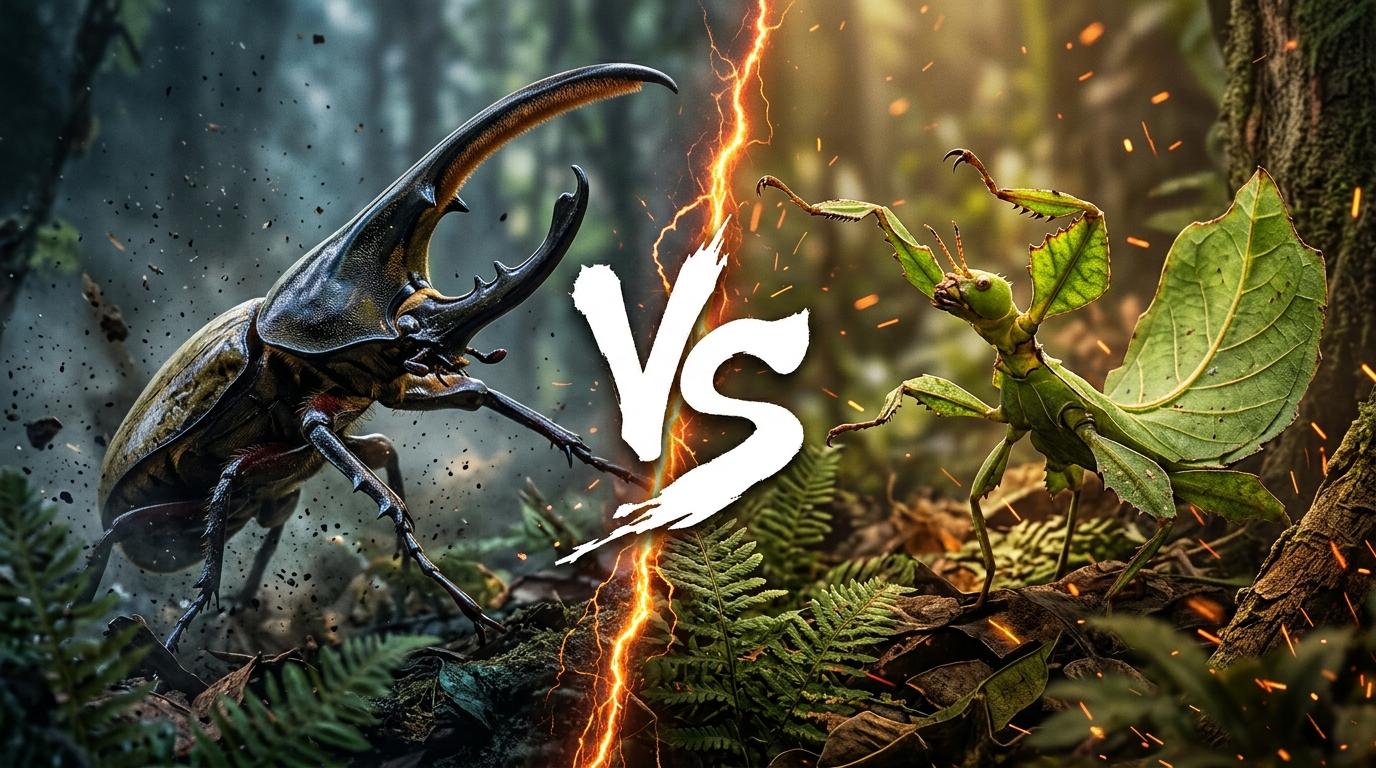
Hercules Beetle vs Philippine Leaf Insect: Who Actually Wins?
Hercules beetle vs Philippine leaf insect: a biology-first breakdown of armor, horns, camouflage and the outcome of a clash between a rainforest heavyweight and a master of disguise.
Hercules Beetle vs Walking Leaf
Matchup winner
Hercules Beetle
Quick verdict
Start with the direct answer, then use the structured comparison below to see what changes the outcome.
The Hercules beetle wins, and it is not close. Dynastes hercules is one of the largest beetles on Earth. It carries a hardened exoskeleton, powerful legs built for gripping, and, in males, a long pincer-like horn evolved specifically for wrestling and flipping rivals. The Philippine leaf insect (Phyllium philippinicum) is a soft-bodied herbivore. It has no weapons and no fighting behavior, and its whole survival strategy is to never be noticed. Once the two are in direct contact, armor and leverage beat camouflage. The leaf insect's real victory condition is avoiding the encounter entirely, and in a dense canopy it often does exactly that.
Read the full explanation
Winner: Hercules beetle, which has armor, strength and a horn built for combat.
The leaf insect has no offensive tools; its defense is disguise, not resistance.
In cover, the leaf insect can 'win' by never being found, but it cannot win a contact fight.
Neither species is a predator of the other, so a real-world clash would be accidental.
Reader vote
Who do you think wins?
Pick a side — no account needed. Results update live.
No votes yet — be the first to call it.
Editorial note
Why people disagree
Camouflage fans argue that undetected means undefeated. That is true for survival, but it is not the same as winning a confrontation.
Explosive power
The beetle's ability to pry and toss rivals translates directly into dislodging a light, leaf-shaped insect.
Close-range durability
In contact, the beetle can absorb pressure the leaf insect cannot, so any grappling favors armor.
Weapon systems
Only one side has evolved hardware for intraspecific combat.
Read the full explanation +
Some readers assume similar body lengths mean a fair fight. Mass, armor thickness and muscle architecture make the beetle far heavier and tougher.
Both are gentle herbivores, so some readers argue 'neither would fight'. Male Hercules beetles do wrestle constantly, which gives them practiced combat mechanics.
Comparison FAQ
Short, direct answers to the next questions readers usually ask after the headline verdict.
Would a Hercules beetle beat a Philippine leaf insect?+
Yes. In any direct contact, the Hercules beetle wins easily thanks to its armor, strength and horn leverage.
Which is stronger, the Hercules beetle or the leaf insect?+
The Hercules beetle, by a wide margin. It is one of the strongest insects for its size, while the leaf insect is built for stillness and disguise, not force.
Can the leaf insect hurt a Hercules beetle?+
Not meaningfully. It has no stinger, bite weapon or toxin capable of piercing the beetle's armor.
Why is the leaf insect still 'dangerous' to underestimate?+
Its camouflage is so good that predators and rivals often never detect it at all. Its danger lies in evasion: it wins survival contests without ever fighting.
Do these insects meet in the wild?+
Rarely, if ever. Hercules beetles live in Central and South American rainforests, while Phyllium philippinicum is native to the Philippines.
Head-to-head species stats
These are the same core AnimalDex stat dimensions used on the dedicated animal pages, pulled side by side so the matchup is faster to scan.
Hercules Beetle
Tier CWalking Leaf
Tier DTrait-by-trait comparison
Only the categories that matter to this matchup are included. The goal is not filler stats, but the real design differences that change the result.
Heavy lifting strength relative to its size, with horn leverage
Explosive power
Hercules Beetle
Minimal; slow, deliberate movement
Explosive power
Hercules Beetle
Thick, hardened elytra and cuticle
Close-range durability
Hercules Beetle
Thin, flattened, relatively fragile body
Close-range durability
Hercules Beetle
Thoracic and head horn pincer (males), clawed tarsi
Weapon systems
Hercules Beetle
No dedicated weapons
Weapon systems
Hercules Beetle
Dark or olive coloring, moderately cryptic
Ambush avoidance
Walking Leaf
Near-perfect leaf mimicry, including veins, bite-mark edges and a swaying gait
Ambush avoidance
Walking Leaf
Capable flier, strong climber
Escape options
Hercules Beetle
Slow climber; adult females are flightless
Escape options
Hercules Beetle
Males routinely wrestle for mates and feeding sites
Combat instinct
Hercules Beetle
Passive, defensive freezing
Combat instinct
Hercules Beetle
How the verdict forms
Verdict timeline
01 · Explosive power
Hercules Beetle
02 · Close-range durability
Hercules Beetle
03 · Weapon systems
Hercules Beetle
04 · Ambush avoidance
Walking Leaf
05 · Escape options
Hercules Beetle
06 · Combat instinct
Hercules Beetle
Change the conditions
Scenario breakdown
This is where shallow battle content usually fails. Terrain, spacing, timing, and engagement style can change the answer.
Scenario lean
Walking Leaf
Verdict confidence
82%
The leaf insect wins by never being engaged.
Among real leaves, Phyllium's mimicry is extraordinary, and the beetle has no reason to search for it. Success in this frame means survival without contact, and the leaf insect achieves that. It is the leaf insect's only scenario win.
AnimalDex field profiles
Explore these animals
Hercules Beetle
Dynastes hercules
rainforest canopy, humid forest floor, and tropical woodland
Walking Leaf
Phyllium philippinicum
rainforest shrub, understory foliage, and humid garden canopy
Systems Intelligence & Hidden Purpose
See the animals behind this comparison as engineered biological systems: what each one is built to do, where it gains leverage, and why the matchup changes by scenario.
Specialized Hardware
enormous horned male body, heavy lifting strength, and rainforest night activity give the Hercules Beetle a body plan tuned for its niche.
Systems Script
Hercules Beetles operate through rainforest canopy, humid forest floor, and tropical woodland. Their design links movement, feeding, shelter, and timing into one workable survival system.
Strategic Insight
Dense environments reward precision, patience, and the ability to read layered cover.
Specialized Hardware
flat leaf-like body, ragged camouflage edges, and slow swaying disguise give the Walking Leaf a body plan tuned for its niche.
Systems Script
Walking Leafs operate through rainforest shrub, understory foliage, and humid garden canopy. Their design links movement, feeding, shelter, and timing into one workable survival system.
Strategic Insight
Dense environments reward precision, patience, and the ability to read layered cover.
Final take
The Hercules beetle is the clear overall winner. It is built for physical contests, with armor, leverage and a horn shaped by generations of male-versus-male wrestling. The Philippine leaf insect carries none of that hardware.
Read the full explanation
The leaf insect is still one of the most successful defensive designs in the insect world. It does not win fights; it makes fights unnecessary. In its native foliage, that strategy is often enough to survive anything, including far deadlier animals than a beetle.
As a matchup it is lopsided, but it illustrates two opposite survival philosophies: dominate the encounter, or erase yourself from it.
Collect both animals in AnimalDex
Track the species behind this matchup, compare their real traits, and build the rivalry into your AnimalDex collection.
Related comparisons
Continue with nearby matchups to compare more real-world animal traits without dropping into junky who-wins filler.

Bullet Ant vs Hercules Beetle: Who Actually Wins?
The Hercules beetle wins a one-on-one fight. A bullet ant ranks near the very top of the Schmidt sting pain index, and its poneratoxin works on insects as well as vertebrates. To matter, though, that venom has to get inside the target. A male Hercules beetle can reach roughly 15–17 cm including its horn, against the ant's roughly 2.5 cm, and it is wrapped in thick, overlapping armor with very few open seams. The beetle does not need to hunt or kill. It only needs to shove, pin, or flip the ant, then walk away, and it holds every structural advantage for doing that: mass, leg leverage, armor, and a horn built for prying rivals off branches. The ant's best chance is a precise sting into a leg joint or neck membrane. That is possible but unlikely against a body this armored and this much larger. Bring the ant's colony into the picture and the story changes, but in a solo matchup armor and mass beat chemistry.
Read comparison
Hercules Beetle vs Leafcutter Ant: Who Actually Wins?
The Hercules beetle wins this matchup clearly. A male Dynastes hercules can reach about 17 cm including its horn, and a single leafcutter ant is a few millimeters to about 2 cm long. Even the largest Atta cephalotes soldier is outweighed by hundreds of times. The beetle's thick, domed elytra and armored thorax give leafcutter mandibles almost nothing to grip. Its pincer-like horns are built to pry, lift, and fling rivals much heavier than any ant. Leafcutter ants also lack a functional sting, so they cannot inject venom. The ant's real power is the colony: millions of workers, a soldier caste whose jaws can slice skin, and coordinated mass defense. That makes a nest raid the one context where the beetle should back off. In any fair, individual-scale battle, or in the open forest where the beetle can simply walk or fly away, the beetle's armor and mass decide it.
Read comparison
Hercules Beetle vs Green Orchid Bee: Who Actually Wins?
The Hercules beetle wins, and it is not especially close. Dynastes hercules is one of the largest beetles on Earth. Big males reach about 17 cm including the horn, and the whole body sits inside thick, chitin-reinforced elytra built for horn-to-horn wrestling. The green orchid bee (Euglossa dilemma) is a fast, metallic, roughly 1.3 cm pollinator whose sting is mild by bee standards. It struggles to get through beetle armor, and its tiny mandibles cannot pry the shell. The bee holds the edge in speed, agility and flight endurance, so it controls whether contact happens at all. But if the question is who comes out on top when they actually clash, the beetle's size, armor and gripping horns make the outcome lopsided.
Read comparison
Orchid Mantis vs Philippine Leaf Insect: Who Actually Wins?
The orchid mantis wins this matchup decisively. It is a true ambush predator with raptorial forelegs lined with spines, binocular vision tuned to detect motion, and strike reflexes measured in tens of milliseconds. The Philippine leaf insect is a slow, plant-eating stick-insect relative. Its whole survival strategy is not being noticed, and it carries no grasping weapons, venom, or real bite to use against an attacker. The leaf insect does have some advantages. It is a bit longer and broader, especially adult females, its armor-like flattened body is awkward to grip, and its camouflage is among the best in the insect world. Once a mantis has detected it, though, the fight is mostly over. In any encounter where the mantis knows the leaf insect is there, the predator's hardware beats the prey's disguise.
Read comparison
Discussion
What do you think?
Share your reasoning with other readers. Be civil and stick to the animals.
Sign in to join the discussion.
Sign inNo comments yet. Start the conversation.