

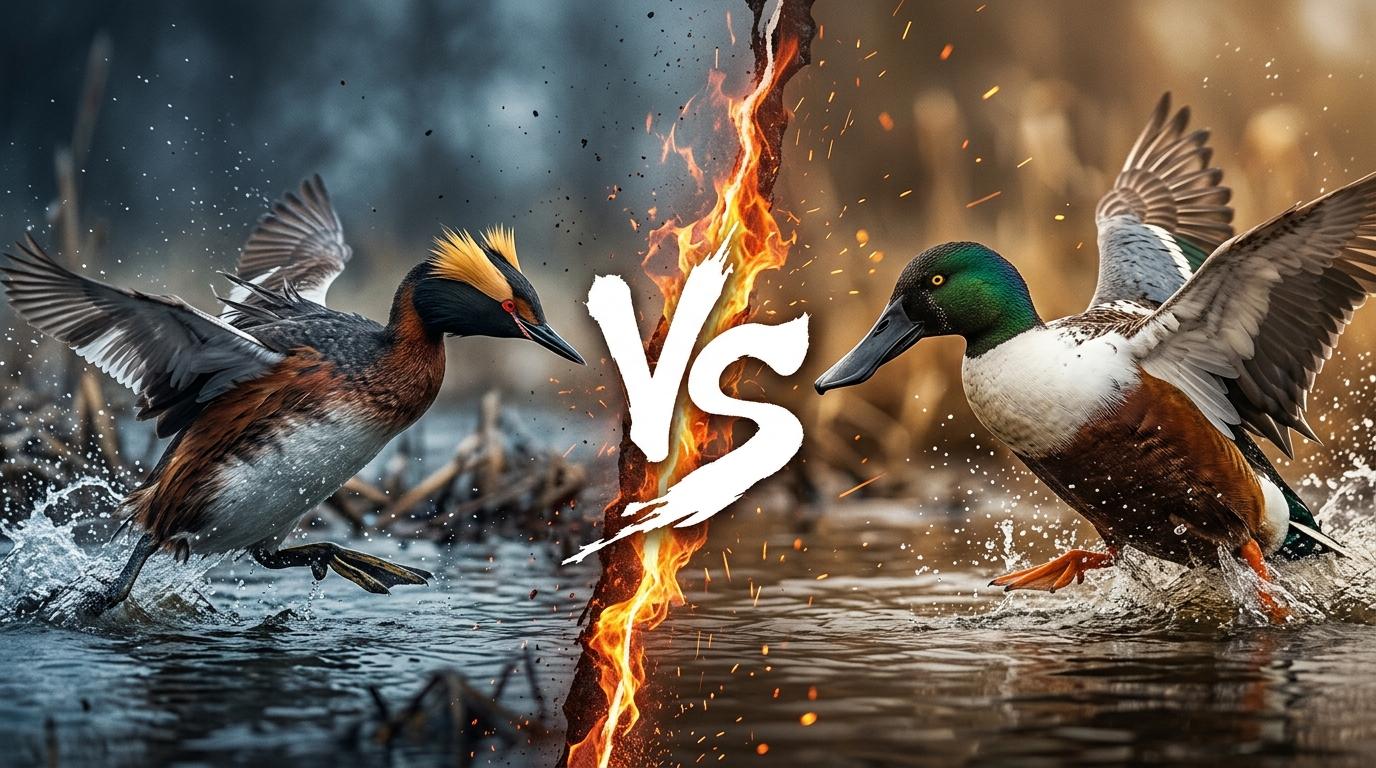
Horned Grebe vs Northern Shoveler: Who Actually Wins?
Horned Grebe vs Northern Shoveler: a biology-first look at size, beak weapons, diving skill and waterfowl aggression to decide who would win a wetland showdown.
Horned Grebe vs Northern Shoveler
Matchup winner
Northern Shoveler
Quick verdict
Start with the direct answer, then use the structured comparison below to see what changes the outcome.
The Northern Shoveler wins this matchup. At roughly 400–800 g against the Horned Grebe's 300–570 g, the shoveler brings more mass, a broad, firm bill built for shoving, and the routine pair-territory aggression of a breeding drake. That is enough to push a grebe off a contested patch of water. The grebe is no pushover. It is a sharper-billed, lobe-toed diving specialist that can vanish underwater and jab with precision. But it wins by leaving, not by holding ground. In any surface standoff over space or food, the heavier dabbler with chest-bump and bill-pressing tactics controls the encounter, and the grebe's best move is to dive away.
Read the full explanation
Overall winner: Northern Shoveler, thanks to more body mass and surface-shoving power.
The Horned Grebe has the more dangerous-looking pointed bill and is far better underwater.
Most real encounters end with the grebe diving and resurfacing elsewhere, which counts as a shoveler win on territory.
In deep water with room to dive, the grebe is nearly untouchable.
Reader vote
Who do you think wins?
Pick a side — no account needed. Results update live.
No votes yet — be the first to call it.
Editorial note
Why people disagree
Pointed bill vs mass: people assume the grebe's dagger-like bill should beat a spoon-shaped one, but these are not fighting weapons. Body weight decides most waterfowl shoving matches.
Body mass & shove power
In surface disputes between waterbirds, the heavier bird usually displaces the lighter one without anyone getting hurt.
Bill as a weapon
A grebe's pointed bill delivers focused pecks. The shoveler's bill is built for sieving and is blunt in combat.
Underwater control
The grebe can change the battlefield at any moment by going where the shoveler can't follow.
Read the full explanation +
Escape vs victory: the grebe's diving makes it almost impossible to pin down, so some readers count 'can't be caught' as a win.
Season matters: a breeding Horned Grebe defends its territory fiercely, and wintering birds behave very differently from nesting ones.
Comparison FAQ
Short, direct answers to the next questions readers usually ask after the headline verdict.
Would a Horned Grebe beat a Northern Shoveler in a fight?+
Usually no. The shoveler is heavier and more willing to hold ground on the surface. The grebe typically dives away instead of fighting it out, except near its own nest.
Which is stronger, the Horned Grebe or the Northern Shoveler?+
The Northern Shoveler is stronger in raw terms because it is the larger, heavier bird. The grebe is stronger underwater, where its rear-set legs and lobed toes make it a powerful diver.
Why is the Horned Grebe still dangerous even though it loses?+
Its sharp, pointed bill can deliver precise jabs, and its diving ability lets it attack from below or escape at will. A defending grebe near its nest can chase off much larger birds.
Do Horned Grebes and Northern Shovelers actually meet in the wild?+
Yes. They overlap on northern prairie ponds and wetlands in summer and on lakes and coasts in winter. They mostly avoid conflict because they feed differently: grebes dive for prey while shovelers sieve at the surface.
What is the Northern Shoveler's biggest advantage?+
Body mass combined with territorial drive. Shoveler drakes defend their space more actively than many other dabbling ducks.
Head-to-head species stats
These are the same core AnimalDex stat dimensions used on the dedicated animal pages, pulled side by side so the matchup is faster to scan.
Horned Grebe
Tier CNorthern Shoveler
Tier DTrait-by-trait comparison
Only the categories that matter to this matchup are included. The goal is not filler stats, but the real design differences that change the result.
Compact, ~300–570 g
Body mass & shove power
Northern Shoveler
Heavier, ~400–800 g
Body mass & shove power
Northern Shoveler
Short, pointed, precise jabber
Bill as a weapon
Horned Grebe
Huge spatulate filter bill
Bill as a weapon
Horned Grebe
Elite diver, lobed toes, rear-set legs
Underwater control
Horned Grebe
Surface dabbler, rarely dives
Underwater control
Horned Grebe
Fierce near nest, otherwise evasive
Surface aggression & territory
Northern Shoveler
Drakes actively defend pair space
Surface aggression & territory
Northern Shoveler
Needs a running takeoff, prefers diving
Flight & escape speed
Northern Shoveler
Fast, agile flier with quick takeoff
Flight & escape speed
Northern Shoveler
Dense, waterproof plumage, low profile
Close-range durability
Northern Shoveler
Larger frame absorbs bumps
Close-range durability
Northern Shoveler
How the verdict forms
Verdict timeline
01 · Body mass & shove power
Northern Shoveler
02 · Bill as a weapon
Horned Grebe
03 · Underwater control
Horned Grebe
04 · Surface aggression & territory
Northern Shoveler
05 · Flight & escape speed
Northern Shoveler
06 · Close-range durability
Northern Shoveler
Change the conditions
Scenario breakdown
This is where shallow battle content usually fails. Terrain, spacing, timing, and engagement style can change the answer.
Scenario lean
Horned Grebe
Verdict confidence
82%
The grebe owns tight, vegetated water.
Among emergent vegetation near its floating nest, the Horned Grebe is at its most aggressive and most maneuverable. It can dive, surface beside the intruder and jab, and the shoveler's bulk becomes a liability in cramped stems. Home-field motivation and three-dimensional movement favor the grebe.
AnimalDex field profiles
Explore these animals
Horned Grebe
Podiceps auritus
pond, lake, and coastal inlet
Northern Shoveler
Spatula clypeata
marsh, pond, and shallow wetland
Systems Intelligence & Hidden Purpose
See the animals behind this comparison as engineered biological systems: what each one is built to do, where it gains leverage, and why the matchup changes by scenario.
Specialized Hardware
gold hornlike breeding plumes, compact diving body, and feet-set-back underwater pursuit give the Horned Grebe a body plan tuned for its niche.
Systems Script
Horned Grebes operate through pond, lake, and coastal inlet. Their design links movement, feeding, shelter, and timing into one workable survival system.
Strategic Insight
In moving water, the best systems use flow, visibility, and depth instead of fighting every current.
Specialized Hardware
broad spoon-shaped bill, surface-filter feeding behavior, and marsh-dabbling body give the Northern Shoveler a body plan tuned for its niche.
Systems Script
Northern Shovelers operate through marsh, pond, and shallow wetland. Their design links movement, feeding, shelter, and timing into one workable survival system.
Strategic Insight
Where water controls movement, position and timing often matter more than speed.
Final take
The Northern Shoveler is the winner. This isn't because it's a fighter, since neither bird is built for combat. It comes down to the basic waterfowl rule that heavier, more persistent birds win surface disputes. More mass, active territorial drakes and strong flight give the shoveler control of shared water.
Read the full explanation
The Horned Grebe stays dangerous and frustrating. Its pointed bill and diving skill mean it rarely loses anything that matters. It simply moves the contest underwater, where the shoveler can't operate. Near its nest, it can even drive the bigger duck away.
For the overall verdict, count who holds the water when the encounter ends. More often than not, that is the shoveler.
Collect both animals in AnimalDex
Track the species behind this matchup, compare their real traits, and build the rivalry into your AnimalDex collection.
Related comparisons
Continue with nearby matchups to compare more real-world animal traits without dropping into junky who-wins filler.

Horned Grebe vs Smew: Who Actually Wins?
The Smew wins this matchup. It is the heavier bird, roughly 500–900 g against the Horned Grebe's 300–570 g. It also carries the better weapon: a serrated, hook-tipped sawbill built to seize slippery fish. Male Smew contest space and mates on winter water, so the species is used to physical shoving. The Horned Grebe is no pushover. It is a superb underwater maneuverer with a sharp, dagger-like bill and lobed feet that give it fine control below the surface. But grebes mostly answer threats by diving and slipping away, not by holding ground. When the two meet face-to-face on the water, mass and a gripping bill usually decide it, and the Smew has both.
Read comparison
Discussion
What do you think?
Share your reasoning with other readers. Be civil and stick to the animals.
Sign in to join the discussion.
Sign inNo comments yet. Start the conversation.