

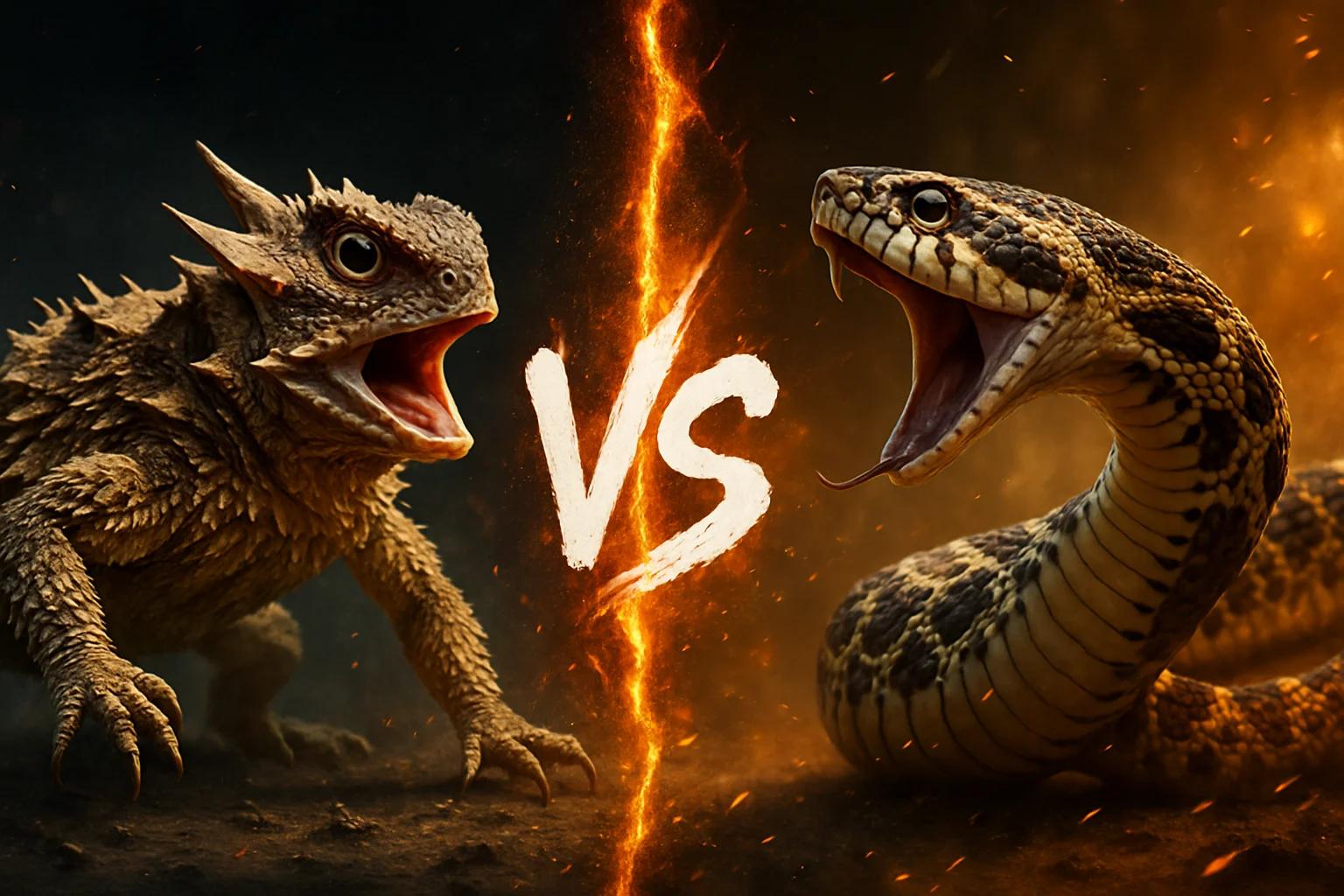
Horned Lizard vs Western Hognose Snake: Who Actually Wins?
Texas horned lizard vs western hognose snake. Can a toad-eating snake swallow a spiny lizard? This guide compares armor, venom, size, and behavior to name a clear winner.
Horned Lizard vs Western Hognose Snake
Matchup winner
Horned Lizard
Quick verdict
Start with the direct answer, then use the structured comparison below to see what changes the outcome.
The Texas horned lizard wins this matchup. The western hognose snake is longer and is a real predator, with an upturned digging snout, mild rear-fang saliva, and a gape built for swallowing toads. But a hognose can only win by swallowing its opponent, and the horned lizard is built to make that dangerous. Its crown of rigid cranial horns, its flattened, spike-fringed body, and its habit of tilting its head down and puffing up all make it a poor and risky meal for a gape-limited snake. Snakes have died from horns piercing the throat or gut wall during swallowing. The hognose's dramatic bluff of hissing, cobra-like hooding, and playing dead does not deter a lizard that never wanted the fight. The horned lizard wins by being nearly impossible to eat, not by killing anything.
Read the full explanation
Winner: Horned Lizard. Its armor defeats the only weapon that matters here, which is swallowing.
The hognose is longer and is the predator in this pairing, but it specializes in toads, not spiked lizards.
A head-first swallow attempt runs straight into rigid horns that can injure or even kill a snake.
This is a defense-beats-offense result, not a knockout.
Reader vote
Who do you think wins?
Pick a side — no account needed. Results update live.
No votes yet — be the first to call it.
Editorial note
Why people disagree
The snake is the predator and the larger animal, so many readers assume it wins by default. Gape-limited predators lose to prey they cannot safely swallow.
Armor integrity
The fight is decided at the snake's mouth, and the lizard's armor is aimed right there.
Reach and size
Length gives the snake initiative and leverage, but not the ability to swallow safely.
Offensive toolkit
The hognose has the only real offense on the field, and it is tuned for toads.
Read the full explanation +
The hognose's hooding and death-feigning look fierce. Nearly all of it is bluff, aimed at things that might eat the hognose.
Small juvenile horned lizards are genuinely vulnerable. The debate often mixes up hatchlings with adults.
Comparison FAQ
Short, direct answers to the next questions readers usually ask after the headline verdict.
Would a horned lizard beat a western hognose snake?+
Yes, in most adult encounters. The lizard's horns and spiked body make it dangerous for the snake to swallow, so the hognose usually fails or backs off.
Which is stronger, a horned lizard or a hognose snake?+
The hognose has more length, reach, and jaw power. The horned lizard has far better defensive armor, and armor is what decides this matchup.
Can a hognose snake eat a horned lizard?+
It can eat small or juvenile ones. Adults are risky, because rigid horns can injure a snake's throat or gut during swallowing.
Does the horned lizard squirt blood at snakes?+
Mostly no. The famous eye-blood squirt is aimed mainly at canine predators such as coyotes and foxes. Against snakes, the lizard relies on its horns and on puffing up its body.
Why is the hognose snake still dangerous even though it loses?+
It is a capable digger and hunter with mild rear-fang venom. It readily kills small vertebrates, including young lizards, so the losing side in this matchup is still a real predator.
Head-to-head species stats
These are the same core AnimalDex stat dimensions used on the dedicated animal pages, pulled side by side so the matchup is faster to scan.
Horned Lizard
Tier CWestern Hognose Snake
Tier DTrait-by-trait comparison
Only the categories that matter to this matchup are included. The goal is not filler stats, but the real design differences that change the result.
Rigid horn crown and spiked flanks
Armor integrity
Horned Lizard
Smooth keeled scales, no armor
Armor integrity
Horned Lizard
Compact, about 7–11 cm body
Reach and size
Western Hognose Snake
Slender, roughly 40–60 cm long
Reach and size
Western Hognose Snake
Pinching bite, mostly ant-eating jaws
Offensive toolkit
Western Hognose Snake
Mild rear-fang saliva, strong jaws
Offensive toolkit
Western Hognose Snake
Inflates and angles horns downward
Swallow resistance
Horned Lizard
Gape-limited eater
Swallow resistance
Horned Lizard
Freezes, flattens, holds its ground
Bluff vs. resolve
Horned Lizard
Hisses, hoods, plays dead
Bluff vs. resolve
Horned Lizard
Superb camouflage on bare soil
Ambush control
Western Hognose Snake
Burrows and digs out hidden prey
Ambush control
Western Hognose Snake
How the verdict forms
Verdict timeline
01 · Armor integrity
Horned Lizard
02 · Reach and size
Western Hognose Snake
03 · Offensive toolkit
Western Hognose Snake
04 · Swallow resistance
Horned Lizard
05 · Bluff vs. resolve
Horned Lizard
06 · Ambush control
Western Hognose Snake
Change the conditions
Scenario breakdown
This is where shallow battle content usually fails. Terrain, spacing, timing, and engagement style can change the answer.
Scenario lean
Horned Lizard
Verdict confidence
82%
The lizard stays cryptic, and any engagement ends in a failed swallow.
In cover the hognose hunts by scent and digging. Even if it locates the lizard, the strike leads to a swallow attempt against the horns. The lizard tucks its head and stiffens, which makes it effectively unswallowable for a typical adult snake.
AnimalDex field profiles
Explore these animals
Horned Lizard
Phrynosoma cornutum
desert, scrub, dry grassland, and sandy open ground
Western Hognose Snake
Heterodon nasicus
prairie, sandy scrub, and dry grassland
Systems Intelligence & Hidden Purpose
See the animals behind this comparison as engineered biological systems: what each one is built to do, where it gains leverage, and why the matchup changes by scenario.
Specialized Hardware
spiny flat body, ant-focused diet, and desert camouflage give the Horned Lizard a body plan tuned for its niche.
Systems Script
Horned Lizards operate through desert, scrub, dry grassland, and sandy open ground Their design links movement, shelter, and feeding into one workable survival system.
Strategic Insight
Flattening the profile can reduce both visibility and vulnerability.
Specialized Hardware
upturned shovel snout, dramatic hooding bluff, and sand-burrowing body give the Western Hognose Snake a body plan tuned for its niche.
Systems Script
Western Hognose Snakes operate through prairie, sandy scrub, and dry grassland. Their design links movement, feeding, shelter, and timing into one workable survival system.
Strategic Insight
Harsh places reward efficiency, timing, and bodies that waste very little.
Final take
The horned lizard wins because the contest happens on its terms. A snake that has to swallow to win meets an animal shaped specifically to be unswallowable.
Read the full explanation
The hognose is not a pushover. It is the larger animal, the actual predator here, and it is fully capable of eating small or young horned lizards. Against an armored adult, though, its toad-specialist toolkit does not fit the problem.
Collect both animals in AnimalDex
Track the species behind this matchup, compare their real traits, and build the rivalry into your AnimalDex collection.
Discussion
What do you think?
Share your reasoning with other readers. Be civil and stick to the animals.
Sign in to join the discussion.
Sign inNo comments yet. Start the conversation.