

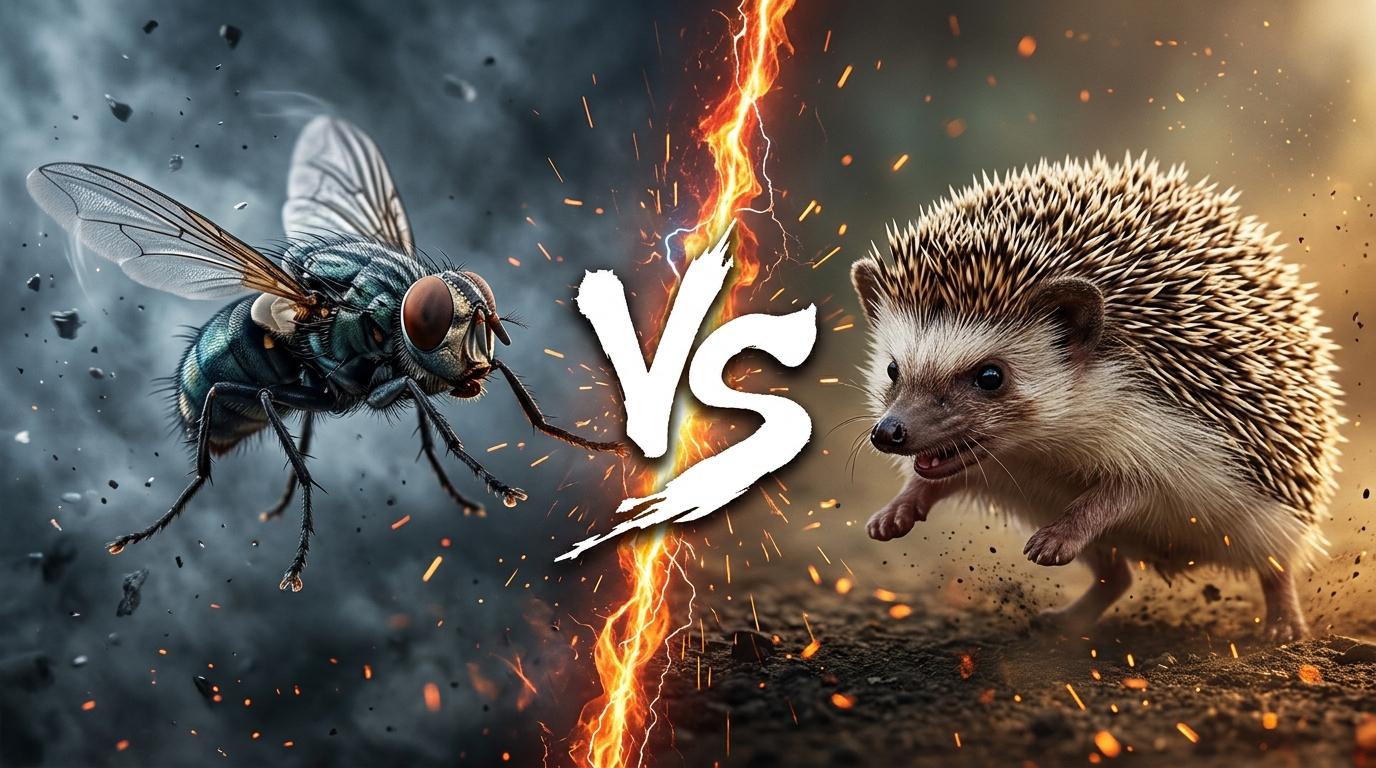
House Fly vs African Pygmy Hedgehog: Who Actually Wins?
House fly vs African pygmy hedgehog: who would win? A biology-first breakdown of speed, armor, senses and appetite, plus why the tiny fly still poses a real risk.
House Fly vs African Pygmy Hedgehog
Matchup winner
African Pygmy Hedgehog
Quick verdict
Start with the direct answer, then use the structured comparison below to see what changes the outcome.
The African pygmy hedgehog wins clearly. This is not a fair fight between rivals. It is a matchup between a dedicated insect-eater and one of its potential snacks. At roughly 250–600 g against a fly weighing a few hundredths of a gram, the hedgehog has an enormous size advantage. It also carries thousands of keratin spines, an acute nose and ears tuned to rustling prey, and a jaw built to crunch through insect exoskeletons. The house fly cannot bite, sting or pierce the hedgehog in any meaningful way. Its only real weapons are evasion and contamination. Those are genuinely impressive: millisecond escape reflexes, near-panoramic vision and a body that carries pathogens. Flies are also linked to flystrike in hedgehogs that are already sick or wounded. The fly can avoid losing a confrontation, but it has no means of winning one. The hedgehog decides how any direct encounter ends.
Read the full explanation
Winner: African pygmy hedgehog. It is a specialist insectivore, and flies fall within its prey range.
The fly cannot physically harm a healthy hedgehog. It has no bite, no sting and no grappling ability.
The fly's best outcome is escape, thanks to elite reflexes and the ability to fly.
The fly's lasting threat is biological. It carries disease and can lay eggs on weakened animals.
Reader vote
Who do you think wins?
Pick a side — no account needed. Results update live.
No votes yet — be the first to call it.
Editorial note
Why people disagree
Some readers count escape as a win. The fly almost always gets away in open air, but getting away is not the same as winning a fight.
Raw mass and reach
The hedgehog outweighs the fly by roughly ten thousand times. Size alone settles any physical contact.
Escape reflex
The fly's whole survival strategy is not being there when the strike lands, and it is very good at it.
Close-range durability
The hedgehog is close to untouchable for a fly. The fly survives only by staying out of reach.
Read the full explanation +
Pound for pound, the fly's sensory and flight hardware is astonishing. That makes it tempting to overrate the fly in a contact matchup.
Flystrike is a real danger to hedgehogs. That leads some people to argue the fly wins in the long run. But that threat targets weak or injured animals, not a healthy one in a direct encounter.
Comparison FAQ
Short, direct answers to the next questions readers usually ask after the headline verdict.
Would a house fly beat an African pygmy hedgehog?+
No. The fly has no means of injuring a healthy hedgehog. The hedgehog can eat the fly.
Which is stronger, a house fly or a hedgehog?+
The hedgehog, by an enormous margin. It is thousands of times heavier, has a strong crushing jaw and is covered in protective spines.
Do hedgehogs eat flies?+
Yes. African pygmy hedgehogs eat a wide range of insects and other invertebrates, and that includes flies and their larvae when they can catch them.
Why is the house fly still dangerous to a hedgehog?+
Flies carry pathogens. They can also lay eggs on wounded or weakened hedgehogs, which can lead to flystrike, a serious and sometimes fatal infestation.
Can a hedgehog catch a flying fly?+
Rarely. In open daylight the fly's reflexes win. Most catches happen when a fly is grounded, cold or slow at night.
Head-to-head species stats
These are the same core AnimalDex stat dimensions used on the dedicated animal pages, pulled side by side so the matchup is faster to scan.
House Fly
Tier CAfrican Pygmy Hedgehog
Tier CTrait-by-trait comparison
Only the categories that matter to this matchup are included. The goal is not filler stats, but the real design differences that change the result.
About 6–7 mm, a few hundredths of a gram
Raw mass and reach
African Pygmy Hedgehog
About 15–22 cm, 250–600 g
Raw mass and reach
African Pygmy Hedgehog
Takes off in milliseconds, with a fast-processing visual system
Escape reflex
House Fly
Rolls into a spiny ball rather than fleeing
Escape reflex
House Fly
A soft exoskeleton that can be crushed in one bite
Close-range durability
African Pygmy Hedgehog
Thousands of erectile spines plus a muscle-locked defensive ball
Close-range durability
African Pygmy Hedgehog
Sponging mouthparts with no bite and no sting
Offensive toolkit
African Pygmy Hedgehog
Sharp insectivore teeth and a strong crushing jaw
Offensive toolkit
African Pygmy Hedgehog
Compound eyes with a near-360° view
Ambush and detection
African Pygmy Hedgehog
Keen smell and hearing, weak eyesight, mostly nocturnal
Ambush and detection
African Pygmy Hedgehog
Carries many pathogens and can cause flystrike
Biological threat
House Fly
No disease-spreading strategy aimed at flies
Biological threat
House Fly
How the verdict forms
Verdict timeline
01 · Raw mass and reach
African Pygmy Hedgehog
02 · Escape reflex
House Fly
03 · Close-range durability
African Pygmy Hedgehog
04 · Offensive toolkit
African Pygmy Hedgehog
05 · Ambush and detection
African Pygmy Hedgehog
06 · Biological threat
House Fly
Change the conditions
Scenario breakdown
This is where shallow battle content usually fails. Terrain, spacing, timing, and engagement style can change the answer.
Scenario lean
African Pygmy Hedgehog
Verdict confidence
82%
The hedgehog snaps up a grounded fly.
Flies are far less active in cool darkness. Meanwhile, the hedgehog roots through leaf litter using smell and hearing. A fly resting on the ground or sitting sluggish on a surface is exactly the kind of prey the hedgehog evolved to find and eat.
AnimalDex field profiles
Explore these animals
House Fly
—
Habitat details are not published on a dedicated AnimalDex species page yet.
Species guide coming soon.
African Pygmy Hedgehog
—
Habitat details are not published on a dedicated AnimalDex species page yet.
Species guide coming soon.
Systems Intelligence & Hidden Purpose
See the animals behind this comparison as engineered biological systems: what each one is built to do, where it gains leverage, and why the matchup changes by scenario.
Specialized Hardware
Compound eyes with thousands of facets, very fast visual processing, halteres that stabilize flight, sponging mouthparts and a rapid breeding cycle.
Systems Script
Breaks down decaying organic matter, feeds many predators and spreads microbes between waste and living hosts. It acts as both a recycler and a disease vector.
Strategic Insight
You do not need to win confrontations if you never stay in one. Reaction speed and scale can matter more than strength.
Specialized Hardware
Thousands of keratin spines, a muscle that locks the body into a defensive ball, a sensitive nose and ears, and teeth built for crunching exoskeletons.
Systems Script
Patrols savanna and scrub at night, controlling insect, snail and other invertebrate populations while staying low-profile and hard to eat.
Strategic Insight
Defense you never have to think about frees all your energy for steady, low-risk gains, but you still have to watch for small, slow-acting threats.
Final take
The African pygmy hedgehog is the overall winner, and it is not close. It is an armored, nocturnal insect specialist. Any direct engagement with a house fly ends in one of two ways: the fly escapes, or the fly becomes food.
Read the full explanation
The fly's strengths are real, but they are defensive and biological rather than combative. Its outstanding reflexes win individual moments, and its role as a disease carrier gives it influence far beyond its size. Neither of those lets it beat a healthy hedgehog.
Collect both animals in AnimalDex
Track the species behind this matchup, compare their real traits, and build the rivalry into your AnimalDex collection.
Related comparisons
Continue with nearby matchups to compare more real-world animal traits without dropping into junky who-wins filler.

Western Fence Lizard vs African Pygmy Hedgehog: Who Actually Wins?
The African Pygmy Hedgehog wins clearly. At roughly 250–600 g, it outweighs a 10–25 g Western Fence Lizard by about twenty times or more. It carries a coat of keratin spines and can roll into a sealed defensive ball. It is also an opportunistic forager that will eat small vertebrates when it finds them. The lizard is faster, more alert, and far better at bolting for a crevice. However, its bite cannot get through quills, and it has no way to overpower an animal that heavy. If the meeting is forced and escape is not an option, the hedgehog controls every outcome. The lizard's real victory condition is not fighting at all: it spots the hedgehog first and is gone before contact. These two species never meet in the wild, since one lives in western North America and the other in sub-Saharan Africa. This is a thought experiment built on body plans, not a real ecological rivalry.
Read comparison
Oriental Latrine Fly vs House Fly: Who Actually Wins?
In the contest between the Oriental Latrine Fly and the House Fly, the Oriental Latrine Fly emerges as the clear winner due to its superior speed and adaptability in various environments, which give it a decisive edge in survival and competition.
Read comparison
Discussion
What do you think?
Share your reasoning with other readers. Be civil and stick to the animals.
Sign in to join the discussion.
Sign inNo comments yet. Start the conversation.