

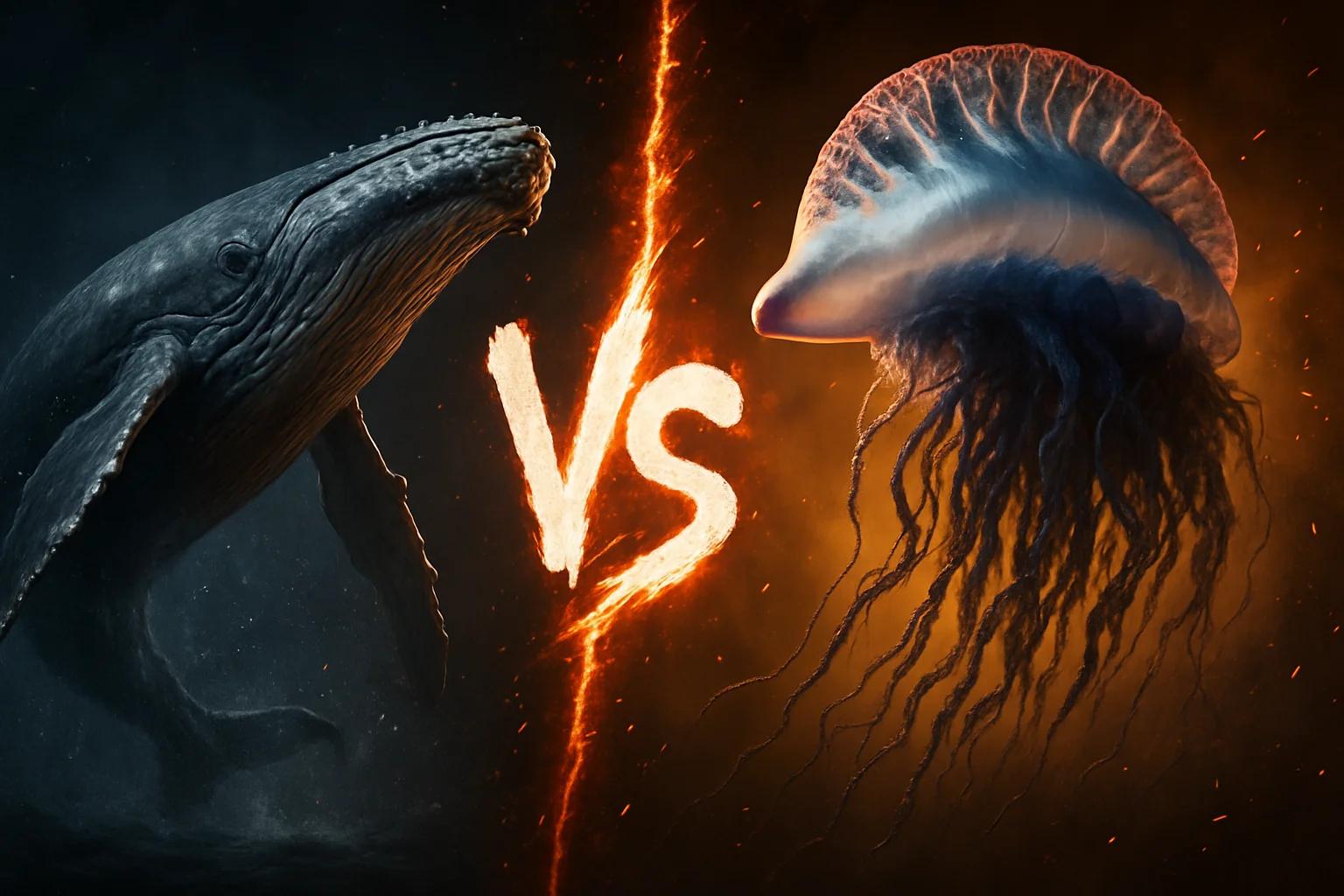
Humpback Whale vs Portuguese Man o' War: Who Actually Wins?
Humpback whale vs Portuguese man o' war: a 30-ton baleen giant against a drifting colony of venomous tentacles. Here's who wins, and why the man o' war still deserves respect.
Humpback Whale vs Portuguese Man o' War
Matchup winner
Humpback Whale
Quick verdict
Start with the direct answer, then use the structured comparison below to see what changes the outcome.
The humpback whale wins clearly. A Portuguese man o' war is not a single animal that can pursue, grapple, or inject a lethal dose into something the size of a school bus. It is a siphonophore, a floating colony of specialized zooids that drifts wherever wind and current push its gas-filled float. Its nematocyst-loaded tentacles can trail 10 meters or more and deliver a sting that cripples small fish and seriously hurts humans. A humpback, though, carries thick skin, a deep blubber layer, roughly 30 to 40 tons of mass, and the agency to simply avoid it. Whales do occasionally take incidental stings around the mouth and eyes, and those are painful irritations. Against a whale's body they are not a fight-ending weapon. The man o' war has no way to choose a target, chase, or escalate. The whale controls every encounter, and the worst realistic outcome for the whale is a stinging nuisance.
Read the full explanation
Humpback whale wins in virtually every realistic scenario.
Man o' war venom is built to disable small fish, not 30-ton mammals.
The man o' war cannot swim after anything. It drifts on wind and current.
The tentacles are still dangerous to swimmers, and a sting to a whale's eye or mouth is a real irritation.
Reader vote
Who do you think wins?
Pick a side — no account needed. Results update live.
No votes yet — be the first to call it.
Editorial note
Why people disagree
Venom hype: people hear 'deadly stinger' and assume the venom scales up against any target. Dose and body mass matter enormously.
Raw mass
The mass gap is extreme, and it decides how much venom it would take to matter. No realistic sting load comes close.
Venom payload
This is the man o' war's only real weapon. It is excellent for paralyzing prey fish, but it is tuned for small targets.
Close-range durability
Blubber and thick skin blunt sting penetration across most of the whale's body. The colony itself tears easily.
Read the full explanation +
'It's not even one animal': the colony biology makes the man o' war sound exotic and unpredictable, but that structure also means it has no coordinated attack.
Human sting stories: severe beach stings make the man o' war seem formidable. Humans are thin-skinned and small compared with a whale.
Comparison FAQ
Short, direct answers to the next questions readers usually ask after the headline verdict.
Would a humpback whale beat a Portuguese man o' war?+
Yes, easily. The man o' war cannot pursue or meaningfully harm a 30-ton whale. At worst it leaves painful local stings.
Which is stronger, a humpback whale or a Portuguese man o' war?+
The humpback, by an enormous margin. It is one of the most powerful animals in the ocean. The man o' war has no muscular strength and moves only on wind and current.
Can a Portuguese man o' war kill a whale?+
There is no evidence that one can. Its venom is calibrated for small fish, and a whale's mass and blubber dilute and block its effect.
Why is the Portuguese man o' war still dangerous if it loses?+
Its tentacles can stretch 10+ meters and keep firing nematocysts even after detaching or washing ashore. For thin-skinned humans and small animals, stings can cause severe pain and, rarely, dangerous reactions.
Is a Portuguese man o' war a jellyfish?+
No. It is a siphonophore, a colony of specialized zooids that work together as one organism.
Head-to-head species stats
These are the same core AnimalDex stat dimensions used on the dedicated animal pages, pulled side by side so the matchup is faster to scan.
Humpback Whale
Tier BPortuguese Man o' War
Tier CTrait-by-trait comparison
Only the categories that matter to this matchup are included. The goal is not filler stats, but the real design differences that change the result.
Up to ~40 tons, 14–16 m long
Raw mass
Humpback Whale
Float ~30 cm; body weighs grams
Raw mass
Humpback Whale
None
Venom payload
Portuguese Man o' War
Thousands of nematocysts per tentacle
Venom payload
Portuguese Man o' War
Thick skin, deep blubber
Close-range durability
Humpback Whale
Fragile gelatinous zooids
Close-range durability
Humpback Whale
Powerful fluke, ~25 km/h bursts
Mobility and engagement control
Humpback Whale
Passive wind-driven drift
Mobility and engagement control
Humpback Whale
Complex learning, cooperative bubble-netting
Tactical cognition
Humpback Whale
No central nervous system
Tactical cognition
Humpback Whale
Displaces water, not space
Passive area denial
Portuguese Man o' War
10+ m tentacle curtain
Passive area denial
Portuguese Man o' War
How the verdict forms
Verdict timeline
01 · Raw mass
Humpback Whale
02 · Venom payload
Portuguese Man o' War
03 · Close-range durability
Humpback Whale
04 · Mobility and engagement control
Humpback Whale
05 · Tactical cognition
Humpback Whale
06 · Passive area denial
Portuguese Man o' War
Change the conditions
Scenario breakdown
This is where shallow battle content usually fails. Terrain, spacing, timing, and engagement style can change the answer.
Scenario lean
Humpback Whale
Verdict confidence
82%
The whale avoids it or plows through with trivial cost.
In open water the man o' war drifts on the surface while the humpback travels freely in three dimensions. The whale can pass beneath or around it, and even a direct pass leaves stings on tough skin with little systemic effect. Control of engagement belongs entirely to the mobile animal.
AnimalDex field profiles
Explore these animals
Humpback Whale
Megaptera novaeangliae
Open ocean, productive feeding grounds, and warm breeding waters.
Portuguese Man o' War
Physalia physalis
open ocean surface waters and warm pelagic currents
Systems Intelligence & Hidden Purpose
See the animals behind this comparison as engineered biological systems: what each one is built to do, where it gains leverage, and why the matchup changes by scenario.
Specialized Hardware
Very long pectoral fins, knobbly head and broad tail flukes, and often breaches or slaps the water give the Humpback Whale a body plan tuned for its niche.
Systems Script
Humpback Whales operate in open ocean, productive feeding grounds, and warm breeding waters. Their design helps them match food access, shelter, and timing inside that environment.
Strategic Insight
A system can stay connected across great distance when routes and signals remain dependable.
Specialized Hardware
gas-filled floating sail, stinging trailing tentacles, and colonial body made of specialized parts give the Portuguese Man o' War a body plan tuned for its niche.
Systems Script
Portuguese Man o' Wars operate through open ocean surface waters and warm pelagic currents Their design links movement, shelter, and feeding into one workable survival system.
Strategic Insight
A coordinated system can look like one body even when it is really many specialists combined.
Final take
The humpback whale wins this matchup by a wide margin, though the man o' war's strengths are real. They are just built for a different problem. Its stinging cells form a fishing net made of chemistry, designed to stop small, soft prey. Against a giant with blubber, size, and the power to leave, that system has nothing to push against.
Read the full explanation
The man o' war stays dangerous because of what it is, not because it can win. It is a drifting hazard that never has to make a decision, so it cannot be outmaneuvered in the usual sense, only avoided. That makes it a serious risk for swimmers and small fish, and an occasional annoyance even for whales.
Collect both animals in AnimalDex
Track the species behind this matchup, compare their real traits, and build the rivalry into your AnimalDex collection.
Discussion
What do you think?
Share your reasoning with other readers. Be civil and stick to the animals.
Sign in to join the discussion.
Sign inNo comments yet. Start the conversation.