

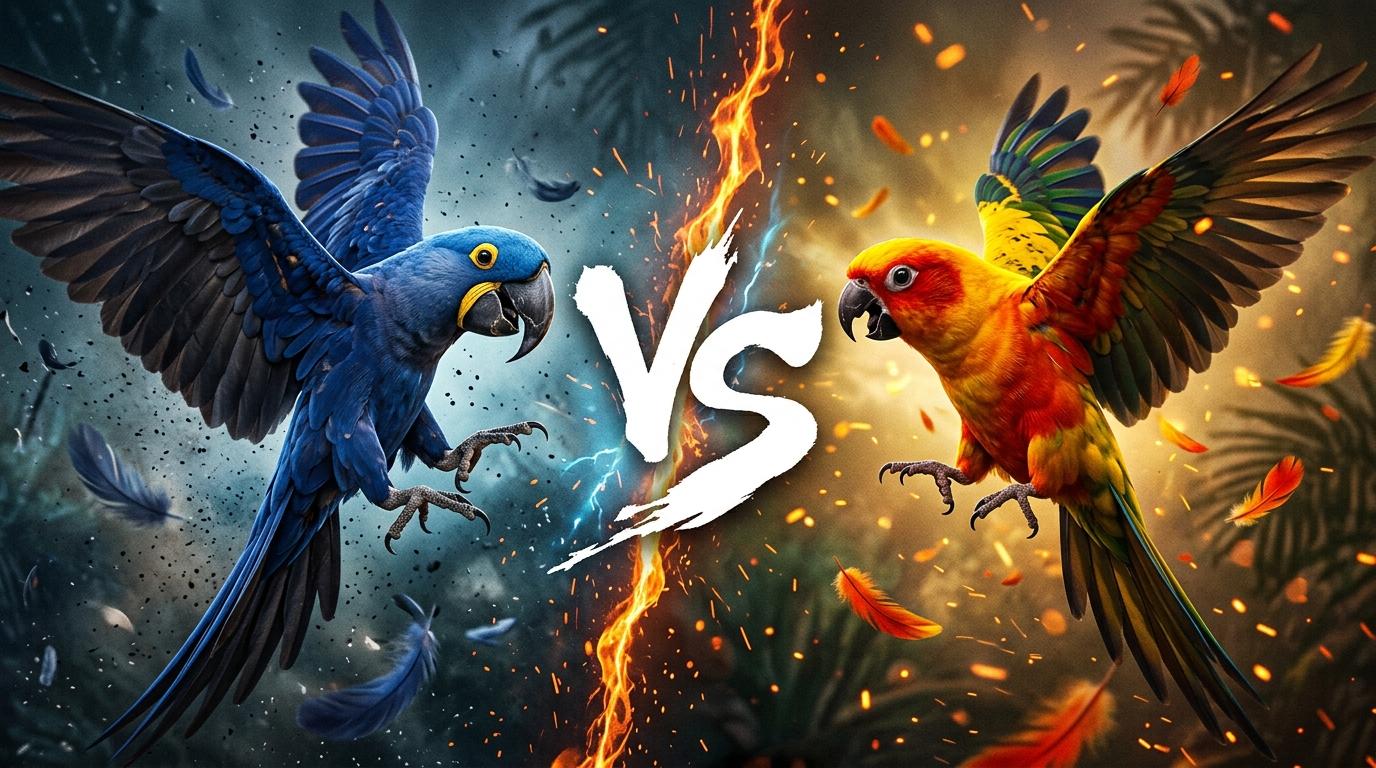
Hyacinth Macaw vs Sun Conure: Who Actually Wins?
Hyacinth macaw vs sun conure: who would win? A biology-first breakdown of size, bite force, agility and parrot intelligence, and why the giant blue macaw takes it.
Hyacinth Macaw vs Sun Conure
Matchup winner
Hyacinth Macaw
Quick verdict
Start with the direct answer, then use the structured comparison below to see what changes the outcome.
The Hyacinth Macaw wins this one decisively. It is the largest flying parrot on Earth, about 1 m from beak to tail tip and up to roughly 1.7 kg. The Sun Conure is around 30 cm and close to 110–120 g, so the macaw outweighs it by more than ten times. The hyacinth's beak is built to crack palm nuts so hard that few other animals can open them. Pair that with its larger body, longer reach and calm, deliberate problem-solving, and the conure has no realistic way to force a confrontation. The conure is quick, loud and social, and it can dart out of trouble. But escaping is not winning, and in any committed contact the macaw's beak and mass settle things almost immediately.
Read the full explanation
Hyacinth Macaw wins clearly: more than 10x the body mass and a nut-cracking beak.
Sun Conure's best tools are agility, alarm calls and flock numbers, which help it flee, not win.
In close contact the macaw's bite and reach end the exchange fast.
The conure can only 'win' by refusing the fight and leaving.
Reader vote
Who do you think wins?
Pick a side — no account needed. Results update live.
No votes yet — be the first to call it.
Editorial note
Why people disagree
Sun conures are famously bold and loud, so people overestimate how much attitude makes up for a huge size gap.
Crushing bite
A beak built for acuri and bocaiúva nuts can seriously injure a small parrot in one grip, so the conure cannot afford close contact.
Mass and reach
The size gap controls every perch, branch and grappling moment.
Evasive agility
The conure's main asset is getting out of reach, which keeps it alive but doesn't give it a win.
Read the full explanation +
Hyacinth macaws are nicknamed 'gentle giants,' which leads some readers to assume they won't defend themselves. They will.
Flock behavior makes conures seem formidable, but mobbing a far larger parrot mostly drives it off rather than defeating it.
Comparison FAQ
Short, direct answers to the next questions readers usually ask after the headline verdict.
Who would win, hyacinth macaw or sun conure?+
The Hyacinth Macaw. It is more than ten times heavier and has one of the most powerful beaks of any bird.
How strong is a hyacinth macaw's beak?+
Strong enough to crack hard palm nuts that most animals cannot open. Its bite is among the most powerful of any parrot, far beyond anything a sun conure can resist.
Why is the sun conure still dangerous?+
It is quick, persistent and social. A flock's loud mobbing can stress and displace bigger birds, and a conure's bite can still cause painful wounds to anything that grabs it carelessly.
Do these parrots fight in the wild?+
Rarely, if ever. Hyacinth macaws are found mainly in the Pantanal and interior Brazil, while sun conures live in northern South America. Their ranges barely overlap, so real conflicts are unlikely. In the wild they mostly avoid conflict anyway.
Is a sun conure smarter than a hyacinth macaw?+
Both are intelligent. The macaw generally shows more deliberate, composed problem-solving, especially when handling food.
Head-to-head species stats
These are the same core AnimalDex stat dimensions used on the dedicated animal pages, pulled side by side so the matchup is faster to scan.
Hyacinth Macaw
Tier BSun Conure
Tier BTrait-by-trait comparison
Only the categories that matter to this matchup are included. The goal is not filler stats, but the real design differences that change the result.
Palm-nut cracking beak, among the strongest of any bird
Crushing bite
Hyacinth Macaw
Small seed-and-fruit beak
Crushing bite
Hyacinth Macaw
~1 m long, up to ~1.7 kg
Mass and reach
Hyacinth Macaw
~30 cm, ~110–120 g
Mass and reach
Hyacinth Macaw
Powerful but broad, steady flier
Evasive agility
Sun Conure
Tight turns, quick bursts
Evasive agility
Sun Conure
Deliberate, tool-like manipulation of food
Problem-solving composure
Hyacinth Macaw
Clever, excitable and reactive
Problem-solving composure
Hyacinth Macaw
Pairs and small family groups
Social alarm network
Sun Conure
Noisy flocks with piercing calls
Social alarm network
Sun Conure
Large, heavily built body
Close-range durability
Hyacinth Macaw
Light, fragile frame
Close-range durability
Hyacinth Macaw
How the verdict forms
Verdict timeline
01 · Crushing bite
Hyacinth Macaw
02 · Mass and reach
Hyacinth Macaw
03 · Evasive agility
Sun Conure
04 · Problem-solving composure
Hyacinth Macaw
05 · Social alarm network
Sun Conure
06 · Close-range durability
Hyacinth Macaw
Change the conditions
Scenario breakdown
This is where shallow battle content usually fails. Terrain, spacing, timing, and engagement style can change the answer.
Scenario lean
Hyacinth Macaw
Verdict confidence
82%
Macaw controls the perch.
In tight canopy the conure's agility is limited by clutter. Its best options are slipping away or clambering out of reach, but any face-off on a branch puts it inside the macaw's reach. The hyacinth uses its feet and beak like a climbing tool, so it holds position and makes the cost of contact very high.
AnimalDex field profiles
Explore these animals
Hyacinth Macaw
Anodorhynchus hyacinthinus
palm savannah, seasonally flooded grassland, and woodland edge
Sun Conure
Aratinga solstitialis
savannah woodland, palm groves, and dry forest edge
Systems Intelligence & Hidden Purpose
See the animals behind this comparison as engineered biological systems: what each one is built to do, where it gains leverage, and why the matchup changes by scenario.
Specialized Hardware
giant cobalt-blue body, immense nut-cracking beak, and strong pair-bonded flight give the Hyacinth Macaw a body plan tuned for its niche.
Systems Script
Hyacinth Macaws operate through palm savannah, seasonally flooded grassland, and woodland edge. Their design links movement, feeding, shelter, and timing into one workable survival system.
Strategic Insight
Dense environments reward precision, patience, and the ability to read layered cover.
Specialized Hardware
sun-bright orange and yellow plumage, fast noisy flock flight, and strong curved seed-cracking bill give the Sun Conure a body plan tuned for its niche.
Systems Script
Sun Conures operate through savannah woodland, palm groves, and dry forest edge. Their design links movement, feeding, shelter, and timing into one workable survival system.
Strategic Insight
Harsh places reward efficiency, timing, and bodies that waste very little.
Final take
This matchup is about scale. The Hyacinth Macaw is a heavyweight whose beak evolved to open some of the toughest nuts in the Neotropics. The Sun Conure is a nimble, flock-driven survivor built to avoid danger, not to win close fights.
Read the full explanation
The conure deserves respect for its speed and its alarm network. Those are real survival tools, but they all point toward escape. In any scenario where the two birds actually make contact, the Hyacinth Macaw wins, and wins quickly.
Collect both animals in AnimalDex
Track the species behind this matchup, compare their real traits, and build the rivalry into your AnimalDex collection.
Discussion
What do you think?
Share your reasoning with other readers. Be civil and stick to the animals.
Sign in to join the discussion.
Sign inNo comments yet. Start the conversation.