


Ibisbill vs Takahe: Who Actually Wins?
Ibisbill vs Takahe: a Himalayan river wader against New Zealand's heavyweight flightless rail. We compare size, bill power, speed and temperament to explain why the takahe wins a confrontation.
Ibisbill vs Takahe
Matchup winner
Takahe
Quick verdict
Start with the direct answer, then use the structured comparison below to see what changes the outcome.
The takahe wins, and it is not especially close. It is a flightless swamphen of roughly 2.5–4 kg, about ten times the weight of a 270–320 g ibisbill. It carries a deep, shear-like red bill built to snip tough tussock and is fiercely territorial toward intruders. The ibisbill is a slim, agile shingle-river specialist. Its long decurved bill is a precision probe for turning over stones to find insect larvae, not a weapon. In any face-to-face contest over space, the takahe's mass, bill leverage and willingness to stand its ground decide things quickly. The ibisbill's real advantage is that it can fly, so its best outcome is a clean exit rather than a win.
Read the full explanation
Takahe wins: roughly 10x heavier, with a far stronger cutting bill.
Takahe is territorial and defends its ground. The ibisbill is a cautious forager.
Ibisbill's edge is flight and footing on cold, rocky rivers, which helps it escape rather than win.
In open ground or over a contested resource, the takahe controls the space.
Reader vote
Who do you think wins?
Pick a side — no account needed. Results update live.
No votes yet — be the first to call it.
Editorial note
Why people disagree
Speed stats flatter the ibisbill. It is quicker and can fly, but escaping is not the same as winning a confrontation.
Body mass
In bird confrontations, mass dominates. The takahe can simply shoulder an ibisbill out of any space.
Bill as a tool or weapon
A bill built to cut fibrous grass delivers forceful pecks and bites. A probing bill is delicate and risks damage.
Escape mobility
The ibisbill can end a contest whenever it chooses, which makes it hard to catch but does not help it win.
Read the full explanation +
Rarity fascinates people. The takahe's tiny population (around 500 birds) makes it seem fragile, but individual birds are robust and assertive.
The two birds never meet. Ibisbills live in the high Himalaya and Central Asia, takahe in New Zealand, so any matchup is a thought experiment about body plans.
Comparison FAQ
Short, direct answers to the next questions readers usually ask after the headline verdict.
Would an ibisbill beat a takahe?+
No. The takahe is about ten times heavier, has a far more powerful bill and actively defends its territory. The ibisbill's best outcome is flying away.
Which bird is stronger, the ibisbill or the takahe?+
The takahe, by a wide margin. Its thick legs and shearing bill are built for force, while the ibisbill is built for precision foraging.
Why does the ibisbill stay dangerous even though it loses?+
It is never easy to pin down. It can fly, it moves nimbly on loose stones, and its long bill can still jab. A takahe would struggle to trap or seriously injure it.
Do ibisbills and takahe ever meet in the wild?+
No. Ibisbills live on high-altitude rivers in the Himalaya and Central Asia, while takahe are found only in New Zealand.
Is the takahe aggressive?+
Takahe pairs are territorial and will confront intruders, including other takahe, to defend their feeding grounds.
Head-to-head species stats
These are the same core AnimalDex stat dimensions used on the dedicated animal pages, pulled side by side so the matchup is faster to scan.
Ibisbill
Tier BTakahe
Tier CTrait-by-trait comparison
Only the categories that matter to this matchup are included. The goal is not filler stats, but the real design differences that change the result.
~270–320 g, slender wader
Body mass
Takahe
~2.5–4 kg, stocky and dense
Body mass
Takahe
Long, thin, decurved probe
Bill as a tool or weapon
Takahe
Deep, conical tussock shears
Bill as a tool or weapon
Takahe
Strong flier, nimble on shingle
Escape mobility
Ibisbill
Flightless, steady walker
Escape mobility
Ibisbill
Wary, often freezes or slips away
Territorial drive
Takahe
Pairs defend territories assertively
Territorial drive
Takahe
Master of cold braided riverbeds
Terrain specialism
Ibisbill
Alpine tussock and wet grassland
Terrain specialism
Ibisbill
Light frame, thin legs
Close-range durability
Takahe
Thick legs, heavy body, dense plumage
Close-range durability
Takahe
How the verdict forms
Verdict timeline
01 · Body mass
Takahe
02 · Bill as a tool or weapon
Takahe
03 · Escape mobility
Ibisbill
04 · Territorial drive
Takahe
05 · Terrain specialism
Ibisbill
06 · Close-range durability
Takahe
Change the conditions
Scenario breakdown
This is where shallow battle content usually fails. Terrain, spacing, timing, and engagement style can change the answer.
Scenario lean
Takahe
Verdict confidence
82%
Takahe dominates its home cover.
Dense tussock slows takeoff and hides approaches. That suits the heavier, ground-bound takahe, which knows the terrain and pushes forward. The ibisbill's cryptic grey camouflage helps on stones but offers little cover in tall grass.
AnimalDex field profiles
Explore these animals
Ibisbill
Ibidorhyncha struthersii
shingle riverbed, alpine stream, and mountain valley
Takahe
Porphyrio hochstetteri
alpine grassland and wet mountain valley
Systems Intelligence & Hidden Purpose
See the animals behind this comparison as engineered biological systems: what each one is built to do, where it gains leverage, and why the matchup changes by scenario.
Specialized Hardware
downcurved coral-red bill, gray river-stone plumage, and swift braided-river running give the Ibisbill a body plan tuned for its niche.
Systems Script
Ibisbills operate through shingle riverbed, alpine stream, and mountain valley. Their design links movement, feeding, shelter, and timing into one workable survival system.
Strategic Insight
In steep terrain, balance and route control matter more than brute force.
Specialized Hardware
heavy cobalt flightless body, thick red bill, and alpine tussock grazing give the Takahe a body plan tuned for its niche.
Systems Script
Takahes operate through alpine grassland and wet mountain valley. Their design links movement, feeding, shelter, and timing into one workable survival system.
Strategic Insight
In steep terrain, balance and route control matter more than brute force.
Final take
The takahe is the clear winner. This is a contest between a heavy, territorial grazer and a light, specialist forager, and confrontations between birds almost always favor mass and motivation.
Read the full explanation
The ibisbill is not a pushover in its own world. On Himalayan shingle rivers it is a superbly adapted, hard-to-reach bird. Its strategy is to avoid conflict rather than to fight.
Verdict: Takahe, with the ibisbill keeping a respectable escape route and nothing more.
Collect both animals in AnimalDex
Track the species behind this matchup, compare their real traits, and build the rivalry into your AnimalDex collection.
Related comparisons
Continue with nearby matchups to compare more real-world animal traits without dropping into junky who-wins filler.

Ibisbill vs Kea: Who Actually Wins?
The kea wins clearly. New Zealand's alpine parrot weighs roughly 800–1,000 g against the ibisbill's 270–320 g. It carries a hooked, crushing beak built to tear and pry, and it ranks among the most curious and problem-solving birds on Earth. The ibisbill is a superbly specialized Himalayan shorebird. Its long, decurved bill is a precision probe for prying invertebrates from under river stones, not a weapon, and its survival strategy is camouflage, vigilance and flight. In any clash over space or food, the kea's mass, grip, beak leverage and bold temperament dominate. The ibisbill's best outcome is a fast, well-timed escape.
Read comparison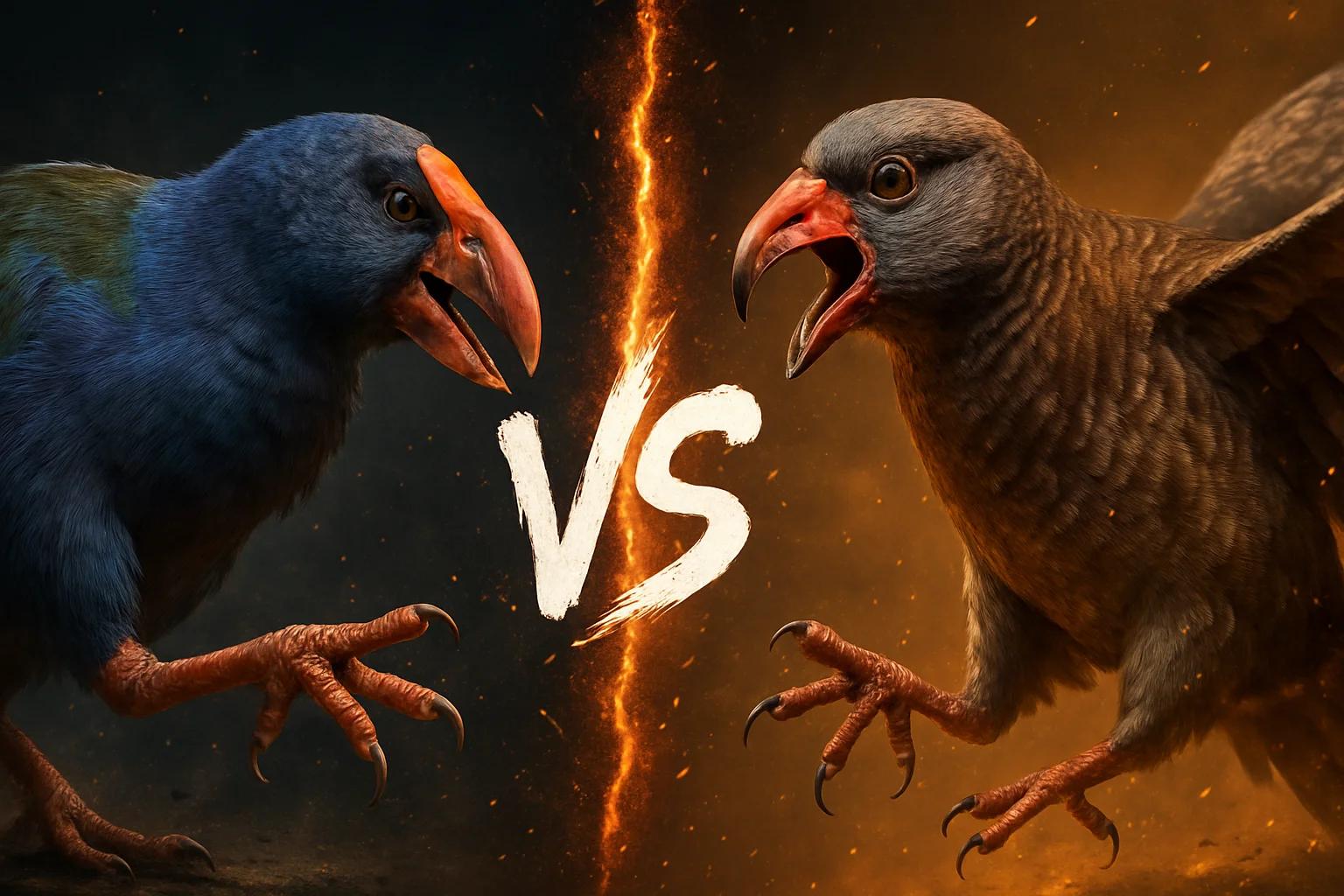
Takahe vs Tooth-billed Pigeon: Who Actually Wins?
The takahe wins, and it is not especially close in a direct contest. New Zealand's flightless swamphen weighs roughly 2.5–3.5 kg, several times the mass of Samoa's tooth-billed pigeon (manumea), which is usually estimated at a few hundred grams. The takahe also carries one of the heaviest bills of any rail, a deep red shearing tool built to snip tough tussock bases. It defends territory on foot, while the manumea's hooked, notched bill is a precision instrument for working seeds and fruit, not a weapon. The pigeon's real advantage is flight. It can leave whenever it wants, so it 'wins' only in the sense of refusing to fight. When the two actually meet and engage, mass, bill force, and ground-level territorial commitment decide it for the takahe.
Read comparison
Discussion
What do you think?
Share your reasoning with other readers. Be civil and stick to the animals.
Sign in to join the discussion.
Sign inNo comments yet. Start the conversation.