

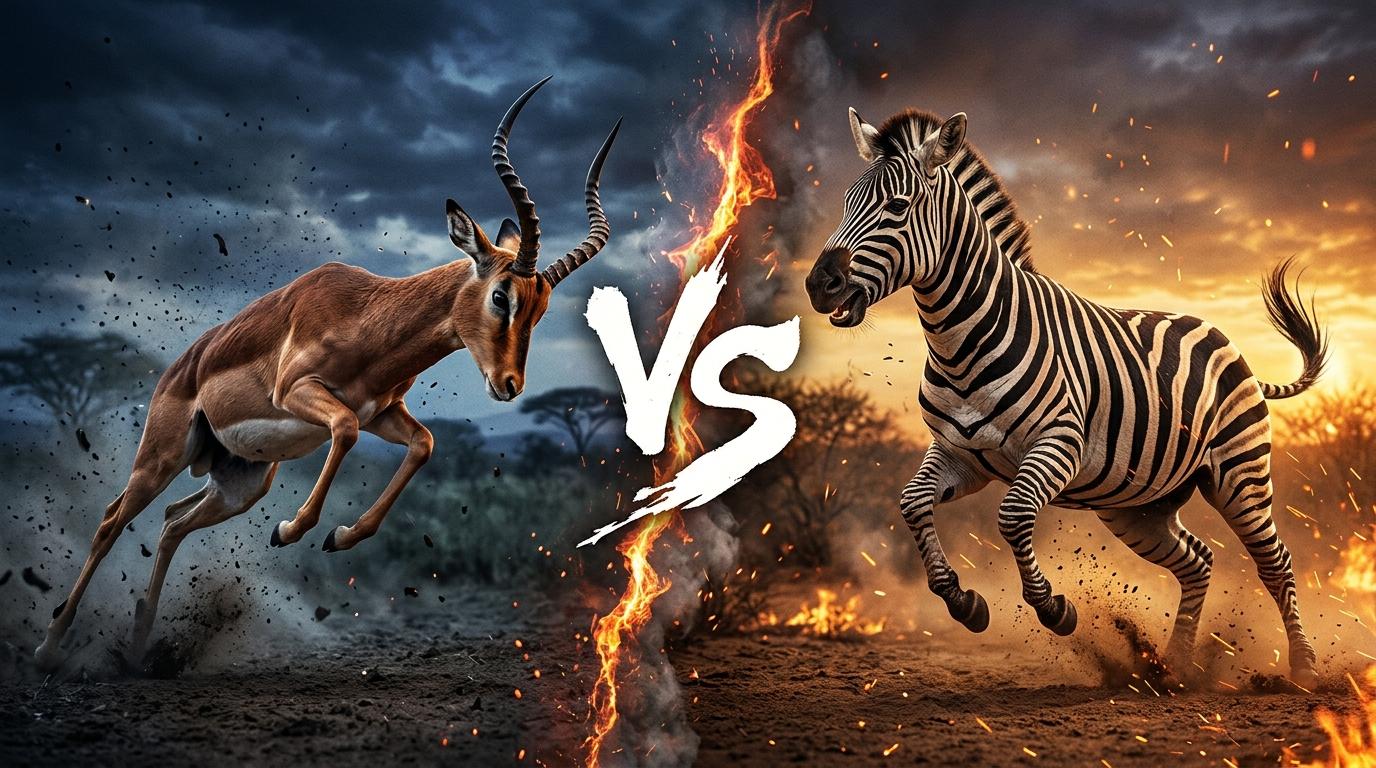
Impala vs Plains Zebra: Who Actually Wins?
Impala vs plains zebra: who would win a fight? The answer comes down to size, weaponry and temperament. The zebra's mass, bite and kick decide it, but the impala's speed and horns keep it dangerous.
Impala vs Plains Zebra
Matchup winner
Plains Zebra
Quick verdict
Start with the direct answer, then use the structured comparison below to see what changes the outcome.
The plains zebra wins clearly. An adult zebra weighs roughly 175–385 kg against an impala's 40–75 kg, which gives it about four to six times the mass. It also carries the two weapons that matter most in a close contest: a crushing incisor bite and a rear kick strong enough to injure lions and break hyena jaws. Zebra stallions fight other stallions as a normal part of life, rearing, biting at necks and legs, and kicking. Impala rams fight too, but their lyre-shaped horns evolved for locking and shoving against other impala, not for wounding a far heavier animal. The impala's real strengths are acceleration, leaps of 3 m high and 10 m long, and sharp alertness. Those traits help it escape and avoid trouble, and they don't win a fight. If the two are forced into one, the zebra's size and aggression win most outcomes.
Read the full explanation
Plains zebra wins in a forced fight thanks to about 4–6x the body mass.
The zebra's bite and double-barrel kick do far more damage than impala horns.
Impala are built to escape. Speed and leaping let them avoid the fight altogether.
A rutting impala ram can still land painful horn jabs, so it isn't harmless.
Reader vote
Who do you think wins?
Pick a side — no account needed. Results update live.
No votes yet — be the first to call it.
Editorial note
Why people disagree
Impala horns look like weapons, but they are built for ritual wrestling, not for piercing a 300 kg equid.
Mass and frame
Mass decides shoving, knockdowns and how much damage an animal can absorb. The zebra wins this category outright.
Close-range weaponry
The zebra has two dangerous weapons and can strike from either end of its body. Impala horns only threaten from the front.
Explosive evasion
The impala's real defense is that it is hard to catch, which matters in escape but not in a fight.
Read the full explanation +
People underrate zebras as 'striped horses'. In reality they are among the most combative grazers in Africa and regularly fight off predators.
Some people count 'never getting caught' as winning. In a battle frame, though, avoiding the fight isn't a victory.
Comparison FAQ
Short, direct answers to the next questions readers usually ask after the headline verdict.
Would an impala beat a zebra in a fight?+
No. A plains zebra would almost always win because of its size, bite and kicking power.
Which is stronger, an impala or a zebra?+
The zebra is far stronger. It has four to six times the mass and a muscular build made for fighting rival stallions.
Why is an impala still dangerous even though it loses?+
Rams have sharp ridged horns and are aggressive during the rut, so a jab can wound. Their speed also means they can rarely be cornered in the first place.
Do impalas and zebras actually fight in the wild?+
Rarely. They graze side by side and benefit from shared vigilance against predators, so serious conflict is uncommon.
Which is faster, an impala or a zebra?+
The impala. It reaches about 80–90 km/h in bursts and is far more agile than the zebra.
Head-to-head species stats
These are the same core AnimalDex stat dimensions used on the dedicated animal pages, pulled side by side so the matchup is faster to scan.
Impala
Tier CPlains Zebra
Tier CTrait-by-trait comparison
Only the categories that matter to this matchup are included. The goal is not filler stats, but the real design differences that change the result.
40–75 kg, slender antelope
Mass and frame
Plains Zebra
175–385 kg, stocky equid
Mass and frame
Plains Zebra
Ringed lyre horns (rams only)
Close-range weaponry
Plains Zebra
Powerful bite plus hard-hoofed rear kicks
Close-range weaponry
Plains Zebra
3 m vertical leaps, rapid zigzag bursts
Explosive evasion
Impala
Steady gallop, less agile
Explosive evasion
Impala
Flees first, fights during the rut
Combat temperament
Plains Zebra
Stallions routinely bite and kick rivals and predators
Combat temperament
Plains Zebra
Sharp alarm snorts, mixed-herd sentinel
Vigilance and alarm
Impala
Group cohesion, harem stallion guards
Vigilance and alarm
Impala
Light build, fragile legs
Close-range durability
Plains Zebra
Thick neck, dense muscle, survives lion attacks
Close-range durability
Plains Zebra
How the verdict forms
Verdict timeline
01 · Mass and frame
Plains Zebra
02 · Close-range weaponry
Plains Zebra
03 · Explosive evasion
Impala
04 · Combat temperament
Plains Zebra
05 · Vigilance and alarm
Impala
06 · Close-range durability
Plains Zebra
Change the conditions
Scenario breakdown
This is where shallow battle content usually fails. Terrain, spacing, timing, and engagement style can change the answer.
Scenario lean
Plains Zebra
Verdict confidence
82%
Zebra wins once there's no escape.
In thick bush the impala loses its biggest advantage, room to leap away. In tight quarters the zebra's bite and kicks connect with a light-boned target, and the impala's horns can't overcome the zebra's mass.
AnimalDex field profiles
Explore these animals
Impala
Aepyceros melampus
savannah, woodland edge, and grassy river country
Plains Zebra
Equus quagga
Savannah, open grassland, lightly wooded plains, and seasonal grazing country near water.
Systems Intelligence & Hidden Purpose
See the animals behind this comparison as engineered biological systems: what each one is built to do, where it gains leverage, and why the matchup changes by scenario.
Specialized Hardware
spring-loaded leaping legs, alert herd movement, and curved lyre-shaped horns give the Impala a body plan tuned for its niche.
Systems Script
Impalas operate through savannah, woodland edge, and grassy river country Their design links movement, shelter, feeding, and survival into one workable system.
Strategic Insight
Fast reaction times can turn open ground into safer ground.
Specialized Hardware
Fast acceleration, durable grazing physiology, and many eyes distributed across a moving herd make plains zebras effective vigilance hardware for open systems.
Systems Script
Zebras convert group movement into risk buffering on exposed grassland. They absorb grazing pressure while helping keep predator detection active across wide visible terrain.
Strategic Insight
Open environments reward distributed awareness. One watcher is fragile; many watchers become infrastructure.
Final take
The plains zebra wins this matchup. It is a heavy, combative equid that fights rivals and predators as part of normal life. The impala is a lightweight antelope that survives by not being there when trouble arrives.
Read the full explanation
Both strategies work in the wild, which is why the two species share the same savannas. In a forced, head-to-head contest, though, mass and weapons decide it, and the zebra has more of both.
Collect both animals in AnimalDex
Track the species behind this matchup, compare their real traits, and build the rivalry into your AnimalDex collection.
Related comparisons
Continue with nearby matchups to compare more real-world animal traits without dropping into junky who-wins filler.
Plains Zebra vs Sable Antelope: Who Actually Wins?
The sable antelope wins this one. A plains zebra is tough, fast, and armed with kicks and bites that are hard to underestimate. But a sable bull carries one of Africa's most dangerous horn sets: ringed scimitars often over a metre long, backed by a dense neck and a fighting style built around kneeling, sweeping, and stabbing. Sables have a strong reputation among ungulates for standing their ground and seriously injuring lions. The zebra's main weapon is the rear kick, which requires turning away from the threat. Against a horned animal that attacks head-on, that posture exposes its flank and hindquarters to the very horns it needs to avoid. Weight is roughly even, so the decisive factor is reach. The sable's horns land before the zebra's teeth do, and the zebra's best move, which is running, wins it a separation rather than a fight.
Read comparison
Discussion
What do you think?
Share your reasoning with other readers. Be civil and stick to the animals.
Sign in to join the discussion.
Sign inNo comments yet. Start the conversation.