

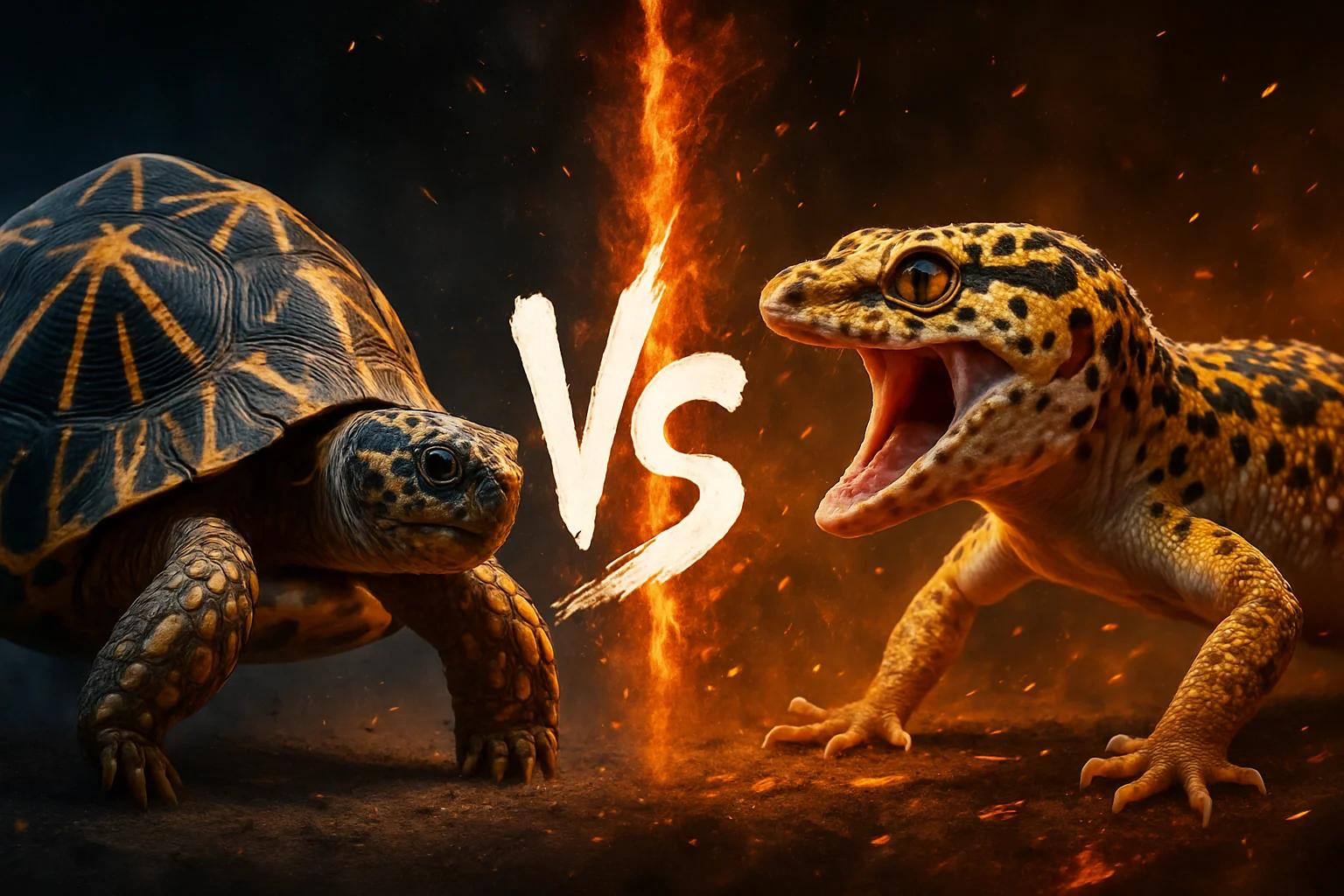
Indian Star Tortoise vs Leopard Gecko: Who Actually Wins?
Indian Star Tortoise vs Leopard Gecko: a biology-first look at armor, speed, bite and survival strategy, and which reptile comes out ahead in a confrontation.
Indian Star Tortoise vs Leopard Gecko
Matchup winner
Indian Star Tortoise
Quick verdict
Start with the direct answer, then use the structured comparison below to see what changes the outcome.
The Indian Star Tortoise wins this matchup, and it isn't especially close. A leopard gecko is quicker, more agile and a capable insect hunter, but its small jaws are built for crickets and beetles, not for breaking into a domed, bony carapace. The star tortoise outweighs a gecko many times over (adults often weigh 1–2+ kg against roughly 50–80 g), can pull its head and limbs behind armored scutes, and can deliver a firm, crushing beak bite if the gecko lingers near its face. The gecko's realistic best outcome is avoiding contact altogether. In any frame where the two actually have to resolve a contest, the tortoise's armor and mass decide it.
Read the full explanation
Winner: Indian Star Tortoise, through armor, mass and a strong beak.
The leopard gecko is far faster and more agile, but it has no way to hurt a shelled tortoise.
The gecko's real strengths are escape, a detachable tail and nocturnal stealth, not fighting.
In real life these animals don't compete. This is a thought experiment about body plans.
Reader vote
Who do you think wins?
Pick a side — no account needed. Results update live.
No votes yet — be the first to call it.
Editorial note
Why people disagree
Speed looks decisive on paper. The gecko's 30 speed rating against the tortoise's 10 suggests it controls the fight, but control only matters if you have a weapon that works on the other animal.
Close-range durability
Armor sets the terms here. The gecko's bite simply has no viable target on a withdrawn tortoise.
Weight class
A 15–30x mass gap means the tortoise can bulldoze, pin or simply ignore the gecko.
Burst mobility
Speed lets the gecko choose engagement or leave at will, which is its main survival lever.
Read the full explanation +
Some people picture the tortoise as purely passive. Star tortoises are mostly herbivorous and calm, but their beaks are strong enough to clamp onto something that crowds their head.
Gecko keepers point to tail autotomy and nimbleness as 'unbeatable'. Those are excellent survival tools, but they help the gecko lose safely, not win.
Comparison FAQ
Short, direct answers to the next questions readers usually ask after the headline verdict.
Would an Indian Star Tortoise beat a Leopard Gecko in a fight?+
Yes. The tortoise's shell blocks anything the gecko can do, and its mass and beak let it push or bite the gecko if it gets close.
Which is stronger, an Indian Star Tortoise or a Leopard Gecko?+
The Indian Star Tortoise, by a wide margin. It is many times heavier and built to bear weight and push through vegetation, while the gecko is a lightweight sprinter.
Can a leopard gecko hurt a tortoise?+
Barely. It might nip soft skin around the legs or neck, but it can't damage the shell, and the tortoise can withdraw those areas instantly.
Why is the leopard gecko still dangerous to underestimate?+
It's fast, alert and an effective predator of insects and small invertebrates. If grabbed, it can drop its tail to escape and bite defensively. It's hard to catch even when it can't win.
Do Indian Star Tortoises and Leopard Geckos live in the same areas?+
Their ranges partly overlap in South Asia's dry scrub regions, including parts of India and Pakistan, but they occupy different niches and rarely interact meaningfully.
Should these animals be housed together as pets?+
No. Mixing species causes stress, injury risk and disease transmission. Both need separate, species-appropriate enclosures.
Head-to-head species stats
These are the same core AnimalDex stat dimensions used on the dedicated animal pages, pulled side by side so the matchup is faster to scan.
Indian Star Tortoise
Tier CLeopard Gecko
Tier CTrait-by-trait comparison
Only the categories that matter to this matchup are included. The goal is not filler stats, but the real design differences that change the result.
Domed bony carapace and plastron, retractable limbs
Close-range durability
Indian Star Tortoise
Soft bumpy skin, no armor
Close-range durability
Indian Star Tortoise
Roughly 1–2+ kg adult
Weight class
Indian Star Tortoise
Roughly 50–80 g adult
Weight class
Indian Star Tortoise
Slow, deliberate walker
Burst mobility
Leopard Gecko
Quick dashes, agile climber over rock
Burst mobility
Leopard Gecko
Keratin beak for shearing tough plants
Bite utility
Indian Star Tortoise
Small jaws tuned for insects
Bite utility
Indian Star Tortoise
Withdraw into shell
Escape toolkit
Leopard Gecko
Tail autotomy, burrow use, night activity
Escape toolkit
Leopard Gecko
Good daytime vision, scent-led foraging
Ambush awareness
Leopard Gecko
Low-light vision, motion-sensitive predator
Ambush awareness
Leopard Gecko
How the verdict forms
Verdict timeline
01 · Close-range durability
Indian Star Tortoise
02 · Weight class
Indian Star Tortoise
03 · Burst mobility
Leopard Gecko
04 · Bite utility
Indian Star Tortoise
05 · Escape toolkit
Leopard Gecko
06 · Ambush awareness
Leopard Gecko
Change the conditions
Scenario breakdown
This is where shallow battle content usually fails. Terrain, spacing, timing, and engagement style can change the answer.
Scenario lean
Leopard Gecko
Verdict confidence
82%
The gecko slips into gaps the tortoise can't follow.
In broken rock with tight crevices, the leopard gecko's small, flexible body and climbing grip let it vanish completely. The tortoise can't reach or pursue it, so the gecko 'wins' by denying any contact. That is survival through terrain, not a fight victory.
AnimalDex field profiles
Explore these animals
Indian Star Tortoise
Geochelone elegans
dry scrub, thorn forest, and semi-arid grassland
Leopard Gecko
Eublepharis macularius
Dry rocky scrub, semi-desert, and broken stony ground with crevices.
Systems Intelligence & Hidden Purpose
See the animals behind this comparison as engineered biological systems: what each one is built to do, where it gains leverage, and why the matchup changes by scenario.
Specialized Hardware
radiating star shell pattern, slow dryland grazing, and strong camouflage in scrub give the Indian Star Tortoise a body plan tuned for its niche.
Systems Script
Indian Star Tortoises operate through dry scrub, thorn forest, and semi-arid grassland Their design links movement, shelter, and feeding into one workable survival system.
Strategic Insight
Decoration and concealment can sometimes be the same thing.
Specialized Hardware
Movable eyelids, fat-storing tail, and low-light hunting senses make leopard geckos resilient nocturnal hardware for arid and rocky terrain.
Systems Script
They clean up insects and small prey in the cooler hours when daytime heat loses its advantage. Their niche runs on timing discipline and energy storage rather than brute force.
Strategic Insight
Resilience improves when you carry reserves and choose the shift that fits your hardware.
Final take
The Indian Star Tortoise wins because its body plan solves the problem the gecko can't. Armor and mass make it essentially immune to a small insectivore's offense, while its beak gives it a credible response at close range.
Read the full explanation
The leopard gecko isn't outclassed in every way. It's faster, sharper-sensed and has one of the reptile world's best emergency exits in its detachable tail. Those traits make it nearly impossible for a slow tortoise to catch, which is why it rarely loses anything that matters. But winning a contest means imposing an outcome, and only the tortoise can do that here.
Collect both animals in AnimalDex
Track the species behind this matchup, compare their real traits, and build the rivalry into your AnimalDex collection.
Related comparisons
Continue with nearby matchups to compare more real-world animal traits without dropping into junky who-wins filler.
Armadillo Girdled Lizard vs Leopard Gecko: Who Actually Wins?
The armadillo girdled lizard wins this matchup overall. Both lizards are similar in body length, but the girdled lizard is built like a mobile fortress. Thick, spiny osteoderm-backed scales cover its back and tail, and its famous tail-in-mouth roll turns it into a spiked ring with almost no soft target exposed. The leopard gecko is quicker and a capable night hunter of insects, but its soft, granular skin and comparatively light bite give it little way to hurt an armored opponent. In any sustained contact the gecko is the one taking damage, and its best outcome is breaking off. Speed lets the gecko avoid a fight, but it does not let the gecko win one.
Read comparison
Discussion
What do you think?
Share your reasoning with other readers. Be civil and stick to the animals.
Sign in to join the discussion.
Sign inNo comments yet. Start the conversation.