

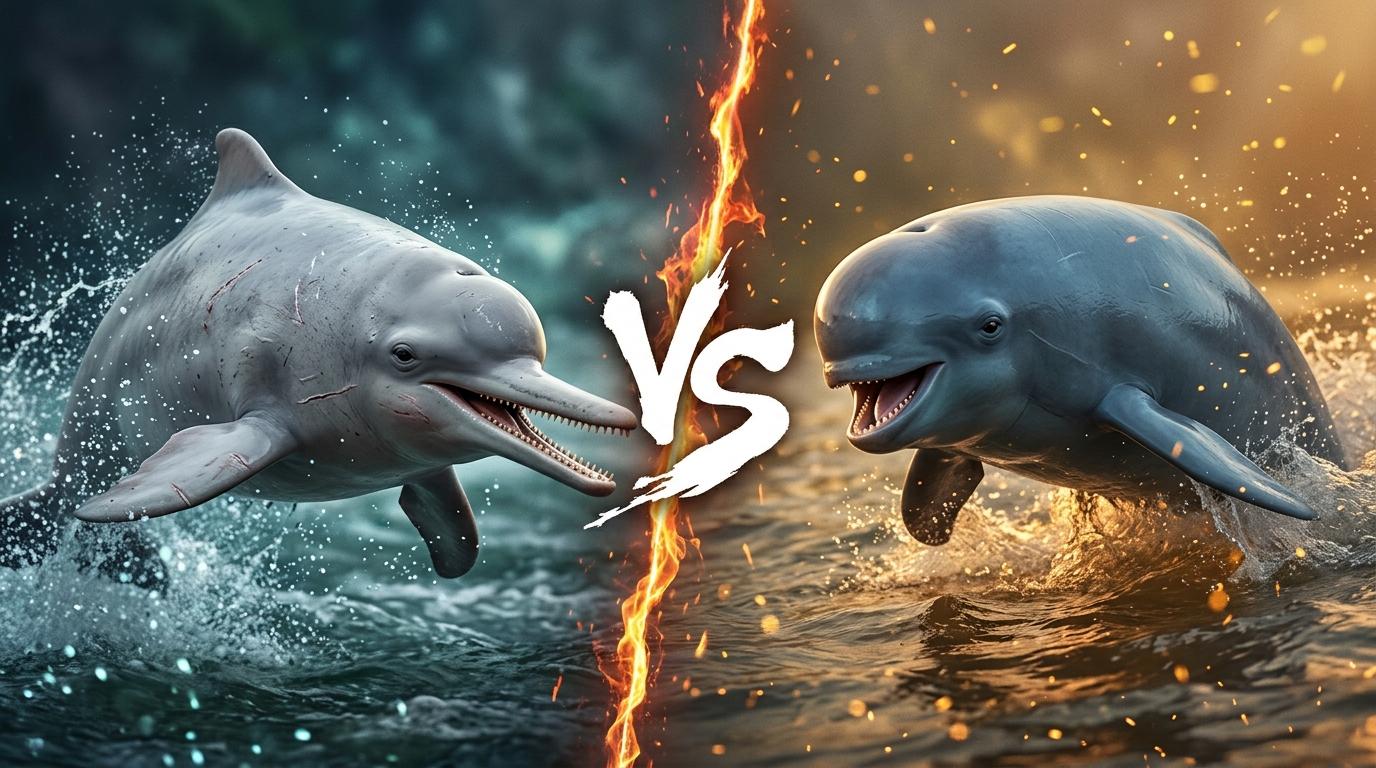
Indus River Dolphin vs Yangtze Finless Porpoise: Who Actually Wins?
Indus River Dolphin vs Yangtze Finless Porpoise: a biology-first look at size, teeth, sonar and maneuverability, and why the long-beaked Indus dolphin gets the edge in a hypothetical clash.
Indus River Dolphin vs Yangtze Finless Porpoise
Matchup winner
Indus River Dolphin
Quick verdict
Start with the direct answer, then use the structured comparison below to see what changes the outcome.
The Indus River Dolphin wins this hypothetical matchup, with roughly 68% confidence. It is the longer animal, reaching about 2 to 2.5 m against the porpoise's typical 1.5 to 1.8 m. It also carries a weapon the porpoise lacks: a long, narrow beak lined with dozens of sharp, interlocking teeth on each side. That beak is built to snap at fish in muddy water, and it gives the dolphin reach, a precise strike and a clear first-contact advantage. The Yangtze Finless Porpoise is compact, agile and socially sophisticated, but its small spade-shaped teeth suit gripping prey, not inflicting damage, and it has no reach to match. These two never meet in the wild. One lives in Pakistan's Indus River system and the other in China's Yangtze. Both are among the rarest cetaceans on Earth, so this is a thought experiment about body design, not a real rivalry.
Read the full explanation
Winner: Indus River Dolphin, mainly through greater length and a long, tooth-lined beak.
The finless porpoise is nimble and highly social, but it has no real weapon.
The dolphin's sonar is tuned for close-range work in silty, near-zero visibility water.
In reality the two never meet, and both are endangered river specialists.
Reader vote
Who do you think wins?
Pick a side — no account needed. Results update live.
No votes yet — be the first to call it.
Editorial note
Why people disagree
Some readers assume 'porpoise' means tougher, but the finless porpoise is the smaller and less armed of the two.
Reach and weaponry
Reach lets the dolphin strike first and from distance, and in a short clash the first strike is the biggest lever.
Body mass and frame
The extra length and mass give the dolphin more momentum when it ramps or shoves the porpoise.
Sonar targeting
In silty water, the dolphin's full reliance on sound makes its close-range targeting exceptionally refined.
Read the full explanation +
The Indus dolphin is functionally blind, which sounds like a weakness until you remember its sonar does the seeing in murky rivers.
The porpoise's intelligence score and group living impress people, but sociality matters less in a one-on-one frame.
Comparison FAQ
Short, direct answers to the next questions readers usually ask after the headline verdict.
Would an Indus River Dolphin beat a Yangtze Finless Porpoise?+
Yes, in a hypothetical one-on-one. Its greater length and sharp-toothed beak give it the edge.
Which is stronger?+
The Indus River Dolphin. It is longer and generally heavier, with more momentum and a more damaging bite.
Why is the finless porpoise still dangerous?+
It is quick, turns tightly and can coordinate with group members. In open water or with backup, it can harass a rival or escape cleanly.
Do they ever meet in the wild?+
No. One lives in the Indus River system in Pakistan and the other in China's Yangtze basin.
Is the Indus River Dolphin really blind?+
Functionally, yes. Its eye has no lens, so it relies on echolocation. Its eyes may still sense light.
Head-to-head species stats
These are the same core AnimalDex stat dimensions used on the dedicated animal pages, pulled side by side so the matchup is faster to scan.
Indus River Dolphin
Tier BYangtze Finless Porpoise
Tier BTrait-by-trait comparison
Only the categories that matter to this matchup are included. The goal is not filler stats, but the real design differences that change the result.
Long narrow beak with many sharp, interlocking teeth
Reach and weaponry
Indus River Dolphin
Short rounded head with small spade-shaped teeth
Reach and weaponry
Indus River Dolphin
About 2–2.5 m; females larger, up to roughly 80–90 kg
Body mass and frame
Indus River Dolphin
About 1.5–1.8 m; roughly 45–70 kg
Body mass and frame
Indus River Dolphin
Near-constant echolocation; the eye has no lens
Sonar targeting
Indus River Dolphin
Capable echolocation backed by functional vision
Sonar targeting
Indus River Dolphin
Flexible neck; swims on its side to scan the riverbed
Tight-turn agility
Yangtze Finless Porpoise
Compact, finless back built for quick turns
Tight-turn agility
Yangtze Finless Porpoise
Mostly solitary or in loose pairs
Social and cognitive edge
Yangtze Finless Porpoise
Small coordinated groups with active vocal communication
Social and cognitive edge
Yangtze Finless Porpoise
How the verdict forms
Verdict timeline
01 · Reach and weaponry
Indus River Dolphin
02 · Body mass and frame
Indus River Dolphin
03 · Sonar targeting
Indus River Dolphin
04 · Tight-turn agility
Yangtze Finless Porpoise
05 · Social and cognitive edge
Yangtze Finless Porpoise
Change the conditions
Scenario breakdown
This is where shallow battle content usually fails. Terrain, spacing, timing, and engagement style can change the answer.
Scenario lean
Indus River Dolphin
Verdict confidence
82%
The dolphin's home terrain.
In turbid, low-visibility water, vision is nearly useless and sonar decides who acts first. The Indus dolphin lives in exactly this setting. It can lock onto the porpoise acoustically and snap with its long jaw before the porpoise closes the distance. The porpoise's working eyes give it no edge here.
AnimalDex field profiles
Explore these animals
Indus River Dolphin
Platanista gangetica minor
slow river channel, meander bend, and silty freshwater basin
Yangtze Finless Porpoise
Neophocaena asiaeorientalis asiaeorientalis
broad river channel, oxbow edge, and freshwater floodplain corridor
Systems Intelligence & Hidden Purpose
See the animals behind this comparison as engineered biological systems: what each one is built to do, where it gains leverage, and why the matchup changes by scenario.
Specialized Hardware
Lensless eyes, near-continuous echolocation, a long beak with interlocking teeth, a flexible neck and side-swimming posture for scanning the riverbed.
Systems Script
A top fish predator in turbid river channels. It regulates fish and crustacean populations and signals river health; it disappears where flow and connectivity collapse.
Strategic Insight
When a sense fails you, invest everything in the one that works. Total commitment to the right tool can beat a broad toolkit.
Specialized Hardware
A finless back with a tubercle-studded ridge, a compact agile body, spade-shaped teeth, and echolocation plus communicative clicks.
Systems Script
A flagship species and last cetacean of the Yangtze after the baiji's loss. It feeds on small fish and shrimp, and its presence serves as a key yardstick for river restoration.
Strategic Insight
Agility and coordination keep you alive when you can't out-muscle a threat. Choose the battles you can avoid.
Final take
The Indus River Dolphin takes the overall win because its design is unusually weapon-like for a small cetacean. It has length, mass and a long, tooth-lined jaw guided by refined sonar. The finless porpoise is the better escape artist and the more social thinker, but agility alone rarely wins a direct confrontation.
Read the full explanation
The more important truth is that neither animal is winning its real fight. River damming, fishing nets, pollution and boat traffic have pushed both into tiny, fragmented populations. The Indus dolphin numbers only a few thousand. The Yangtze finless porpoise is estimated at roughly 1,200 to 1,300 and is critically endangered, and its river already lost the baiji.
Collect both animals in AnimalDex
Track the species behind this matchup, compare their real traits, and build the rivalry into your AnimalDex collection.
Related comparisons
Continue with nearby matchups to compare more real-world animal traits without dropping into junky who-wins filler.
X-ray Tetra vs Yangtze Finless Porpoise: Who Actually Wins?
The Yangtze finless porpoise wins decisively. This is not a fight between rivals. It is a predator-prey relationship. The porpoise is a roughly 1.5 to 1.8 meter, 40 to 70 kg air-breathing mammal that echolocates its way to small fish in murky river water. The X-ray tetra is a roughly 4 to 5 cm schooling characin from South American rivers. In a direct encounter the tetra has no offensive tools that matter, while the porpoise has the mass, sonar, and suction-and-snap feeding style to treat it as a snack. The tetra's only real game is survival. Its translucent body, tight schooling, and quick darting can buy escapes, but they cannot reverse a size gap of more than a thousand to one by mass.
Read comparison
Discussion
What do you think?
Share your reasoning with other readers. Be civil and stick to the animals.
Sign in to join the discussion.
Sign inNo comments yet. Start the conversation.