

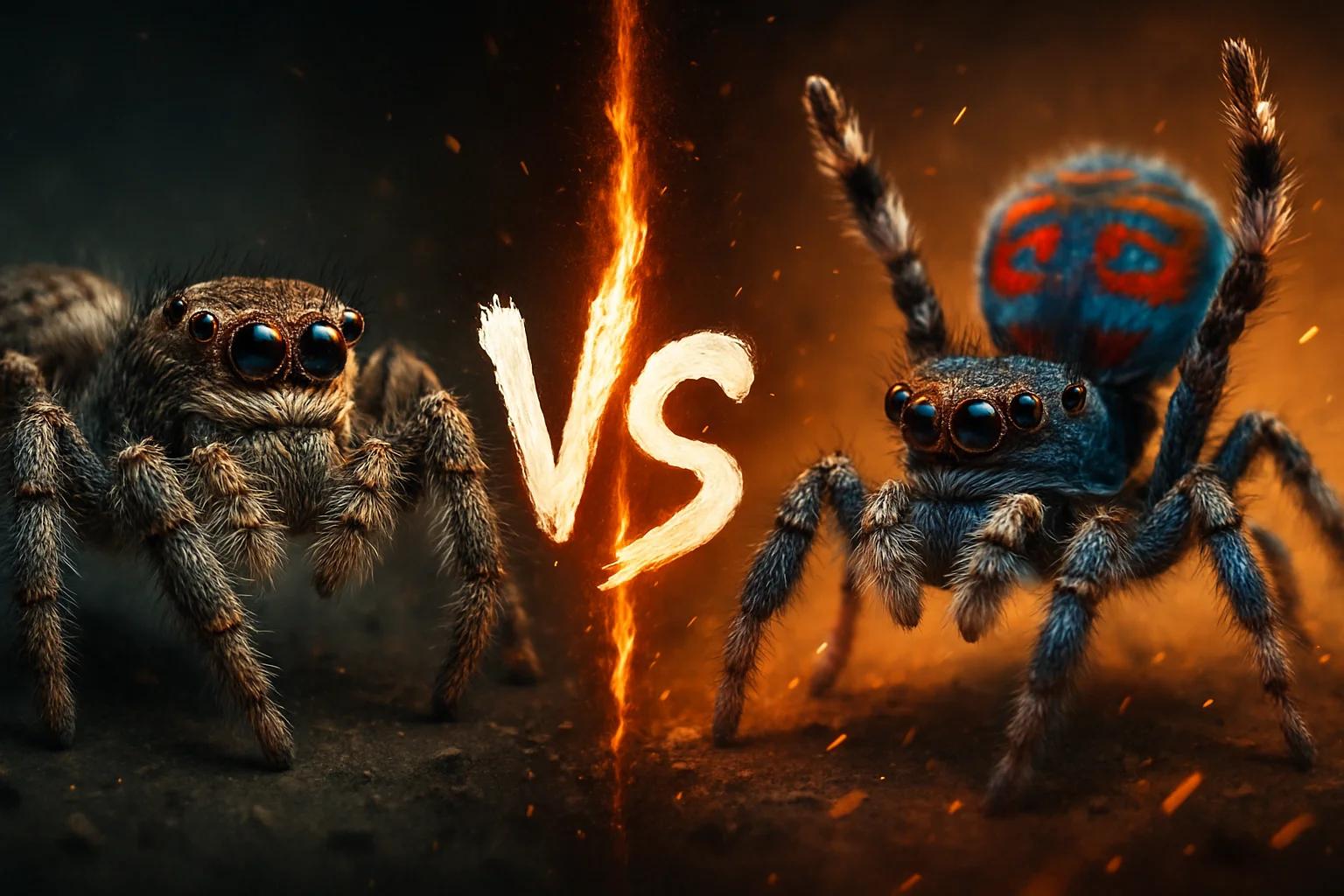
Jumping Spider vs Peacock Spider: Who Actually Wins?
Tan jumping spider (Platycryptus undatus) vs peacock spider (Maratus volans). This head-to-head compares size, vision, hunting tactics and fighting ability between two salticid cousins to show which spider wins and why.
Jumping Spider vs Peacock Spider
Matchup winner
Jumping Spider
Quick verdict
Start with the direct answer, then use the structured comparison below to see what changes the outcome.
The tan jumping spider (Platycryptus undatus) wins clearly. Both are salticids: daylight hunters with superb forward-facing eyes, silk safety lines and a pounce instead of a web. The gap is size. An adult tan jumper runs roughly 8–13 mm, while a peacock spider is about 4–5 mm. That gives Platycryptus several times the body mass, longer reach, stronger chelicerae and a bigger venom load. Peacock spiders are not wired for this kind of contest either. Their most striking hardware, the male's iridescent fan and his leg-waving dance, evolved to win over females, not to win fights. Small salticids also sit squarely inside the prey range of larger jumping spiders, and salticids readily eat other spiders. In most realistic encounters, the tan jumper treats the peacock spider as a meal.
Read the full explanation
Winner: tan jumping spider (Platycryptus undatus), by a wide margin.
It is roughly 2–3× longer and several times heavier, with matching gains in fangs and venom.
Both have elite vision, so there is no sensory edge for the peacock spider to exploit.
The peacock spider's real weapon is its courtship display, which does nothing in a fight.
Reader vote
Who do you think wins?
Pick a side — no account needed. Results update live.
No votes yet — be the first to call it.
Editorial note
Why people disagree
Peacock spiders go viral, so people assume a showy animal must also be a tough one. The colors are a sales pitch to females, not a weapon.
Explosive power
Salticids jump by rapidly raising blood pressure in their legs. A bigger body throws a bigger, harder strike.
Strike precision and vision
Both see brilliantly. The tan jumper's larger eyes give slightly better resolution at range, so it can plan its approach and land the pounce.
Close-range durability
In a grapple between spiders, whoever's fangs land first usually wins. Extra size buys margin for error.
Read the full explanation +
Both are 'jumping spiders,' which makes the matchup sound even. Within the same family, size usually decides who eats whom.
Peacock spiders are smart, careful hunters. But intelligence that is equal on both sides cancels out, and then mass and reach take over.
Comparison FAQ
Short, direct answers to the next questions readers usually ask after the headline verdict.
Would a jumping spider beat a peacock spider?+
Yes. A tan jumping spider (Platycryptus undatus) would almost always win, and it could prey on the peacock spider because it is far larger with a stronger bite.
Which spider is stronger?+
The tan jumping spider. It is roughly 2–3 times longer and several times heavier, with bigger fangs, more venom and a more powerful jump.
Is a peacock spider a type of jumping spider?+
Yes. Peacock spiders (genus Maratus) belong to the jumping spider family Salticidae, which is why the deciding factor here is size rather than a difference in tactics.
Why is the peacock spider still dangerous?+
To the insects it hunts, it is a precise, intelligent ambush predator with excellent vision. Against a larger spider, it stays hard to catch because it is tiny, alert and quick to drop away on silk.
Are either of these spiders dangerous to humans?+
No. Both are harmless to people. They rarely bite, and their venom is not medically significant.
Head-to-head species stats
These are the same core AnimalDex stat dimensions used on the dedicated animal pages, pulled side by side so the matchup is faster to scan.
Jumping Spider
Tier DPeacock Spider
Tier DTrait-by-trait comparison
Only the categories that matter to this matchup are included. The goal is not filler stats, but the real design differences that change the result.
Long, forceful pounce powered by a larger body
Explosive power
Jumping Spider
Short, precise hop scaled to a 4–5 mm frame
Explosive power
Jumping Spider
Large principal eyes, excellent depth judgment
Strike precision and vision
Jumping Spider
Superb vision tuned to color and display
Strike precision and vision
Jumping Spider
Thicker legs and carapace, flattened bark-hugging build
Close-range durability
Jumping Spider
Tiny, delicate body
Close-range durability
Jumping Spider
Larger chelicerae and venom reserve
Venom and bite
Jumping Spider
Small bite suited to tiny insects
Venom and bite
Jumping Spider
Mottled bark camouflage, patient stalker
Ambush control
Jumping Spider
Cryptic female and resting male, stalks small prey
Ambush control
Jumping Spider
Modest courtship display
Signal sophistication
Peacock Spider
World-class iridescent fan and dance
Signal sophistication
Peacock Spider
How the verdict forms
Verdict timeline
01 · Explosive power
Jumping Spider
02 · Strike precision and vision
Jumping Spider
03 · Close-range durability
Jumping Spider
04 · Venom and bite
Jumping Spider
05 · Ambush control
Jumping Spider
06 · Signal sophistication
Peacock Spider
Change the conditions
Scenario breakdown
This is where shallow battle content usually fails. Terrain, spacing, timing, and engagement style can change the answer.
Scenario lean
Jumping Spider
Verdict confidence
82%
The tan jumper stalks and pounces first.
In cluttered cover, both spiders rely on vision and a careful approach. Platycryptus is a camouflage specialist on bark, and its longer reach lets it strike from a range where the peacock spider's own bite cannot reach back. Once it lands, its size advantage decides the grapple.
AnimalDex field profiles
Explore these animals
Jumping Spider
Salticidae
Walls, bark, shrubs, leaf litter, grass stems, and sunny edges with abundant small insects.
Peacock Spider
Maratus volans
Grassland, scrub, leaf litter, and low vegetation in warm open habitat.
Systems Intelligence & Hidden Purpose
See the animals behind this comparison as engineered biological systems: what each one is built to do, where it gains leverage, and why the matchup changes by scenario.
Specialized Hardware
Large forward-facing eyes, sharp depth judgment, and hydraulically powered jumps make jumping spiders unusually accurate visual hunters without the need for capture webs.
Systems Script
Jumping spiders regulate insect traffic at a tiny scale across leaves, bark, walls, and understory surfaces. They show how precision predation can emerge from compact hardware and strong sensory computation.
Strategic Insight
Accuracy compounds. At small scales, the cleanest win usually comes from better targeting, not more force.
Specialized Hardware
Tiny body with large forward eyes, bright patterned abdominal fan on males, and jerky jumping movement give the Peacock Spider a body plan tuned for its niche.
Systems Script
Peacock Spiders operate in grassland, scrub, leaf litter, and low vegetation in warm open habitat. Their design helps them match food access, shelter, and timing inside that environment.
Strategic Insight
Scale does not limit impact when the signal is memorable enough.
Final take
The tan jumping spider wins this matchup convincingly. It has the same elite salticid toolkit as its opponent, including advanced eyes, a hydraulic pounce and silk safety lines, scaled up into a bigger, heavier and better-armed body. Among jumping spiders, that kind of size gap usually turns a fight into predation.
Read the full explanation
The peacock spider is not a lesser animal. It is specialized in a different direction. Its biology invests heavily in sexual display, and its survival plan relies on being small, cryptic and quick to escape. Its edge is getting away early, not winning once contact is made.
Collect both animals in AnimalDex
Track the species behind this matchup, compare their real traits, and build the rivalry into your AnimalDex collection.
Discussion
What do you think?
Share your reasoning with other readers. Be civil and stick to the animals.
Sign in to join the discussion.
Sign inNo comments yet. Start the conversation.