

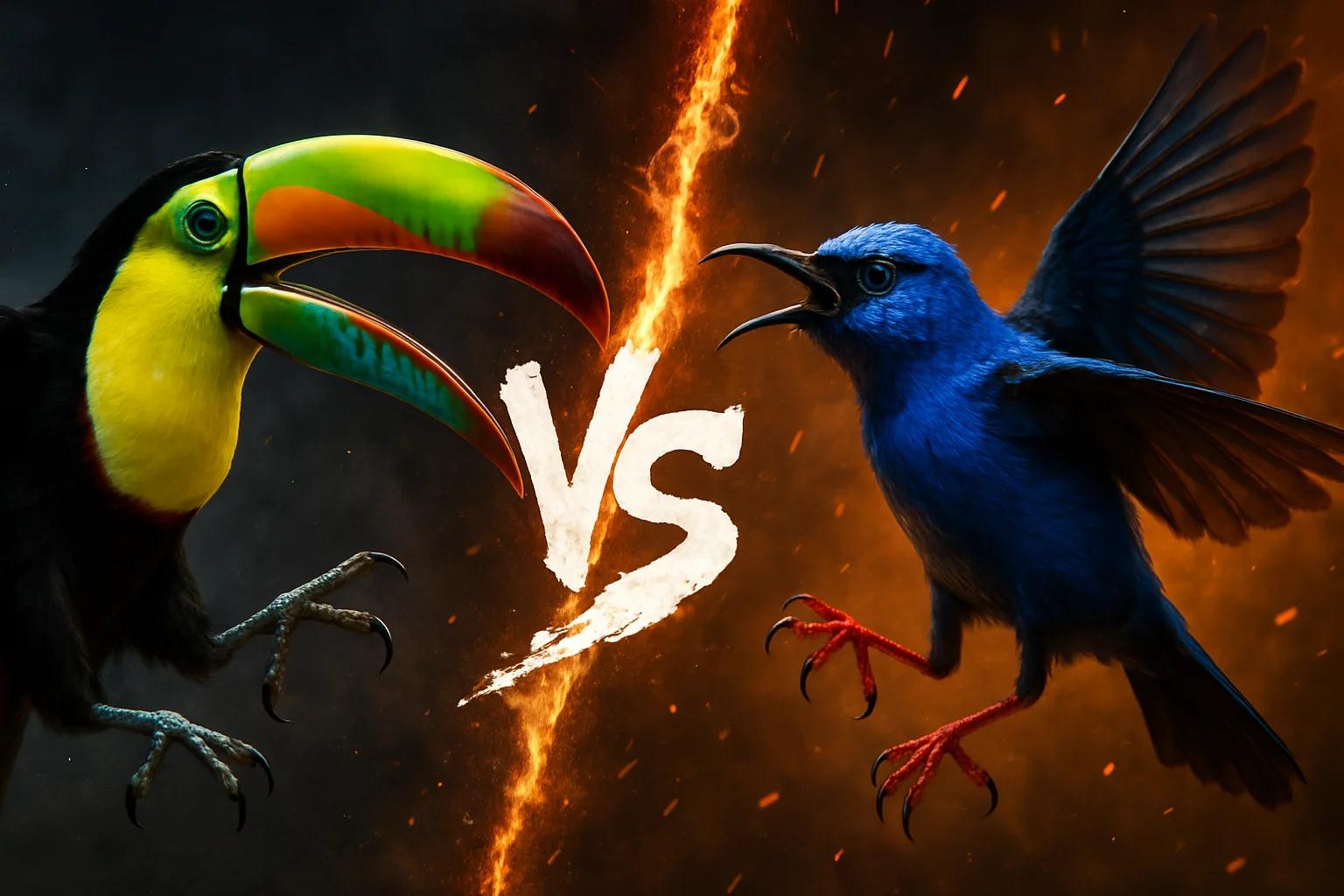
Keel-billed Toucan vs Red-legged Honeycreeper: Who Actually Wins?
Keel-billed Toucan vs Red-legged Honeycreeper: a biology-first breakdown of size, bill power, agility and canopy behavior. Here's who wins, and why the tiny honeycreeper still matters.
Keel-billed Toucan vs Red-legged Honeycreeper
Matchup winner
Keel-billed Toucan
Quick verdict
Start with the direct answer, then use the structured comparison below to see what changes the outcome.
The Keel-billed Toucan wins clearly. At roughly 380–500 g against a honeycreeper's 12–16 g, the toucan outweighs its rival about 25–30 times. Its huge serrated bill gives it reach, leverage and grip. Toucans also raid other birds' nests for eggs and nestlings, so small birds already treat them as a real threat. The Red-legged Honeycreeper is quicker to take off and dart through the canopy, but speed only helps it escape. It has no way to hurt a bird this large. In any real confrontation, the honeycreeper's best move is to leave, and that is exactly what it does in the wild.
Read the full explanation
Keel-billed Toucan wins: about 25–30x heavier with a long, serrated, grasping bill.
Toucans are known nest predators of small songbirds, so this is a predator–prey size gap, not an even fight.
The honeycreeper's edge is agility and fast escape, which helps it survive but can't win a contest.
The honeycreeper wins only by avoiding contact, using mobbing, quick flight and dense foliage.
Reader vote
Who do you think wins?
Pick a side — no account needed. Results update live.
No votes yet — be the first to call it.
Editorial note
Why people disagree
The toucan's bill looks fearsome but is light and honeycombed inside, so some readers assume it's all show. It still delivers reach and grip a 14 g bird can't counter.
Mass advantage
A gap this large settles almost every physical contest among birds before any skill comes into play.
Weapon reach
The toucan can grab and pin from a distance. The honeycreeper's bill is built for flowers, not combat.
Burst agility
Agility is the honeycreeper's survival tool: it lets the small bird pick whether and when contact happens.
Read the full explanation +
Honeycreepers are faster and more nimble in short bursts, which people confuse with being able to win a fight.
Both birds share fruiting trees, and small birds sometimes mob larger ones. That looks like bravery winning, but mobbing pushes a predator away without beating it.
Comparison FAQ
Short, direct answers to the next questions readers usually ask after the headline verdict.
Would a Keel-billed Toucan beat a Red-legged Honeycreeper?+
Yes. The toucan wins decisively in almost any direct confrontation because of its enormous size advantage and long, serrated bill.
Which bird is stronger?+
The Keel-billed Toucan, by far. It weighs roughly 25–30 times more than the honeycreeper and can grip and pin with its bill.
Do toucans actually attack small birds?+
Yes. Toucans opportunistically eat eggs and nestlings of smaller birds, so small canopy birds treat them as predators and often mob them.
Why is the honeycreeper still hard to catch?+
Its rapid takeoff, tight maneuvering in foliage and habit of feeding in alert mixed-species flocks make it hard to corner. An adult honeycreeper can almost always escape.
Can a honeycreeper ever win?+
Only by driving the toucan away rather than beating it. Group mobbing at a nest can push a toucan off, but one honeycreeper alone can't win a fight.
Head-to-head species stats
These are the same core AnimalDex stat dimensions used on the dedicated animal pages, pulled side by side so the matchup is faster to scan.
Keel-billed Toucan
Tier CRed-legged Honeycreeper
Tier CTrait-by-trait comparison
Only the categories that matter to this matchup are included. The goal is not filler stats, but the real design differences that change the result.
~380–500 g, heavy-bodied
Mass advantage
Keel-billed Toucan
~12–16 g, warbler-sized
Mass advantage
Keel-billed Toucan
Bill up to ~1/3 body length, serrated edges
Weapon reach
Keel-billed Toucan
Fine, decurved nectar-probing bill
Weapon reach
Keel-billed Toucan
Short undulating flights, hops between branches
Burst agility
Red-legged Honeycreeper
Rapid takeoff, sharp turns in foliage
Burst agility
Red-legged Honeycreeper
Opportunistic egg and nestling raider
Predatory intent
Keel-billed Toucan
Nectar, fruit and insect forager
Predatory intent
Keel-billed Toucan
Small noisy flocks
Group defense
Red-legged Honeycreeper
Joins mixed-species flocks that mob intruders
Group defense
Red-legged Honeycreeper
Bold, curious, flexible diet
Canopy problem-solving
Keel-billed Toucan
Alert, quick-learning flock member
Canopy problem-solving
Keel-billed Toucan
How the verdict forms
Verdict timeline
01 · Mass advantage
Keel-billed Toucan
02 · Weapon reach
Keel-billed Toucan
03 · Burst agility
Red-legged Honeycreeper
04 · Predatory intent
Keel-billed Toucan
05 · Group defense
Red-legged Honeycreeper
06 · Canopy problem-solving
Keel-billed Toucan
Change the conditions
Scenario breakdown
This is where shallow battle content usually fails. Terrain, spacing, timing, and engagement style can change the answer.
Scenario lean
Red-legged Honeycreeper
Verdict confidence
82%
Honeycreeper survives by escaping
In dense vine tangles, the toucan's long bill and bulk get in the way, while the honeycreeper slips through gaps. Nobody is beaten here. The small bird just uses cover to avoid contact, which counts as a survival win in tight foliage.
AnimalDex field profiles
Explore these animals
Keel-billed Toucan
Ramphastos sulfuratus
rainforest canopy and humid forest edge
Red-legged Honeycreeper
Cyanerpes cyaneus
rainforest edge, second growth, and humid woodland
Systems Intelligence & Hidden Purpose
See the animals behind this comparison as engineered biological systems: what each one is built to do, where it gains leverage, and why the matchup changes by scenario.
Specialized Hardware
rainbow-striped giant bill, short rounded wings, and fruit-carrying canopy movement give the Keel-billed Toucan a body plan tuned for its niche.
Systems Script
Keel-billed Toucans operate through rainforest canopy and humid forest edge. Their design links movement, feeding, shelter, and timing into one workable survival system.
Strategic Insight
Dense environments reward precision, patience, and the ability to read layered cover.
Specialized Hardware
electric blue body in males, bright red legs, and flower-and-fruit canopy feeding give the Red-legged Honeycreeper a body plan tuned for its niche.
Systems Script
Red-legged Honeycreepers operate through rainforest edge, second growth, and humid woodland. Their design links movement, feeding, shelter, and timing into one workable survival system.
Strategic Insight
Dense environments reward precision, patience, and the ability to read layered cover.
Final take
The Keel-billed Toucan is the clear winner. Body mass, a long grasping bill and a habit of raiding small birds' nests put it in a different weight class entirely. This isn't a close matchup between rivals. It's a large omnivore set against a small bird that sometimes ends up on its menu.
Read the full explanation
The Red-legged Honeycreeper still has a winning strategy of its own: don't fight. Quick flight, flock vigilance and dense cover keep it alive in the same canopy as the toucan. It wins by never letting the encounter turn physical.
Collect both animals in AnimalDex
Track the species behind this matchup, compare their real traits, and build the rivalry into your AnimalDex collection.
Related comparisons
Continue with nearby matchups to compare more real-world animal traits without dropping into junky who-wins filler.
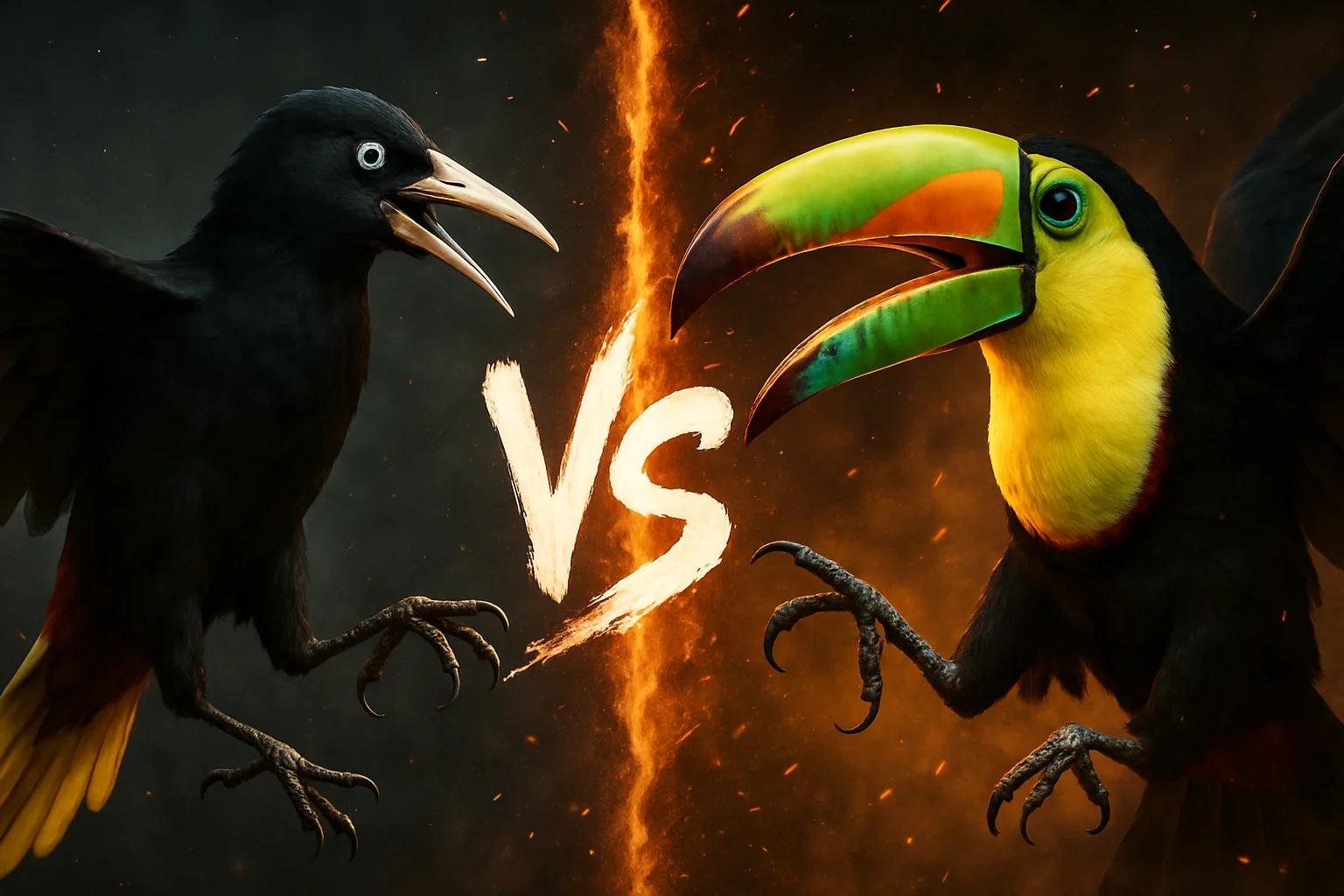
Crested Oropendola vs Keel-billed Toucan: Who Actually Wins?
The Crested Oropendola wins this matchup by a narrow but real margin. The Keel-billed Toucan is usually the heavier bird, at roughly 380–500 g against about 300 g for a large male oropendola, and its huge rainbow bill looks like a weapon. That bill, however, is a lightweight honeycomb of keratin built for reach, fruit handling, and heat shedding, not for hard, precise strikes. The oropendola carries a sharp, conical, ivory-tipped bill built for prying and jabbing. It is also the quicker, more maneuverable flier, and it comes from a colonial species that routinely mobs nest raiders, toucans included. In a real exchange, agility, a pointed tool, and a willingness to press the attack beat bulk and bluff. The toucan still takes contests where reach and intimidation decide things, such as a crowded fruit tree.
Read comparison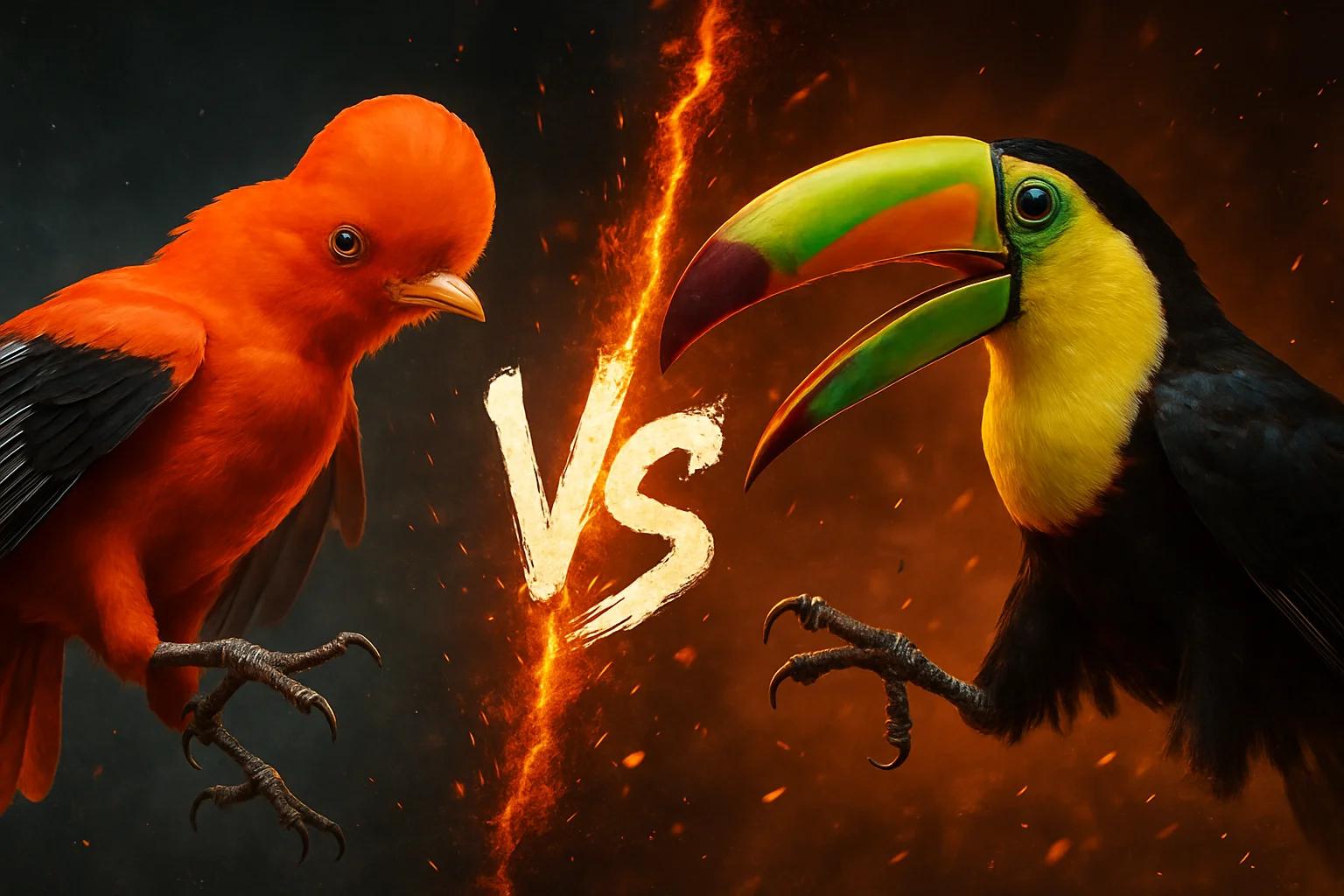
Guianan Cock-of-the-rock vs Keel-billed Toucan: Who Actually Wins?
The Keel-billed Toucan wins this matchup, and the result is not especially close. At roughly 380–500 g and up to about 55 cm long, it is close to twice the mass of a Guianan Cock-of-the-rock (about 200–220 g, roughly 30–32 cm). It also carries a 12–15 cm bill that gives it reach the cock-of-the-rock cannot match. Toucans routinely bully smaller birds off fruiting trees and raid nests for eggs and chicks, so confrontation is part of their foraging routine. The cock-of-the-rock is built for something else: spectacular lek displays in which males posture, bow, and flash orange crests. Its fights are mostly ritualized theater, not damage-dealing combat. The cock-of-the-rock is quick, tough for its size, and dangerous in the cluttered understory near its rocky nesting sites. In most realistic confrontations, though, the toucan's mass, reach, and habitual aggression decide the outcome.
Read comparison
Discussion
What do you think?
Share your reasoning with other readers. Be civil and stick to the animals.
Sign in to join the discussion.
Sign inNo comments yet. Start the conversation.