

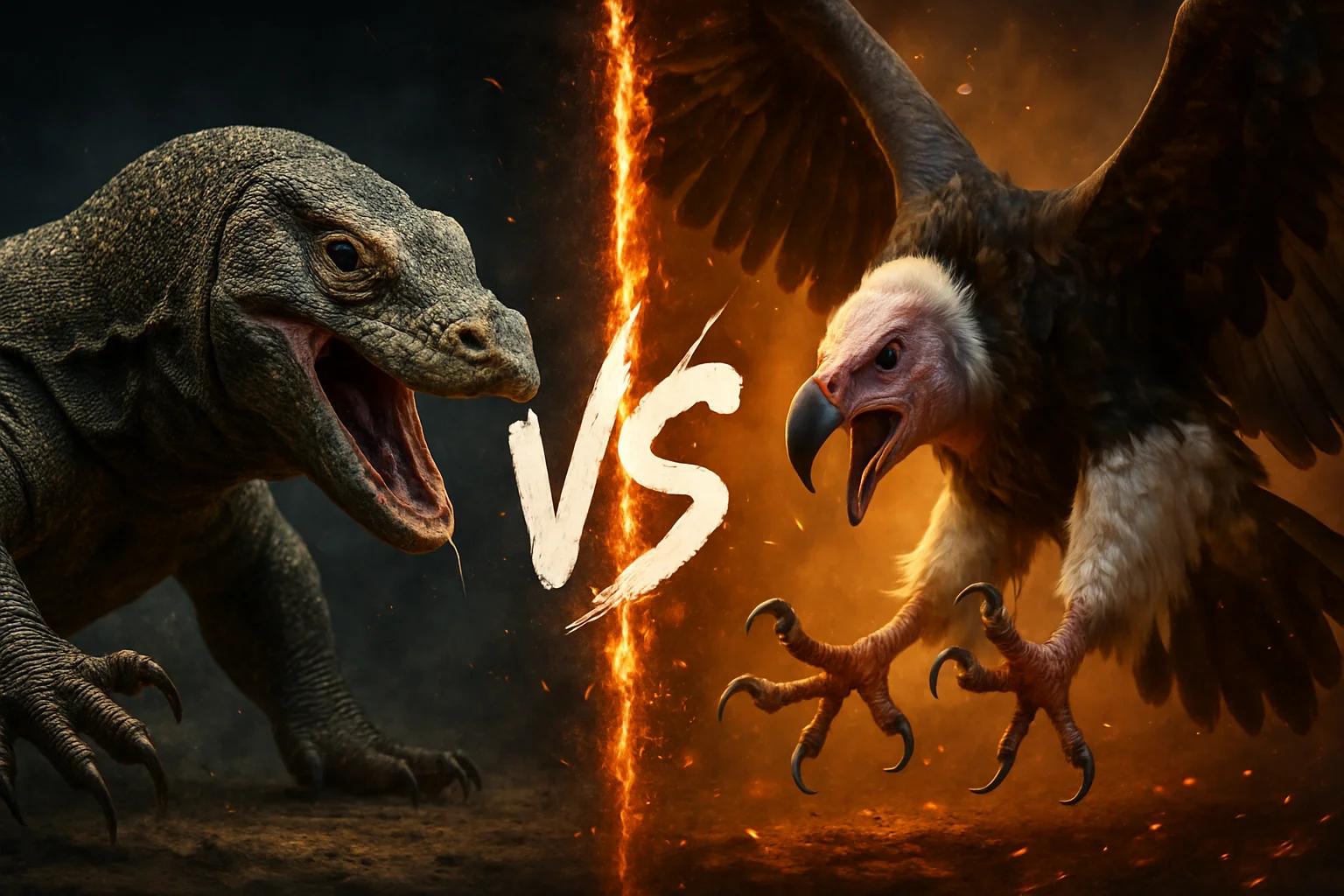
Komodo Dragon vs White-headed Vulture: Who Actually Wins?
Komodo dragon vs white-headed vulture: an evidence-based look at size, bite, flight, and carcass behavior, and why the dragon wins any real confrontation.
Komodo Dragon vs White-headed Vulture
Matchup winner
Komodo Dragon
Quick verdict
Start with the direct answer, then use the structured comparison below to see what changes the outcome.
The Komodo dragon wins clearly. An adult male can weigh 70–90 kg and reach about 3 m, armed with serrated, shark-like teeth, a venom-assisted bite that disrupts clotting, and armor-like osteoderms under its skin. The white-headed vulture weighs roughly 3.3–5.3 kg. It is a capable, assertive scavenger with a strong hooked bill, but it is built to tear open carcasses, not to fight a reptile twenty times its mass. If the vulture is caught on the ground within lunging range, the encounter is over in seconds. The vulture's real strengths are flight, early detection of food from soaring height, and the option to leave. That means it survives by avoiding the fight, not by winning it. In any scenario framed as a contest, the dragon's mass, bite, and close-range durability decide the outcome.
Read the full explanation
Komodo dragon wins: roughly 15–25x heavier with a lethal, venom-assisted bite.
The vulture's beak is made for tearing carcasses, not for subduing a large armored predator.
The vulture's best move is flight. It can avoid losing, but it cannot win.
On a contested carcass, the dragon controls the meat and the vulture waits its turn.
Reader vote
Who do you think wins?
Pick a side — no account needed. Results update live.
No votes yet — be the first to call it.
Editorial note
Why people disagree
Flight feels like a trump card, but escaping is not the same as winning, and a vulture cannot hurt a dragon from the air.
Raw mass
A gap this large means a single bite or shake from the dragon can decide the encounter. The vulture has no mass to resist with.
Killing toolkit
The dragon's mouth evolved to disable deer and pigs. The vulture's bill opens hides that are already dead.
Close-range durability
Pecks barely register on dragon armor, while one dragon bite can wreck a bird built for minimal weight.
Read the full explanation +
Vultures look fierce at carcasses, yet that boldness comes from competing with other scavengers, not from fighting apex reptiles.
These species never meet in the wild. The Komodo dragon lives on a few Indonesian islands and the white-headed vulture in sub-Saharan Africa, so every matchup is hypothetical and invites speculation.
Comparison FAQ
Short, direct answers to the next questions readers usually ask after the headline verdict.
Would a Komodo dragon beat a white-headed vulture?+
Yes. In any real confrontation where the vulture cannot simply fly away, the Komodo dragon wins quickly because of its overwhelming size and lethal bite.
Which is stronger, the Komodo dragon or the white-headed vulture?+
The Komodo dragon, by a wide margin. It is roughly 15–25 times heavier, and its bite and neck muscles can bring down deer and water buffalo.
Can a vulture hurt a Komodo dragon?+
Barely. Its hooked bill can tear exposed soft tissue, but the dragon's osteoderm-reinforced hide resists pecking, and the bird can't stay in range long enough to do meaningful damage.
Why is the white-headed vulture still dangerous in this matchup?+
It is dangerous mainly as an escape artist. It spots threats from far away, takes off quickly, and its bill can still wound eyes or soft skin if cornered. It won't win, but it is hard to catch.
Do Komodo dragons and white-headed vultures ever meet?+
No. Komodo dragons live on a few Indonesian islands, and white-headed vultures live in sub-Saharan Africa, so this matchup is purely hypothetical.
Head-to-head species stats
These are the same core AnimalDex stat dimensions used on the dedicated animal pages, pulled side by side so the matchup is faster to scan.
Komodo Dragon
Tier AWhite-headed Vulture
Tier BTrait-by-trait comparison
Only the categories that matter to this matchup are included. The goal is not filler stats, but the real design differences that change the result.
70–90 kg adult males
Raw mass
Komodo Dragon
About 3.3–5.3 kg
Raw mass
Komodo Dragon
Serrated teeth, venom glands, powerful neck pull
Killing toolkit
Komodo Dragon
Hooked tearing bill, weak grasping feet
Killing toolkit
Komodo Dragon
Osteoderm-reinforced skin, thick hide
Close-range durability
Komodo Dragon
Lightweight, hollow-boned flight frame
Close-range durability
Komodo Dragon
Short bursts around 15–20 km/h, ground-bound
Mobility and escape
White-headed Vulture
Soaring flight, fast takeoff once airborne
Mobility and escape
White-headed Vulture
Tongue-flicking scent tracking over kilometers
Detection range
White-headed Vulture
Sharp eyesight from high altitude
Detection range
White-headed Vulture
Patient trail-side ambusher, explosive lunge
Ambush control
Komodo Dragon
Not an ambusher; vulnerable during ground feeding
Ambush control
Komodo Dragon
How the verdict forms
Verdict timeline
01 · Raw mass
Komodo Dragon
02 · Killing toolkit
Komodo Dragon
03 · Close-range durability
Komodo Dragon
04 · Mobility and escape
White-headed Vulture
05 · Detection range
White-headed Vulture
06 · Ambush control
Komodo Dragon
Change the conditions
Scenario breakdown
This is where shallow battle content usually fails. Terrain, spacing, timing, and engagement style can change the answer.
Scenario lean
Komodo Dragon
Verdict confidence
82%
Dragon wins decisively.
In brush or broken terrain, the vulture's takeoff run and wingspan become liabilities. The dragon is an ambush specialist that waits close to the ground, and in cover it can close distance before the bird gets airborne. Once it bites, the mass gap makes the outcome near-certain.
AnimalDex field profiles
Explore these animals
Komodo Dragon
Varanus komodoensis
Dry tropical savannah, monsoon forest edges, and coastal scrub environments with prey access.
White-headed Vulture
Trigonoceps occipitalis
Savannah woodland, open dry forest edges, and mixed scrub zones near large mammal ranges.
Systems Intelligence & Hidden Purpose
See the animals behind this comparison as engineered biological systems: what each one is built to do, where it gains leverage, and why the matchup changes by scenario.
Specialized Hardware
Heavy skeletal architecture, serrated bite mechanics, tongue-based chemical sensing, and heat-efficient reptile metabolism make the Komodo dragon premium hardware for ambush, tracking, and territorial control.
Systems Script
The Komodo dragon operates as apex environmental hardware inside a constrained island system. It removes weak links, regulates prey pressure, and keeps limited ecosystems from drifting into easy imbalance.
Strategic Insight
Premium energy should not be spent on noise. Position well, sense early, and commit hard only when the leverage justifies the burn.
Specialized Hardware
Exceptional eyesight, soaring efficiency, and scavenger-grade feeding hardware allow the white-headed vulture to locate carcasses quickly and convert death into cleanup before disease risk spreads.
Systems Script
This species is part of the ecosystem sanitation layer. By clearing carrion, vultures reduce pathogen buildup, accelerate nutrient cycling, and keep the wider environmental operating system cleaner and more stable.
Strategic Insight
Not every valuable system creates by adding more. Some create advantage by removing waste faster than everyone else.
Final take
The Komodo dragon is the clear winner. This is a mismatch between a heavyweight reptilian predator and a lightweight aerial scavenger, and every combat-relevant trait favors the dragon: mass, bite, venom-assisted bleeding, and armored skin.
Read the full explanation
The white-headed vulture still deserves respect as a survivor. Its eyesight, soaring range, and quick exits mean it rarely has to face a fight it would lose. In nature, avoiding a losing battle is a winning strategy. In a head-to-head battle, though, the dragon wins.
Collect both animals in AnimalDex
Track the species behind this matchup, compare their real traits, and build the rivalry into your AnimalDex collection.
Discussion
What do you think?
Share your reasoning with other readers. Be civil and stick to the animals.
Sign in to join the discussion.
Sign inNo comments yet. Start the conversation.