

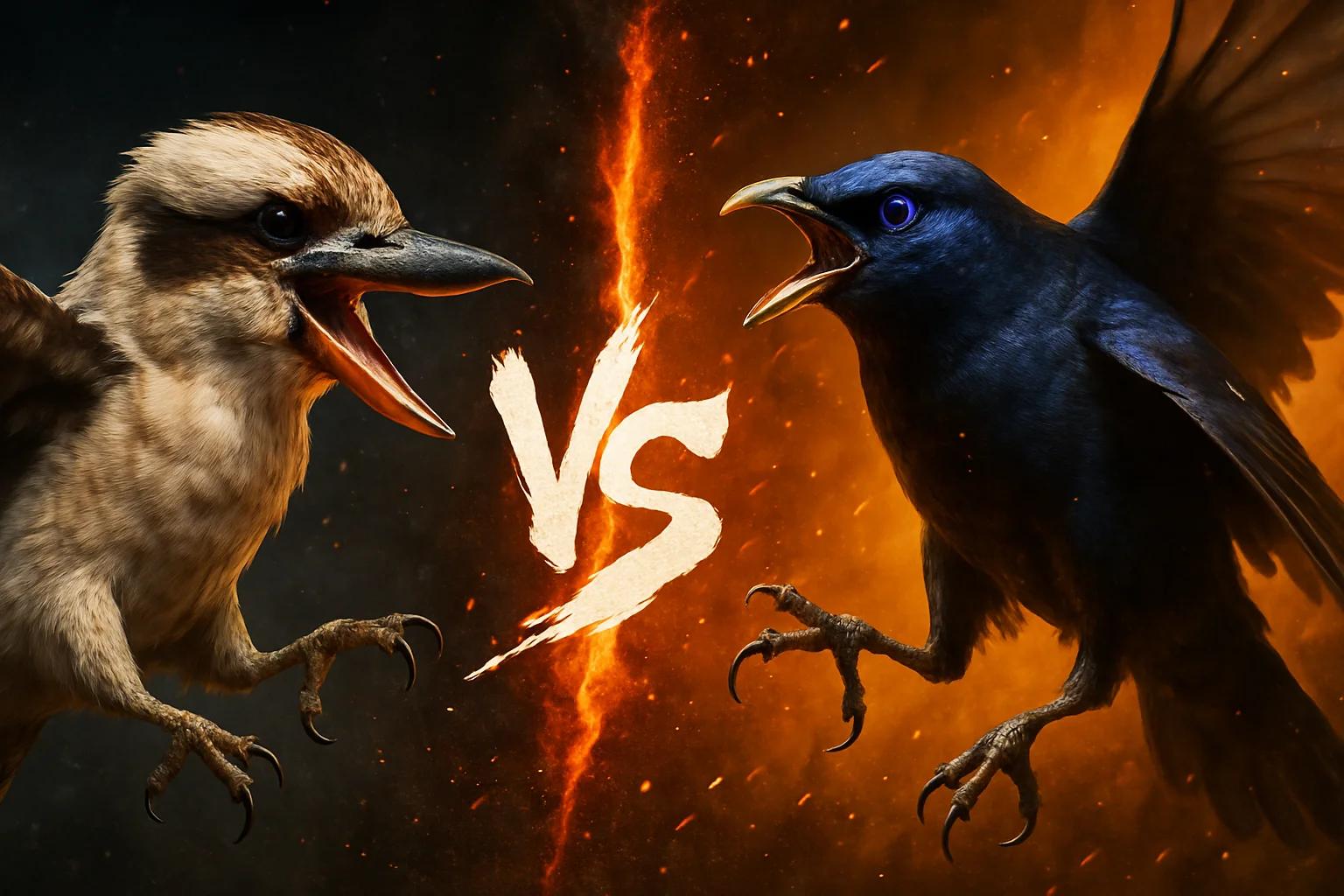
Laughing Kookaburra vs Satin Bowerbird: Who Actually Wins?
Laughing Kookaburra vs Satin Bowerbird: who wins? A biology-first breakdown of beak power, size, agility, intelligence and the scenarios where each Australian bird holds the edge.
Laughing Kookaburra vs Satin Bowerbird
Matchup winner
Laughing Kookaburra
Quick verdict
Start with the direct answer, then use the structured comparison below to see what changes the outcome.
The Laughing Kookaburra wins this matchup clearly. It is a predatory giant kingfisher, about 39–45 cm long and often 300–450 g, built around a heavy, hook-tipped dagger bill that it uses to seize and bash snakes, lizards and rodents. The Satin Bowerbird is smaller, roughly 27–33 cm and 200–290 g, and is mostly a fruit and insect eater. Its brilliance lies in display, mimicry, problem-solving and bower architecture, not in subduing other animals. The bowerbird is a little quicker through foliage and far more cognitively flexible, so it can outmaneuver and escape. In any engagement where contact actually happens, though, the kookaburra's grip-and-slam hardware decides it.
Read the full explanation
Winner: Laughing Kookaburra. It is a heavier, longer bird with a true predator's bill and killing technique.
The Satin Bowerbird is smarter and slightly more agile, and that makes it excellent at avoiding a fight.
Once the two birds are in contact, the kookaburra's crushing grip and bash-kill reflex outclass the bowerbird's fruit-processing beak.
The bowerbird's best result is a clean escape through dense cover, not a win.
Reader vote
Who do you think wins?
Pick a side — no account needed. Results update live.
No votes yet — be the first to call it.
Editorial note
Why people disagree
Bowerbirds look like 'genius birds', and people assume intelligence translates into fighting power. It mostly translates into avoidance and social strategy.
Weapon hardware
The kookaburra's bill evolved to grip and kill struggling reptiles and rodents. The bowerbird's beak is a precision tool for fruit, not a weapon.
Body mass & frame
Extra mass gives the kookaburra pinning leverage and makes it much harder to shake off.
Finishing technique
Only one of these birds has an instinctive, practiced sequence for disabling another animal.
Read the full explanation +
Kookaburras look chunky and comical because of the famous laugh, which hides the fact that they are efficient vertebrate killers.
Raw game stats show the two nearly tied on dominance and speed. Real anatomy, meaning bill shape, mass and diet, tilts contact outcomes sharply toward the kookaburra.
Comparison FAQ
Short, direct answers to the next questions readers usually ask after the headline verdict.
Would a Laughing Kookaburra beat a Satin Bowerbird?+
Yes. In any fight where contact happens, the kookaburra wins thanks to its larger size, heavy dagger bill and predatory bash-kill technique.
Which bird is stronger?+
The Laughing Kookaburra. It is heavier and its bill is built to grip and subdue struggling snakes and rodents.
Is the Satin Bowerbird smarter than the kookaburra?+
Generally, yes. Bowerbirds are famous for complex bower construction, color selection and vocal mimicry. That intelligence helps them avoid danger rather than win fights.
Why does the loser stay dangerous?+
The bowerbird stays hard to catch. Its agility in dense cover and its fast threat assessment mean a kookaburra often never lands the grip it needs, so the bowerbird survives far more encounters than it would win.
Do kookaburras attack other birds?+
Occasionally. They mainly eat reptiles, insects and small mammals, but they do take nestlings and small birds and will aggressively defend their territory.
Head-to-head species stats
These are the same core AnimalDex stat dimensions used on the dedicated animal pages, pulled side by side so the matchup is faster to scan.
Laughing Kookaburra
Tier DSatin Bowerbird
Tier CTrait-by-trait comparison
Only the categories that matter to this matchup are included. The goal is not filler stats, but the real design differences that change the result.
Massive dagger bill with a hooked tip
Weapon hardware
Laughing Kookaburra
Short, stout fruit-and-insect beak
Weapon hardware
Laughing Kookaburra
Up to about 450 g, very large for a kingfisher
Body mass & frame
Laughing Kookaburra
Roughly 200–290 g, slimmer frame
Body mass & frame
Laughing Kookaburra
Seize, then slam prey against branches
Finishing technique
Laughing Kookaburra
No predatory kill routine
Finishing technique
Laughing Kookaburra
Perch-and-pounce, with heavy short bursts
Cover agility
Satin Bowerbird
Nimble hopping and flight through dense understory
Cover agility
Satin Bowerbird
Patient watcher with solid ambush judgment
Tactical cognition
Satin Bowerbird
Elite problem-solver, mimic and planner
Tactical cognition
Satin Bowerbird
Group laughing choruses and aggressive family defense
Territorial intimidation
Laughing Kookaburra
Display-focused, with vocal mimicry used to warn
Territorial intimidation
Laughing Kookaburra
How the verdict forms
Verdict timeline
01 · Weapon hardware
Laughing Kookaburra
02 · Body mass & frame
Laughing Kookaburra
03 · Finishing technique
Laughing Kookaburra
04 · Cover agility
Satin Bowerbird
05 · Tactical cognition
Satin Bowerbird
06 · Territorial intimidation
Laughing Kookaburra
Change the conditions
Scenario breakdown
This is where shallow battle content usually fails. Terrain, spacing, timing, and engagement style can change the answer.
Scenario lean
Satin Bowerbird
Verdict confidence
82%
The bowerbird slips away.
Thick vegetation blocks the kookaburra's preferred tactic of watching from a perch and then making a downward pounce. The bowerbird's agility and quick threat-reading let it vanish through tangles. It does not win by force. It wins by denying contact, and that counts as the better outcome for it here.
AnimalDex field profiles
Explore these animals
Laughing Kookaburra
Dacelo novaeguineae
Open woodland, forest edge, parks, gardens, and farmland with perches and prey-rich ground.
Satin Bowerbird
Ptilonorhynchus violaceus
rainforest edge, wet woodland, and mountain forest
Systems Intelligence & Hidden Purpose
See the animals behind this comparison as engineered biological systems: what each one is built to do, where it gains leverage, and why the matchup changes by scenario.
Specialized Hardware
A heavy bill, broad perch vision, and short decisive strike pattern make kookaburras ambush hardware for mixed prey below branch height.
Systems Script
They convert elevated waiting points into predatory control over reptiles, insects, and small mammals. Their territory calls also make acoustic space part of the operating system.
Strategic Insight
You do not need constant motion when you already own the perch.
Specialized Hardware
glossy blue-black male plumage, carefully built stick bower, and blue-object collecting behavior give the Satin Bowerbird a body plan tuned for its niche.
Systems Script
Satin Bowerbirds operate through rainforest edge, wet woodland, and mountain forest. Their design links movement, feeding, shelter, and timing into one workable survival system.
Strategic Insight
In steep terrain, balance and route control matter more than brute force.
Final take
The Laughing Kookaburra is the clear winner. This is a contest between a predator and a highly specialized display artist. The kookaburra brings mass, a gripping and slamming bill, and a hard-wired routine for disabling vertebrate prey.
Read the full explanation
The Satin Bowerbird is no pushover in the broader survival sense. It is cognitively superior and more agile in cover, which lets it avoid most of these confrontations entirely. If you score the contest as 'who stays safe', the bowerbird does well. If you score it as 'who wins a fight', the kookaburra takes it decisively.
Collect both animals in AnimalDex
Track the species behind this matchup, compare their real traits, and build the rivalry into your AnimalDex collection.
Related comparisons
Continue with nearby matchups to compare more real-world animal traits without dropping into junky who-wins filler.
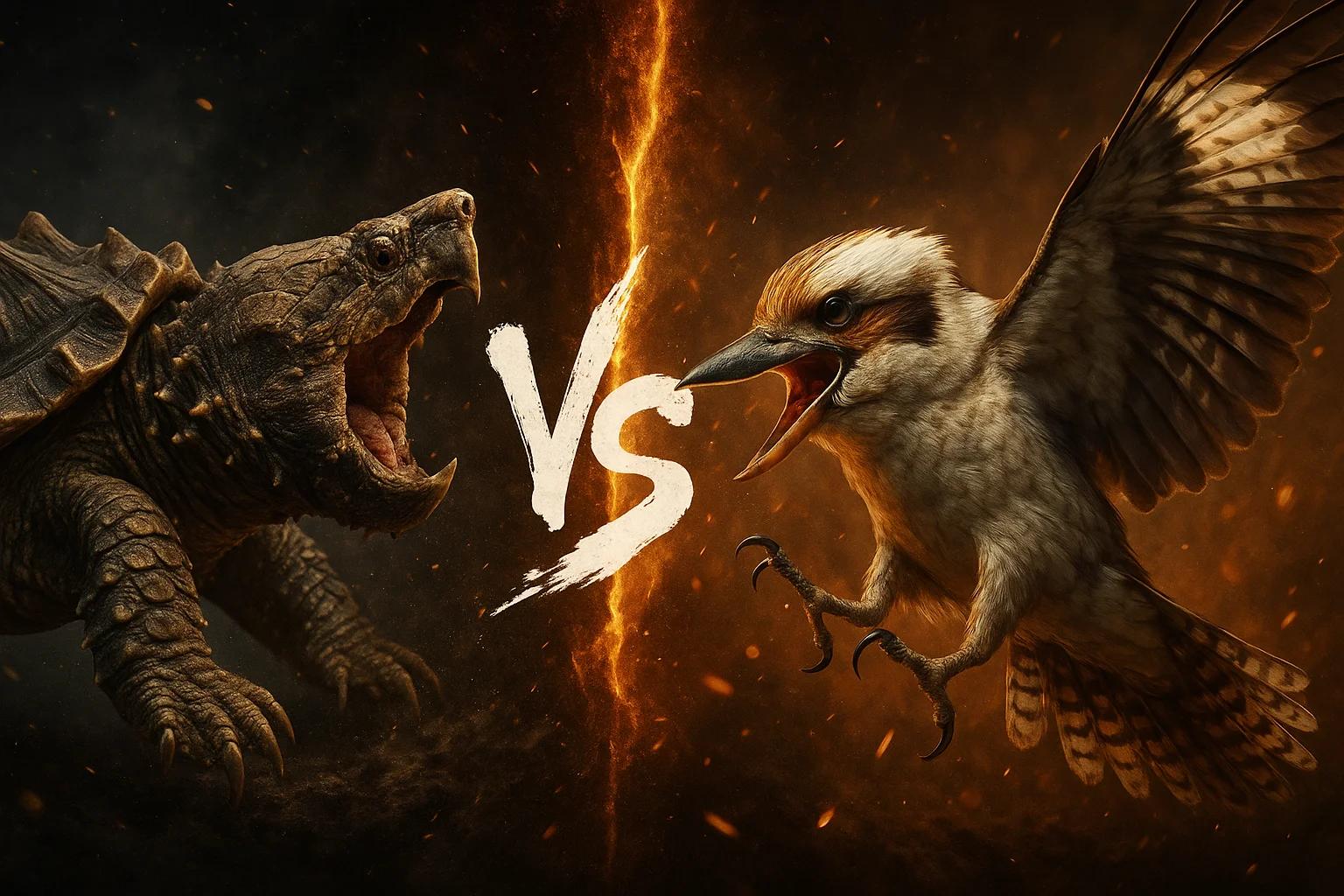
Alligator Snapping Turtle vs Laughing Kookaburra: Who Reigns Supreme?
In a battle of grit and patience, the alligator snapping turtle emerges victorious over the laughing kookaburra. Its formidable jaws and protective shell make it an apex ambush predator, while the kookaburra's agility and intelligence are outmatched in close quarters.
Read comparison
Discussion
What do you think?
Share your reasoning with other readers. Be civil and stick to the animals.
Sign in to join the discussion.
Sign inNo comments yet. Start the conversation.