

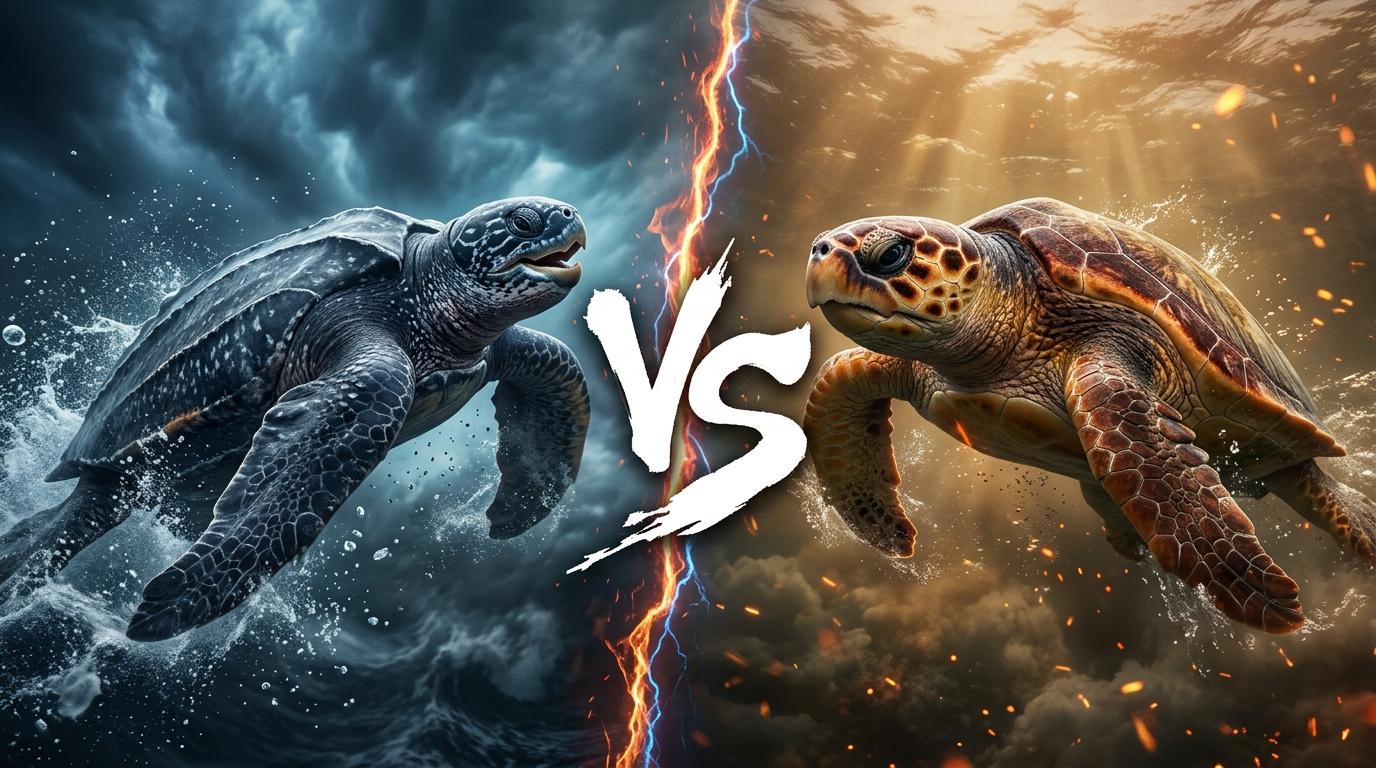
Leatherback Sea Turtle vs Loggerhead Sea Turtle: Who Actually Wins?
Leatherback vs loggerhead sea turtle: who would win? A biology-first comparison of size, power, armor, bite, and endurance, with a clear verdict and scenario breakdown.
Leatherback Sea Turtle vs Loggerhead Sea Turtle
Matchup winner
Leatherback Sea Turtle
Quick verdict
Start with the direct answer, then use the structured comparison below to see what changes the outcome.
The leatherback sea turtle wins, and it isn't especially close. Adult leatherbacks commonly weigh 300–600 kg, with exceptional individuals approaching 900 kg. That makes them roughly three to five times heavier than a typical 80–180 kg loggerhead. Their front flippers can span over 2.5 m, among the most powerful swimming engines of any reptile. In a pushing, shoving, displacement contest, which is how turtle conflicts actually play out, mass and thrust decide the outcome. The loggerhead has real weapons: a massive head and crushing jaws built to crack conch shells and crab armor, plus a hard keratin-plated carapace that the leatherback lacks. Those tools make it a dangerous nuisance, but they cannot overcome a size gap that lets the leatherback simply muscle it aside and outlast it.
Read the full explanation
Leatherback wins overall on sheer mass, flipper power, and stamina.
A leatherback can outweigh a loggerhead by 3–5x, which is the biggest single factor in any turtle shoving contest.
The loggerhead has the far stronger bite and harder shell, so it is the more dangerous animal pound-for-pound.
Real encounters are rare and non-lethal; this is about dominance and displacement, not combat to the death.
Reader vote
Who do you think wins?
Pick a side — no account needed. Results update live.
No votes yet — be the first to call it.
Editorial note
Why people disagree
Shell vs size: the loggerhead's hard armor looks like a winning edge, but the leatherback's leathery, oil-rich hide over a mosaic of small bones is tough in its own right, and mass matters more than plating.
Raw mass
In water, conflicts are about displacement. The heavier turtle controls position, and the leatherback has an enormous margin.
Propulsive power
Thrust lets a turtle drive through, pin, or escape. The leatherback's flipper engine dominates any shoving match.
Crushing bite
The loggerhead's best weapon. It can inflict painful bites to flippers and edges, but can't use them to decide a fight against a far larger body.
Read the full explanation +
Bite headlines: loggerhead jaws are genuinely powerful shell-crushers, while leatherback jaws are scissor-like tools for soft jellyfish. People who focus on weapons tend to overrate the loggerhead.
Pound-for-pound thinking: scaled to equal size, the loggerhead's crushing build might win. But nature doesn't scale them equally, and the leatherback is a different weight class.
Behavior blur: loggerheads are known for aggressive bites and assertive behavior during competition, while leatherbacks are open-ocean wanderers, so temperament gets confused with capability.
Comparison FAQ
Short, direct answers to the next questions readers usually ask after the headline verdict.
Would a leatherback sea turtle beat a loggerhead sea turtle in a fight?+
Yes. The leatherback's size and flipper power let it overpower and displace a loggerhead in most realistic encounters, though such conflicts are rare and rarely harmful.
Which is stronger, a leatherback or a loggerhead?+
The leatherback is far stronger in total power because of its mass and huge flippers. The loggerhead has the stronger bite.
Why is the loggerhead still dangerous if it loses?+
Its massive jaws evolved to crush conchs and crab shells, so a bite can seriously injure flippers. Its hard shell also makes it hard to hurt, and it tends to be more willing to bite first.
Does the leatherback have a shell?+
Not a hard one. It has thick, leathery, oil-rich skin over a mosaic of small bones, built for deep dives rather than armor.
Do leatherbacks and loggerheads fight in the wild?+
Interactions are uncommon because they use different habitats and diets: leatherbacks eat jellyfish in the open ocean, while loggerheads hunt shellfish nearer reefs and coasts.
Head-to-head species stats
These are the same core AnimalDex stat dimensions used on the dedicated animal pages, pulled side by side so the matchup is faster to scan.
Leatherback Sea Turtle
Tier BLoggerhead Sea Turtle
Tier CTrait-by-trait comparison
Only the categories that matter to this matchup are included. The goal is not filler stats, but the real design differences that change the result.
300–600+ kg, record near 900 kg
Raw mass
Leatherback Sea Turtle
80–180 kg typical adults
Raw mass
Leatherback Sea Turtle
Huge front flippers, 2.5 m+ span
Propulsive power
Leatherback Sea Turtle
Solid but compact flippers
Propulsive power
Leatherback Sea Turtle
Sharp-cusped, scissor-like jaw for soft prey
Crushing bite
Loggerhead Sea Turtle
Massive head, shell-cracking jaws
Crushing bite
Loggerhead Sea Turtle
Thick leathery skin over bony mosaic
Armor profile
Loggerhead Sea Turtle
Hard keratin-scuted carapace
Armor profile
Loggerhead Sea Turtle
Gigantothermy, 1,000 m+ dives, ocean-crossing stamina
Endurance engine
Leatherback Sea Turtle
Strong migrator, shallower diver
Endurance engine
Leatherback Sea Turtle
Generally avoids confrontation
Close-range aggression
Loggerhead Sea Turtle
Assertive, readily bites
Close-range aggression
Loggerhead Sea Turtle
How the verdict forms
Verdict timeline
01 · Raw mass
Leatherback Sea Turtle
02 · Propulsive power
Leatherback Sea Turtle
03 · Crushing bite
Loggerhead Sea Turtle
04 · Armor profile
Loggerhead Sea Turtle
05 · Endurance engine
Leatherback Sea Turtle
06 · Close-range aggression
Loggerhead Sea Turtle
Change the conditions
Scenario breakdown
This is where shallow battle content usually fails. Terrain, spacing, timing, and engagement style can change the answer.
Scenario lean
Leatherback Sea Turtle
Verdict confidence
82%
Leatherback overpowers it
In open water nothing offsets mass and thrust. The leatherback drives forward with its huge flippers, displaces the loggerhead, and controls the water column. Loggerhead bites land on a target that simply keeps pushing.
AnimalDex field profiles
Explore these animals
Leatherback Sea Turtle
Dermochelys coriacea
open ocean, cold and warm pelagic water, and nesting beach
Loggerhead Sea Turtle
Caretta caretta
open ocean, coastal shelf, and sandy nesting beach
Systems Intelligence & Hidden Purpose
See the animals behind this comparison as engineered biological systems: what each one is built to do, where it gains leverage, and why the matchup changes by scenario.
Specialized Hardware
huge leathery shell, deep open-ocean diving, and jellyfish-focused feeding give the Leatherback Sea Turtle a body plan tuned for its niche.
Systems Script
Leatherback Sea Turtles operate through open ocean, cold and warm pelagic water, and nesting beach Their design links movement, shelter, and feeding into one workable survival system.
Strategic Insight
Large range is useful only when the body can keep performing far from shelter.
Specialized Hardware
large blocky head, powerful shell-crushing jaws, and long-distance ocean migration give the Loggerhead Sea Turtle a body plan tuned for its niche.
Systems Script
Loggerhead Sea Turtles operate through open ocean, coastal shelf, and sandy nesting beach Their design links movement, shelter, and feeding into one workable survival system.
Strategic Insight
A system can range widely and still depend on one exact place to restart.
Final take
The leatherback sea turtle is the overall winner. It is the largest living turtle and a different weight class from the loggerhead. Its flipper power and endurance turn any realistic contest of pushing and positioning into a mismatch.
Read the full explanation
The loggerhead earns real respect anyway. Its shell-cracking jaws and hard carapace make it the better-armed, better-armored animal, and in cluttered reef terrain or a sudden opening exchange it can win the moment. It just cannot win the long game against something several times its size.
Both species are threatened by fisheries bycatch, plastics, and nesting beach loss. In the real ocean, their biggest battle is with us, not each other.
Collect both animals in AnimalDex
Track the species behind this matchup, compare their real traits, and build the rivalry into your AnimalDex collection.
Discussion
What do you think?
Share your reasoning with other readers. Be civil and stick to the animals.
Sign in to join the discussion.
Sign inNo comments yet. Start the conversation.