

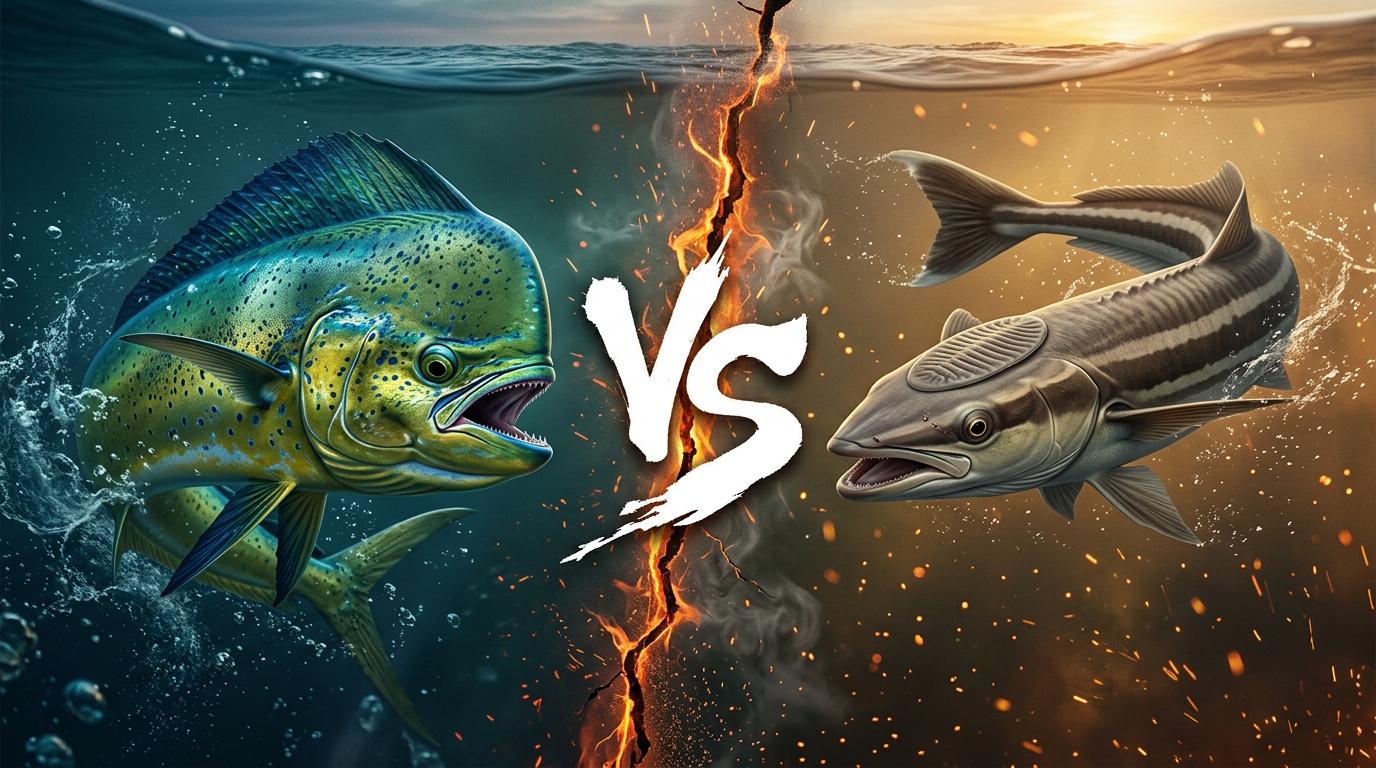
Mahi-mahi vs Live Sharksucker: Who Actually Wins?
Mahi-mahi vs live sharksucker (Echeneis naucrates): a biology-first breakdown of speed, size, bite, and survival strategy to settle who would win.
Mahi-mahi vs Remora
Matchup winner
Mahi-mahi
Quick verdict
Start with the direct answer, then use the structured comparison below to see what changes the outcome.
The mahi-mahi wins clearly. This is a blue-water sprinter built to hunt fast prey, facing a hitchhiker built to save energy. Mahi-mahi can top 1 meter and 10+ kg and are among the fastest fish in the sea. They pair a deep, muscular body with a big mouth lined with fine teeth, and they hunt flying fish and squid by the school. The live sharksucker is longer than many people expect, sometimes approaching 1 meter. But it is slender, and its signature weapon is a suction disc on its head, made for riding sharks, turtles, and rays rather than fighting. Away from a host, the sharksucker has no speed edge, no armor, and no real offense. Its best plays are refusing the fight or clinging to something bigger. In open water the mahi-mahi controls tempo, angle, and finish.
Read the full explanation
Mahi-mahi wins overall: much faster, heavier-bodied, and an active predator.
The sharksucker's suction disc is a ride, not a weapon.
The sharksucker's best survival play is hiding near a large host, not winning a duel.
Smaller juvenile mahi-mahi are the only matchup where things get close.
Reader vote
Who do you think wins?
Pick a side — no account needed. Results update live.
No votes yet — be the first to call it.
Editorial note
Why people disagree
Sharksuckers can be surprisingly long, so people overrate them. Length without bulk or speed doesn't win pelagic encounters.
Explosive power
In open water, whoever closes or escapes distance controls the whole encounter.
Body mass and frame
Mass behind a strike and a turn decides contact; a slim frame gets bullied.
Strike tools
The mahi-mahi's jaws are built for seizing struggling prey. The sharksucker's are built for scraps and parasites.
Read the full explanation +
The 'protected by a shark' factor muddies things. A remora on a host is hard to touch, but that is the host's power, not its own.
Mahi-mahi look flashy and lightweight, so some underestimate how muscular and aggressive these fish are.
Comparison FAQ
Short, direct answers to the next questions readers usually ask after the headline verdict.
Would a mahi-mahi beat a remora?+
Yes. In nearly any one-on-one encounter the mahi-mahi wins thanks to its superior speed, body mass, and predatory jaws.
Which is stronger, mahi-mahi or live sharksucker?+
The mahi-mahi. Its deep, muscular body generates far more power in bursts and turns than the slender sharksucker.
Can a remora hurt a mahi-mahi?+
Not meaningfully. Its small teeth are made for scraps and parasites, and its suction disc is for attachment, not attack.
Why is the sharksucker still dangerous to underestimate?+
It is rarely alone. Its survival comes from clinging to sharks, rays, and turtles. Chasing a sharksucker can mean swimming straight toward a much bigger predator.
Do mahi-mahi eat remoras?+
Mahi-mahi are opportunistic predators of small fish around floating structure, so a small or unattached sharksucker could be prey, though it isn't a typical staple.
Head-to-head species stats
These are the same core AnimalDex stat dimensions used on the dedicated animal pages, pulled side by side so the matchup is faster to scan.
Mahi-mahi
Tier CRemora
Tier CTrait-by-trait comparison
Only the categories that matter to this matchup are included. The goal is not filler stats, but the real design differences that change the result.
Elite burst sprinter, among the fastest fish
Explosive power
Mahi-mahi
Modest cruiser, built for efficiency
Explosive power
Mahi-mahi
Deep, compressed, heavily muscled body
Body mass and frame
Mahi-mahi
Long but slender, low-mass frame
Body mass and frame
Mahi-mahi
Wide mouth, fine teeth, fast-prey hunting habit
Strike tools
Mahi-mahi
Small teeth, scavenger-picker feeding
Strike tools
Mahi-mahi
Relies on speed and schooling
Defensive niche
Remora
Suction disc lets it shelter on large hosts
Defensive niche
Remora
Aggressive, high-metabolism predator
Hunting drive
Mahi-mahi
Opportunistic hitchhiker
Hunting drive
Mahi-mahi
Burns hot, needs constant feeding
Energy economy
Remora
Rides for free, extremely efficient
Energy economy
Remora
How the verdict forms
Verdict timeline
01 · Explosive power
Mahi-mahi
02 · Body mass and frame
Mahi-mahi
03 · Strike tools
Mahi-mahi
04 · Defensive niche
Remora
05 · Hunting drive
Mahi-mahi
06 · Energy economy
Remora
Change the conditions
Scenario breakdown
This is where shallow battle content usually fails. Terrain, spacing, timing, and engagement style can change the answer.
Scenario lean
Mahi-mahi
Verdict confidence
82%
Mahi-mahi dominates.
This is the mahi-mahi's home terrain. It has room to accelerate, turn, and strike. The sharksucker can neither outrun it nor hide, and its disc gives no defensive value without a host to grab.
AnimalDex field profiles
Explore these animals
Mahi-mahi
Coryphaena hippurus
tropical ocean and open pelagic water
Remora
Echeneis naucrates
open ocean, reef edge, and large-animal marine routes
Systems Intelligence & Hidden Purpose
See the animals behind this comparison as engineered biological systems: what each one is built to do, where it gains leverage, and why the matchup changes by scenario.
Specialized Hardware
electric blue-green open-water body, blunt high forehead, and fast floating-debris hunting give the Mahi-mahi a body plan tuned for its niche.
Systems Script
Mahi-mahis operate through tropical ocean and open pelagic water. Their design links movement, feeding, shelter, and timing into one workable survival system.
Strategic Insight
In moving water, the best systems use flow, visibility, and depth instead of fighting every current.
Specialized Hardware
suction-disc head, hitchhiking travel on larger animals, and mobile scavenging and feeding give the Remora a body plan tuned for its niche.
Systems Script
Remoras operate through open ocean, reef edge, and large-animal marine routes Their design links movement, shelter, and feeding into one workable survival system.
Strategic Insight
Leverage often matters more than scale.
Final take
The mahi-mahi is the clear winner. It is a purpose-built pelagic predator: fast, muscular, aggressive, and well armed for seizing prey. The live sharksucker is a master of a completely different game.
Read the full explanation
Don't mistake that for weakness in nature. The sharksucker thrives by never needing to win a fight, outsourcing protection and travel to animals far bigger than either fish. In a straight contest, though, the mahi-mahi owns it.
Collect both animals in AnimalDex
Track the species behind this matchup, compare their real traits, and build the rivalry into your AnimalDex collection.
Discussion
What do you think?
Share your reasoning with other readers. Be civil and stick to the animals.
Sign in to join the discussion.
Sign inNo comments yet. Start the conversation.