

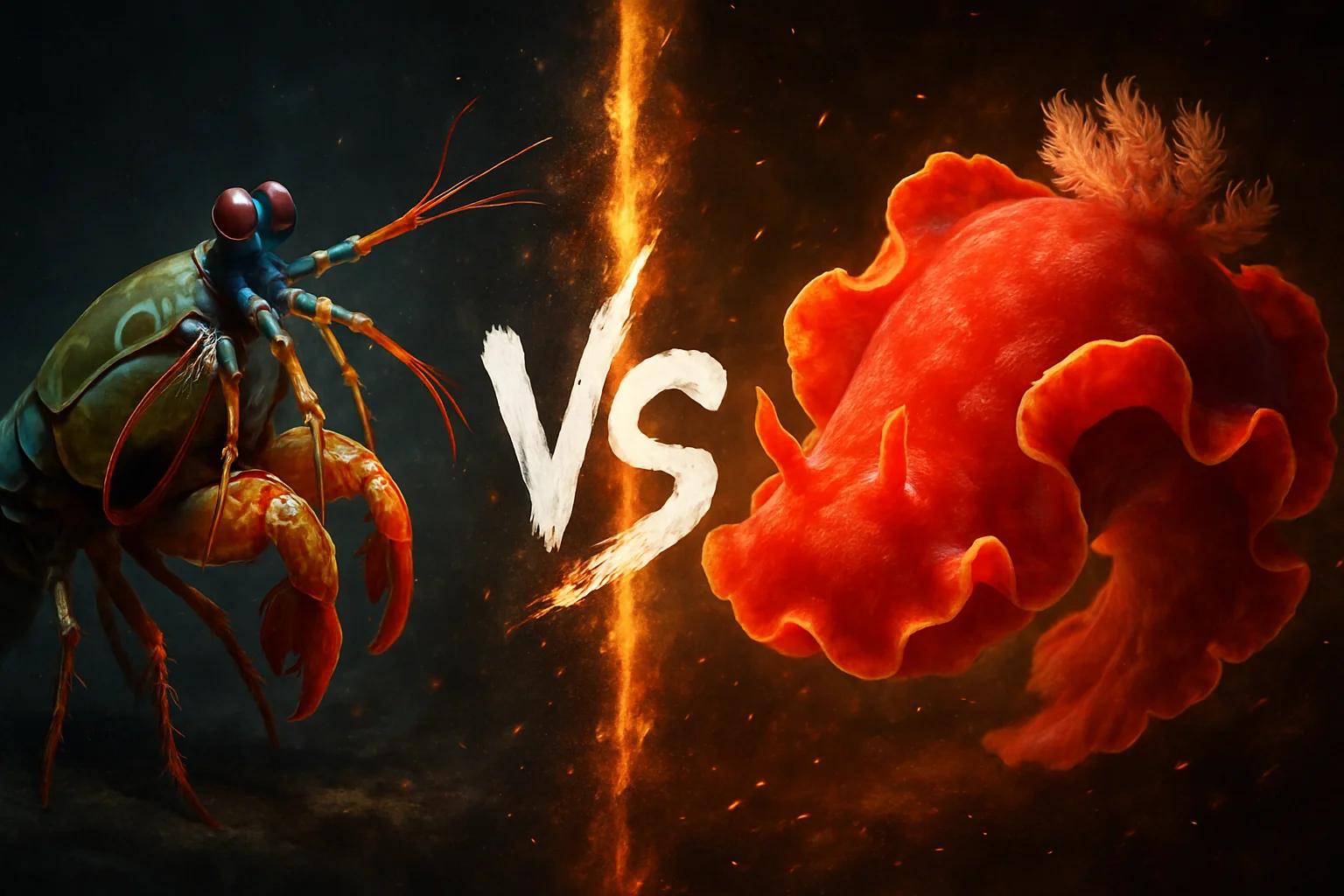
Mantis Shrimp vs Spanish Dancer: Who Actually Wins?
Mantis shrimp vs Spanish dancer nudibranch: a biology-first breakdown of strike power, chemical defense, and which reef animal wins a confrontation.
Mantis Shrimp vs Spanish Dancer
Matchup winner
Mantis Shrimp
Quick verdict
Start with the direct answer, then use the structured comparison below to see what changes the outcome.
The mantis shrimp wins, and it isn't close. It is one of the fastest strikers in the animal kingdom. Smasher species accelerate their raptorial clubs fast enough to crack snail shells and create cavitation bubbles that hit a second time. It also has a complex visual system and an armored, burrow-defending lifestyle built around aggression. The Spanish dancer is a large, soft-bodied nudibranch with no hard parts to absorb a blow and no real weapons. Its survival plan is to taste awful and look like a warning. It carries defensive chemicals and bright aposematic red coloring, and it can swim off with slow, flamenco-like undulations. That plan works against predators that learn and choose. It does little against a single decisive strike from an animal that crushes armored prey for a living. The dancer's best outcome is that the shrimp declines to engage. If contact happens, the shrimp controls it.
Read the full explanation
Mantis shrimp wins decisively in nearly every realistic encounter.
Its club strike is among the fastest in nature and is built to break shells, so soft tissue offers little resistance.
The Spanish dancer relies on chemical defense, warning color and escape swimming, not combat.
The dancer's only real 'win' is being judged unpalatable and left alone.
Reader vote
Who do you think wins?
Pick a side — no account needed. Results update live.
No votes yet — be the first to call it.
Editorial note
Why people disagree
Size fools people: a big Spanish dancer can be longer than many mantis shrimp, but length without armor or weapons doesn't win fights.
Explosive power
One strike from the shrimp can do more damage than the dancer can deliver in its entire life.
Close-range durability
The dancer has nothing that blunts a percussive hit; the shrimp is built to take and deliver impact.
Chemical deterrence
This is the dancer's real weapon: it makes predators regret eating it, not lose the fight.
Read the full explanation +
Chemical defense is real. Many predators avoid nudibranchs, so some argue the dancer 'wins' by never being attacked.
Mantis shrimp mostly eat hard-shelled prey, so people debate whether one would even bother with a soft, foul-tasting slug.
Comparison FAQ
Short, direct answers to the next questions readers usually ask after the headline verdict.
Would a mantis shrimp beat a Spanish dancer?+
Yes. The mantis shrimp's club strike and armored body completely outclass the soft, weaponless Spanish dancer in a confrontation.
Which is stronger, a mantis shrimp or a Spanish dancer?+
The mantis shrimp, by an enormous margin. Its strike is one of the most powerful relative to body size in the animal world, while the Spanish dancer has no striking or gripping weapons.
Why is the Spanish dancer still dangerous to predators?+
Its tissues contain defensive compounds that make it distasteful, and its bright red coloring warns predators off. Many attackers learn to avoid it, so it can survive without ever winning a fight.
Is the Spanish dancer poisonous?+
It is chemically defended and unpalatable to many predators. It isn't known as a significant danger to humans.
Do mantis shrimp eat nudibranchs?+
They mainly target crustaceans, snails, clams and fish. A soft, foul-tasting nudibranch is a poor meal, but a territorial shrimp may still strike one that intrudes.
Head-to-head species stats
These are the same core AnimalDex stat dimensions used on the dedicated animal pages, pulled side by side so the matchup is faster to scan.
Mantis Shrimp
Tier CSpanish Dancer
Tier DTrait-by-trait comparison
Only the categories that matter to this matchup are included. The goal is not filler stats, but the real design differences that change the result.
Spring-loaded club strike, among the fastest in nature
Explosive power
Mantis Shrimp
Essentially none; soft muscular body
Explosive power
Mantis Shrimp
Armored exoskeleton and impact-resistant club
Close-range durability
Mantis Shrimp
Soft, unarmored mantle
Close-range durability
Mantis Shrimp
No meaningful toxins
Chemical deterrence
Spanish Dancer
Defensive compounds and distasteful tissue
Chemical deterrence
Spanish Dancer
Complex compound eyes, precise strike aiming
Sensory targeting
Mantis Shrimp
Simple sensory rhinophores, chemical sensing
Sensory targeting
Mantis Shrimp
Quick darts and burrow retreat
Escape mobility
Mantis Shrimp
Slow undulating swim
Escape mobility
Mantis Shrimp
Threat displays, colorful but combat-backed
Warning signal
Spanish Dancer
Vivid red aposematic coloring
Warning signal
Spanish Dancer
How the verdict forms
Verdict timeline
01 · Explosive power
Mantis Shrimp
02 · Close-range durability
Mantis Shrimp
03 · Chemical deterrence
Spanish Dancer
04 · Sensory targeting
Mantis Shrimp
05 · Escape mobility
Mantis Shrimp
06 · Warning signal
Spanish Dancer
Change the conditions
Scenario breakdown
This is where shallow battle content usually fails. Terrain, spacing, timing, and engagement style can change the answer.
Scenario lean
Mantis Shrimp
Verdict confidence
82%
Mantis shrimp, overwhelmingly.
Mantis shrimp are territorial ambushers that defend burrows hard. A slow nudibranch drifting into strike range at a burrow mouth meets a precise, high-impact hit. The dancer's chemicals act only after tissue is damaged, which is too late to change the outcome.
AnimalDex field profiles
Explore these animals
Mantis Shrimp
Stomatopoda
Coral reef slopes, rubble fields, sandy burrows, and tropical coastal shallows.
Spanish Dancer
Hexabranchus sanguineus
coral reef and warm tropical seafloor
Systems Intelligence & Hidden Purpose
See the animals behind this comparison as engineered biological systems: what each one is built to do, where it gains leverage, and why the matchup changes by scenario.
Specialized Hardware
Hyper-specialized eyes that detect polarized and complex light, plus spring-loaded raptorial appendages that release extreme acceleration, make mantis shrimp elite sensing-and-strike hardware.
Systems Script
Mantis shrimp pressure reef prey with a combination of signal processing and mechanical violence. They help drive local armor races in shells and exoskeletons while occupying tight, defensible burrow systems.
Strategic Insight
Speed is often designed before it is expressed. Preload the mechanism, then let structure deliver the force.
Specialized Hardware
brilliant red body, swimming mantle undulation, and reef-floor nudibranch life give the Spanish Dancer a body plan tuned for its niche.
Systems Script
Spanish Dancers operate through coral reef and warm tropical seafloor Their design links movement, shelter, and feeding into one workable survival system.
Strategic Insight
Striking movement can change how the entire organism is perceived.
Final take
This is a weapon against a warning label. The mantis shrimp is a precision impact system evolved to break armored prey and defend territory. The Spanish dancer is a soft, chemically defended advertisement that survives by convincing predators it isn't worth eating.
Read the full explanation
In any frame where the two actually make contact, the mantis shrimp controls the encounter. The dancer's survival depends entirely on the shrimp's choices, which is why the mantis shrimp is the clear overall winner.
Collect both animals in AnimalDex
Track the species behind this matchup, compare their real traits, and build the rivalry into your AnimalDex collection.
Discussion
What do you think?
Share your reasoning with other readers. Be civil and stick to the animals.
Sign in to join the discussion.
Sign inNo comments yet. Start the conversation.