

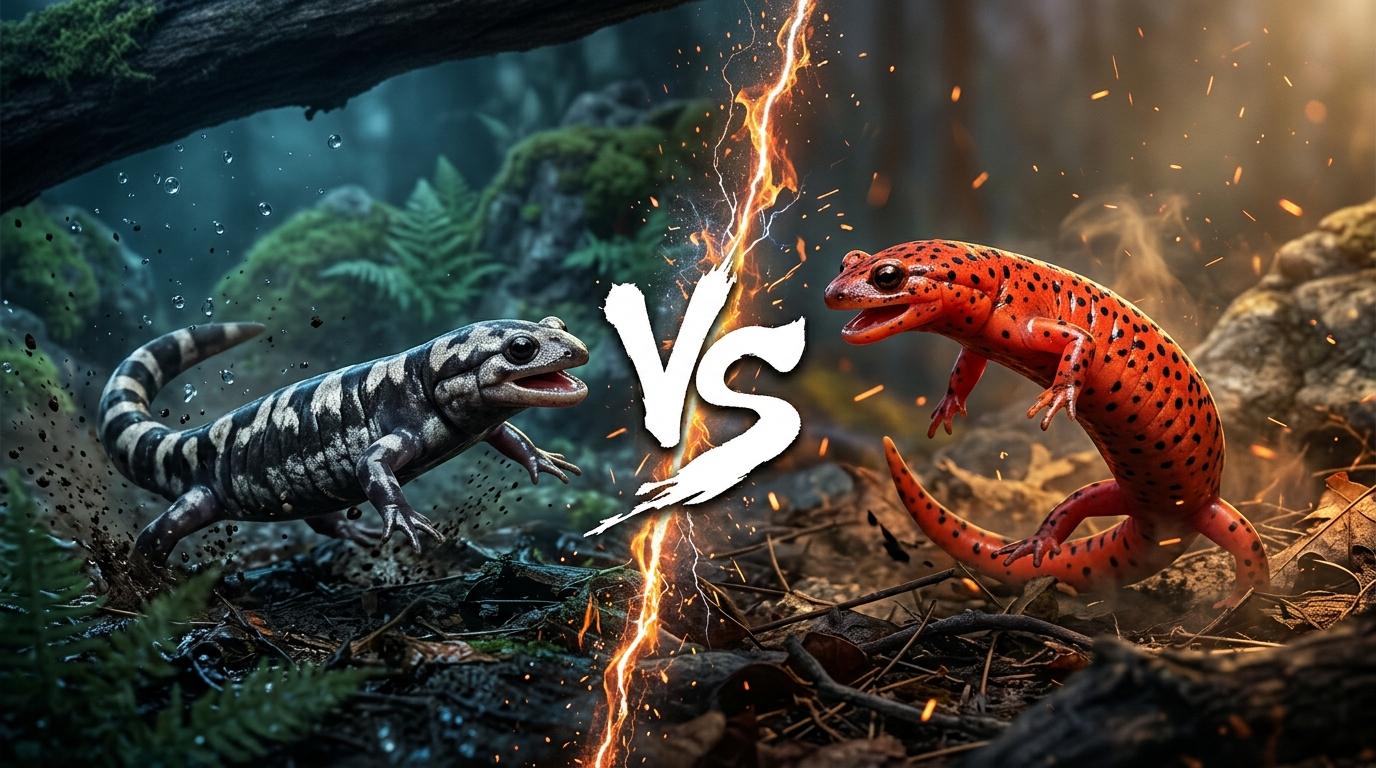
Marbled Salamander vs Red Salamander: Who Actually Wins?
Marbled salamander vs red salamander: a biology-first breakdown of size, bite, toxins and behavior to settle who would win in a head-to-head encounter.
Marbled Salamander vs Red Salamander
Matchup winner
Marbled Salamander
Quick verdict
Start with the direct answer, then use the structured comparison below to see what changes the outcome.
The Red Salamander wins this matchup. At roughly 10–18 cm, Pseudotriton ruber is longer and heavier than the stocky 9–12 cm Marbled Salamander. It also carries noxious skin secretions advertised by its bright red warning coloration, and it is a known predator of other salamanders. The Marbled Salamander is a tough, territorial mole salamander with a strong bite and well-defended glands along its tail. In a contained encounter, though, it is outsized, out-reached and facing a species that treats smaller salamanders as food. Marbled holds its own only in the burrow and leaf-litter situations it controls best.
Read the full explanation
Red Salamander wins overall thanks to its size and reach, and because it actually eats other salamanders.
Its bright red skin warns of toxic secretions, which discourages a counter-bite.
Marbled Salamanders are compact and bold, and they defend nests fiercely, so they stay competitive in tight cover.
Realistic outcome: Red Salamander dominance, not a lethal brawl. Most real encounters end with retreat.
Reader vote
Who do you think wins?
Pick a side — no account needed. Results update live.
No votes yet — be the first to call it.
Editorial note
Why people disagree
Marbled Salamanders look chunkier and more aggressive, so people overrate their strength relative to the longer Red Salamander.
Body mass & reach
In salamander contests, length and mass decide who can pin, grip and swallow. Red leads here clearly.
Predatory intent
A species that already treats smaller salamanders as prey enters the encounter with a hunter's script.
Chemical deterrence
Red's mimicry of the toxic red eft signals danger, and its secretions punish a bite.
Read the full explanation +
Both species are chemically defended, which makes it unclear whose toxins actually deter whom.
They rarely share the same micro-habitat. Red Salamanders favor springs and seeps, while Marbled Salamanders prefer drier upland forest and vernal pools. That leaves people guessing about a fight that seldom happens.
Comparison FAQ
Short, direct answers to the next questions readers usually ask after the headline verdict.
Would a Red Salamander beat a Marbled Salamander?+
Usually, yes. Its greater length, mass and predatory habits give it the edge in most encounters, especially in open or wet ground.
Which salamander is stronger?+
The Red Salamander is generally stronger because it is larger. The Marbled Salamander is more compact and can brace well in tight cover.
Is the Marbled Salamander still dangerous to a Red Salamander?+
Yes. Its tail glands release distasteful secretions, and it bites hard. A nest-guarding female can repel a larger intruder.
Are Red Salamanders poisonous?+
They have noxious skin secretions. Their red color mimics the toxic red eft stage of the eastern newt, which warns predators away. They are not dangerous to people unless handled and then the hands touch the eyes or mouth.
Do these salamanders meet in the wild?+
Their ranges overlap in the eastern United States, but their habitats differ. Red Salamanders favor springs and streams, while Marbled Salamanders prefer drier woodland near vernal pools, so direct fights are uncommon.
Head-to-head species stats
These are the same core AnimalDex stat dimensions used on the dedicated animal pages, pulled side by side so the matchup is faster to scan.
Marbled Salamander
Tier DRed Salamander
Tier CTrait-by-trait comparison
Only the categories that matter to this matchup are included. The goal is not filler stats, but the real design differences that change the result.
Stocky, ~9–12 cm
Body mass & reach
Red Salamander
Robust, ~10–18 cm
Body mass & reach
Red Salamander
Invertebrate hunter, opportunistic
Predatory intent
Red Salamander
Eats worms, insects and other salamanders
Predatory intent
Red Salamander
Granular glands concentrated on the tail
Chemical deterrence
Red Salamander
Noxious skin secretions with bright red warning color
Chemical deterrence
Red Salamander
Burrow-savvy, still and patient
Ambush control in litter
Marbled Salamander
Prefers wet seeps and stream edges
Ambush control in litter
Marbled Salamander
Nest-guarding females, bold defense
Territorial grit
Marbled Salamander
Less overtly territorial
Territorial grit
Marbled Salamander
Slow, deliberate
Burst movement
Red Salamander
Slightly quicker, slippery escape
Burst movement
Red Salamander
How the verdict forms
Verdict timeline
01 · Body mass & reach
Red Salamander
02 · Predatory intent
Red Salamander
03 · Chemical deterrence
Red Salamander
04 · Ambush control in litter
Marbled Salamander
05 · Territorial grit
Marbled Salamander
06 · Burst movement
Red Salamander
Change the conditions
Scenario breakdown
This is where shallow battle content usually fails. Terrain, spacing, timing, and engagement style can change the answer.
Scenario lean
Marbled Salamander
Verdict confidence
82%
Marbled holds the burrow.
In a tight, dry space, Red's extra length becomes a liability. Marbled's compact body can brace and bite, and its tail glands deter repeated attacks. Red usually withdraws rather than pay the chemical cost.
AnimalDex field profiles
Explore these animals
Marbled Salamander
Ambystoma opacum
moist woodland, leaf litter, and vernal pool habitat
Red Salamander
Pseudotriton ruber
cool forest, spring run, and shaded stream bank
Systems Intelligence & Hidden Purpose
See the animals behind this comparison as engineered biological systems: what each one is built to do, where it gains leverage, and why the matchup changes by scenario.
Specialized Hardware
bold silver crossbands, stout forest-floor body, and seasonal pool breeding give the Marbled Salamander a body plan tuned for its niche.
Systems Script
Marbled Salamanders operate through moist woodland, leaf litter, and vernal pool habitat. Their design links movement, feeding, shelter, and timing into one workable survival system.
Strategic Insight
Dense environments reward precision, patience, and the ability to read layered cover.
Specialized Hardware
bright red body, dark scattered spots, and spring and seep dwelling habit give the Red Salamander a body plan tuned for its niche.
Systems Script
Red Salamanders operate through cool forest, spring run, and shaded stream bank. Their design links movement, feeding, shelter, and timing into one workable survival system.
Strategic Insight
Dense environments reward precision, patience, and the ability to read layered cover.
Final take
The Red Salamander is the overall winner. It is bigger and has longer reach. Its warning coloration is backed by real chemistry. It also already eats smaller salamanders, which is the single biggest advantage in a contest between amphibians.
Read the full explanation
The Marbled Salamander is no pushover. On its own terrain, especially under logs or while guarding eggs, its stocky build and defensive tail glands can turn the Red Salamander away. In the wild, both species would far more often avoid each other than fight to a finish.
Collect both animals in AnimalDex
Track the species behind this matchup, compare their real traits, and build the rivalry into your AnimalDex collection.
Related comparisons
Continue with nearby matchups to compare more real-world animal traits without dropping into junky who-wins filler.

Hellbender vs Red Salamander: Who Actually Wins?
The hellbender wins, and it isn't close in a straight contest. At up to about 74 cm (29 in) and well over a kilogram, it outweighs the red salamander (roughly 10–18 cm) many times over. It also has a broad, flat head built for a fast suction-and-bite strike that already handles crayfish, fish, and other salamanders. The red salamander's best weapons are defensive: skin secretions that make it distasteful to predators, plus a warning-red body that advertises them. Those toxins deter attackers and can punish a careless mouth, but they don't let a 15 cm amphibian control a giant that hunts and holds territory underwater. In water, under rock cover, or around a shared food patch, the hellbender has the size, grip, and home advantage. The red salamander's real win condition is avoiding the encounter, which it does well because it spends much of its life on land in seeps, springs, and leaf litter where hellbenders rarely go.
Read comparison
Fire Salamander vs Red Salamander: Who Actually Wins?
The Fire Salamander wins this matchup. Adults commonly reach about 15–25 cm and carry a stocky, heavy build. The Red Salamander usually tops out around 10–18 cm on a slimmer, lungless frame. The bigger factor is chemistry. Fire Salamanders pack enlarged parotoid glands and dorsal glands loaded with samandarine-type alkaloids, steroidal neurotoxins they can squeeze out or even spray at close range. The Red Salamander's bright color is mostly a warning bluff, and its skin secretions are far milder. It is quicker, more alert, and an experienced predator of other salamanders, which makes it the more aggressive hunter on paper. But a mouth-first attack on a larger animal coated in neurotoxic secretions is a losing trade. In most realistic encounters, the Fire Salamander's mass and chemical defense end the contest before the Red Salamander's agility matters.
Read comparison
Discussion
What do you think?
Share your reasoning with other readers. Be civil and stick to the animals.
Sign in to join the discussion.
Sign inNo comments yet. Start the conversation.